

The navel of the universe: Dengfeng and Chinese cosmology
In Chinese cosmology, the axis connecting heaven and earth — the zhongtu, or “centre of the earth” — was believed to pass through Mount Song in Henan Province. For two thousand years, the area around modern Dengfeng was treated as the sacred geographic and astronomical centre of Chinese civilisation. The eight groups of monuments inscribed as a UNESCO World Heritage Site in 2010 are the accumulated record of this belief: temples, towers, academies, and observatories built to mark, measure, and honour the centre of heaven and earth.
UNESCO inscription: where earth meets heaven
Inscribed in 2010, the Historic Monuments of Dengfeng were recognised as an outstanding example of the Chinese understanding of the universe and the architectural tradition that expressed it. The site encompasses eight component groups spanning 1,500 years of construction, each related to the idea of Dengfeng as the geomantic, astronomical, and ritual centre of imperial China.
The Zhou Observatory: measuring the shadow of the sun
The oldest surviving astronomical observatory in China stands at Dengfeng: the Zhou Gong Measurement Platform, built around 1100 BCE by the Duke of Zhou, who used it to determine the length of the solar year by measuring the shadow cast by a gnomon at the summer and winter solstices. The current structure (a brick platform 9 metres high) dates from the Yuan dynasty (1279–1368), when Guo Shoujing used it to calculate the length of the year to within 26 seconds — extraordinary precision without telescopes.
The Shaolin Temple: martial arts, Buddhism, and Chan
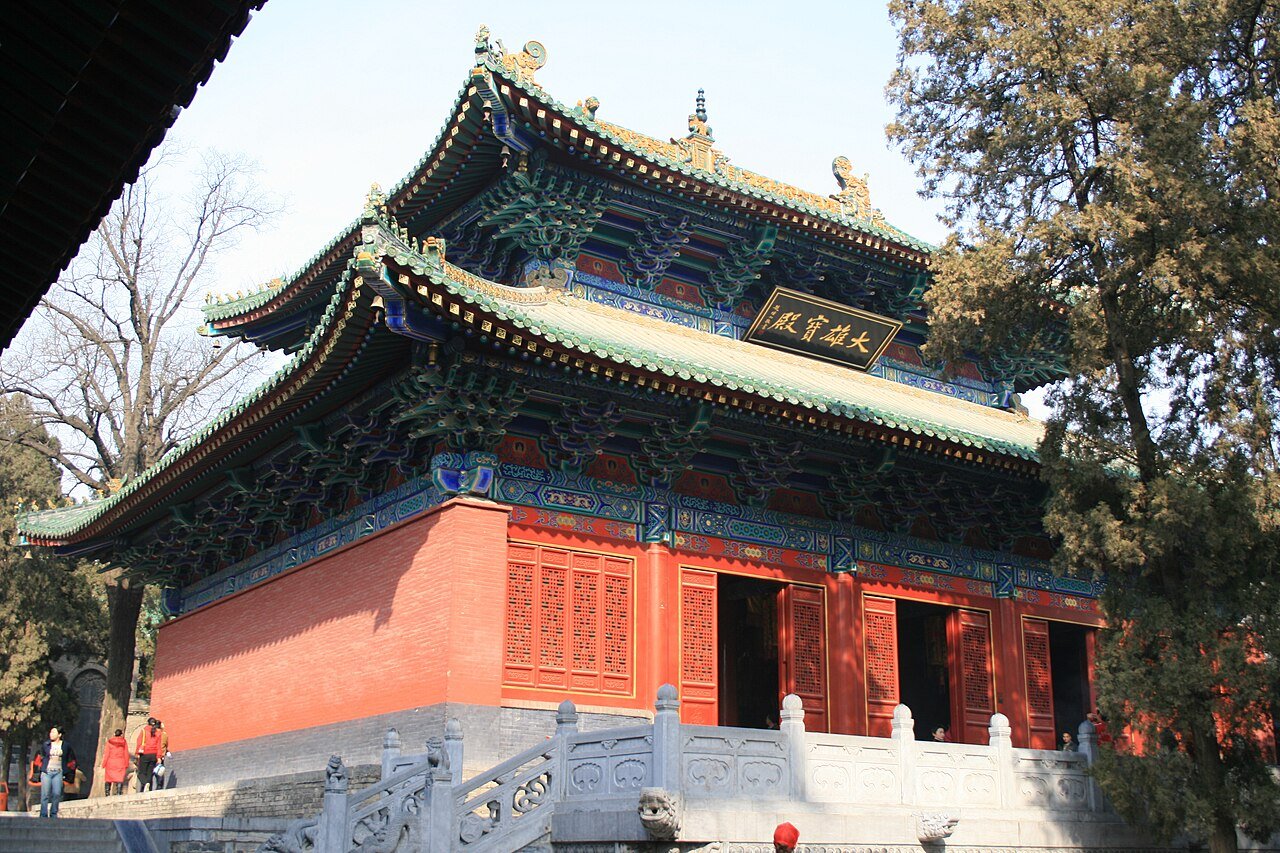
The most famous element of the Dengfeng complex is the Shaolin Temple, founded in 495 CE on the forested slopes of the Shaoshi Mountain. The temple was the cradle of Chan Buddhism (the tradition that would become Zen in Japan) and, according to tradition, the birthplace of Shaolin martial arts — a form of fighting developed by monks who needed to defend the temple and maintain physical fitness through long periods of seated meditation. The temple was destroyed and rebuilt multiple times; its current buildings date mostly from the Ming and Qing dynasties.
The Song Academy and Confucian education
The Songyang Academy — one of China’s four great Classical academies, founded in the Song dynasty (960–1279) — is also part of the inscribed complex. Here, generations of Chinese scholars studied the Confucian classics under the shadow of Mount Song. The academy’s campus, with its lecture halls, dormitories, and library, represents the Confucian ideal of learning in a landscape charged with moral significance.
Pagodas, tombs, and a landscape of monuments
Other components of the inscribed zone include the Songyue Pagoda (520 CE, the oldest surviving brick pagoda in China), the Zhongyue Temple (dedicated to the spirit of Mount Song), the Qimu Que gateway towers (Han dynasty, built 118–123 CE — the oldest existing stone buildings in China), and the Shaolin Pagoda Forest (hundreds of funerary towers for Shaolin monks spanning ten centuries).
Mount Song: a sacred mountain in the Taoist and Buddhist tradition
Mount Song (Song Shan, Central Sacred Mountain) is one of the Five Sacred Mountains of China — the peaks associated with the four cardinal directions and the centre of the Chinese world. The mountain has been a site of Taoist ritual since the Zhou dynasty and of Buddhist practice since the 5th century CE. The layering of Confucian, Taoist, and Buddhist monuments on a single landscape makes Dengfeng uniquely representative of China’s syncretic religious tradition.
Visiting Dengfeng today
Dengfeng lies 80 kilometres southwest of Zhengzhou, the capital of Henan Province, accessible by bus or private vehicle. The principal sites — Shaolin Temple, the Pagoda Forest, the Zhou Observatory, the Songyang Academy, and the Songyue Pagoda — are spread over a 30 km radius and require at least two full days. The Shaolin Temple complex is the most visited and includes daily martial arts demonstrations by monks and students. The site is most beautiful in spring and autumn.
Find it on the map
See this place and what’s around it →📷 Become a Cultural Heritage Online photographer
Share your photos of places: they stay published under your name as the author. The more they're seen, the more you get noticed — and soon a contest will reward the most appreciated photos.
Log in or sign up free to add a photo