

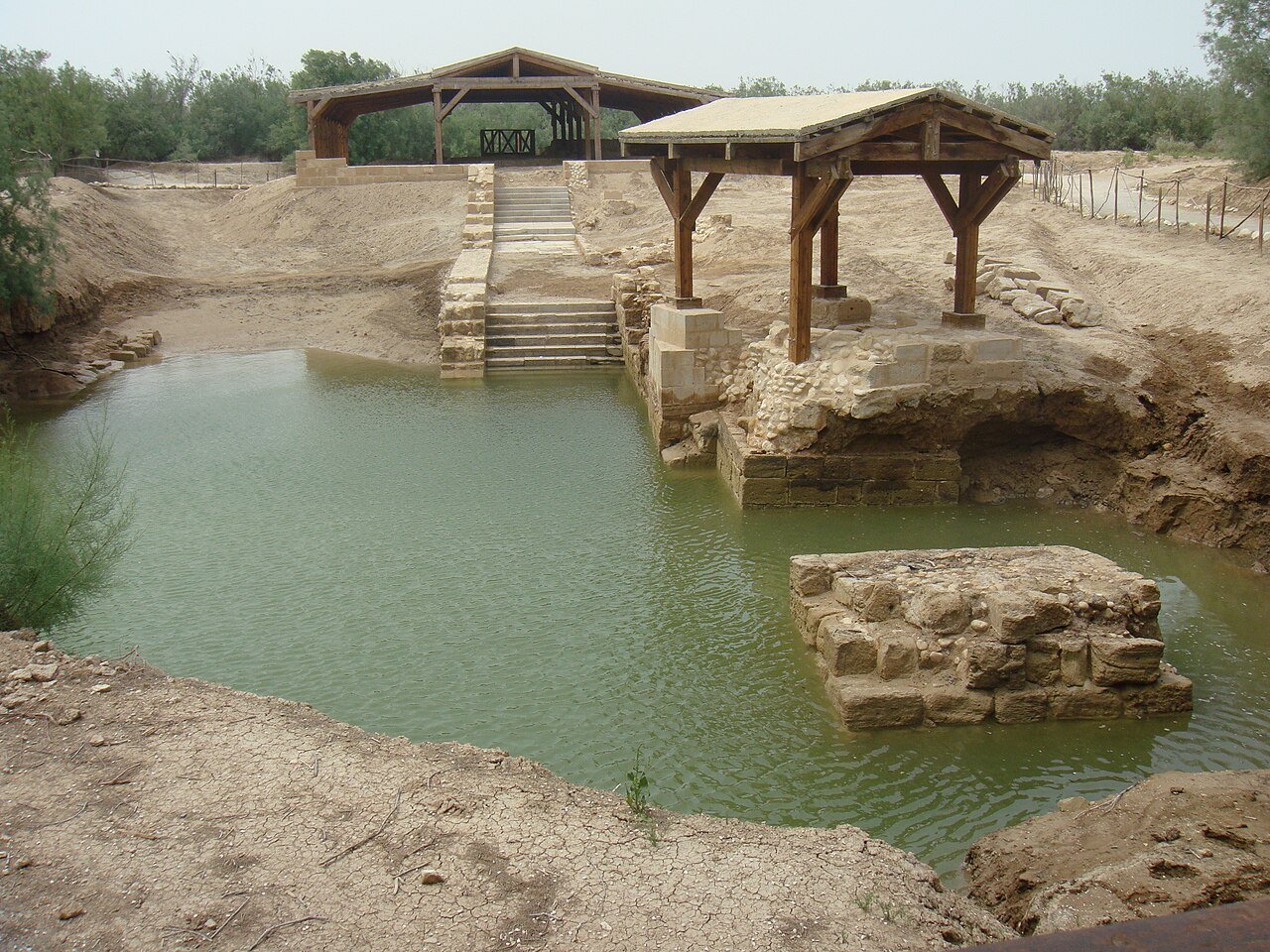
Where Jesus was baptised: Bethany beyond the Jordan
On the eastern bank of the Jordan River, 9 kilometres north of the Dead Sea, lies Al-Maghtas — in Arabic, “the place of immersion.” This is the site identified in the Gospel of John as “Bethany beyond the Jordan” (John 1:28), where John the Baptist preached and where, according to Christian tradition, Jesus of Nazareth was baptised. Archaeological excavations begun in 1996 have uncovered a remarkable landscape of early Christian devotion: pools, caves, churches, and monasteries spanning five centuries of pilgrimage.
UNESCO inscription: a landscape of revelation
Inscribed in 2015, Al-Maghtas was recognised by UNESCO as an outstanding example of a landscape associated with a defining event in world religious history. The citation emphasises the exceptional state of preservation of the remains — buried under sediment and protected by the military zone that prevented development for decades — and the multilayered testimony to early Christian pilgrimage that the site contains.
The baptism site: archaeological evidence
Excavations at Tell Mar Elias have revealed a sequence of baptismal structures spanning the 1st to 6th centuries CE. The earliest is a circular Byzantine church, its mosaic floor still partially intact, built over what the excavators believe is the exact spot of the baptism. Around it are several large stepped pools — baptisteries for ritual immersion — fed by a spring whose course has shifted as the Jordan River gradually moved westward over the centuries.
The Church of John the Baptist: pilgrim testimony
A Byzantine basilica (6th century CE) dedicated to John the Baptist was built over an earlier church, which was built over earlier ruins — each construction reflecting the continuity of pilgrimage to this site across centuries. The Pilgrim of Piacenza (c. 570 CE) described the site: “In this place of the baptism of the Lord, there is a church built over the waters, with the water flowing beneath it, so that at the time of the Epiphany the water rises to the step of the altar.”
Monasteries and hermit caves: the ascetic landscape
Beyond the core baptism complex, the inscribed zone includes the remains of several Byzantine monasteries and dozens of hermit caves cut into the hillside above the Jordan flood plain. Hermits and monks settled here from the 4th century CE, drawn by the sanctity of the site. The landscape of caves, cisterns, and ruined chapels preserves the character of an early Christian desert retreat remarkable for its survival.
A pilgrimage destination for all Christians
Pope John Paul II visited Al-Maghtas in 2000 and designated it an official holy pilgrimage site of the Roman Catholic Church. It has since been recognised by Eastern Orthodox, Anglican, Lutheran, and other Christian denominations. The site receives around 100,000 visitors annually — a fraction of its potential, largely because of its remote location and the security restrictions of the adjacent Israeli border zone.
The Jordan River crossing: Elijah and Jesus
The Jordan River is thick with religious geography. At Al-Maghtas, the river is also identified with the crossing of the prophet Elijah, who “went up by a whirlwind into heaven” (2 Kings 2:11) somewhere nearby. This layering of sacred memory — Moses viewing Canaan, Elijah ascending, John baptising, Jesus crossing — makes the Jordan Valley one of the most theologically dense landscapes in the world.
Visiting Al-Maghtas
The site is located 9 km west of Madaba and 50 km from Amman. Access is by private vehicle or guided tour; the site is inside a military reserve and requires entry through a checkpoint. Guided tours are mandatory and run from the visitor centre near the main entrance. The best time to visit is in the morning before the heat; the walk through the excavated zone takes 1–2 hours. Pope John Paul II’s commemorative plaque marks the baptism pool.
Find it on the map
See this place and what’s around it →📷 Become a Cultural Heritage Online photographer
Share your photos of places: they stay published under your name as the author. The more they're seen, the more you get noticed — and soon a contest will reward the most appreciated photos.
Log in or sign up free to add a photo