

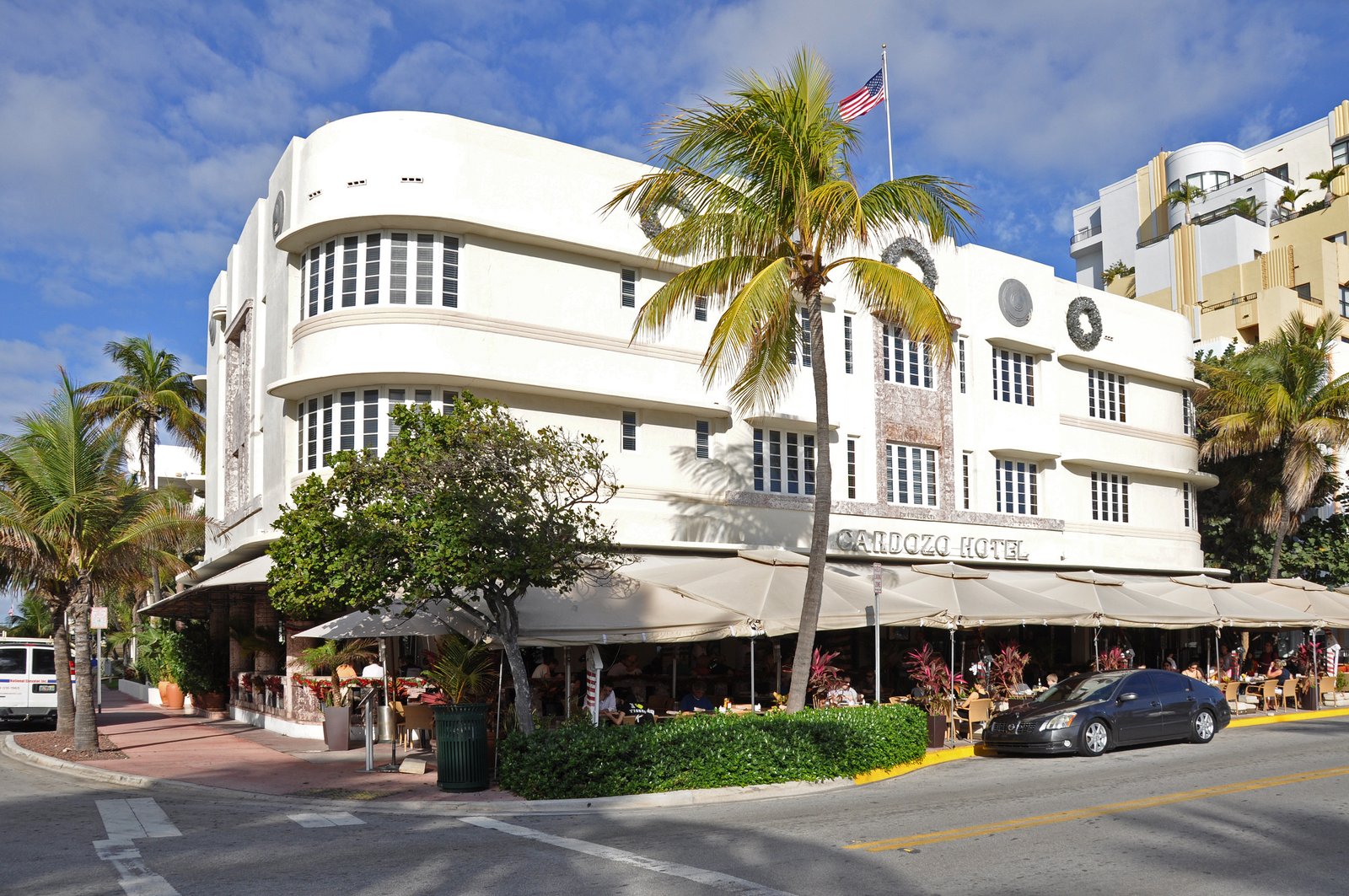
Henry Hohauser’s 1939 Streamline Moderne masterpiece anchors the heart of Ocean Drive — a three-storey building that distilled the optimism of a depression-era resort into horizontal speed lines and sun-drenched curves.
At a glance
The Cardozo Hotel opened in 1939 at 1300 Ocean Drive, designed by Henry Hohauser, one of the most prolific architects of Miami Beach’s Art Deco golden age. Its compact three-storey volume is wrapped in the hallmarks of Streamline Moderne: sweeping horizontal banding, curved corner bay windows, eyebrow shades over each opening, and a roof-line that tapers like the prow of an ocean liner. The building sits at the northern end of the main Ocean Drive strip, across from Lummus Park and the Atlantic.
Key facts
- Architect: Henry Hohauser (1895–1963)
- Completed: 1939
- Style: Streamline Moderne / Art Deco
- Address: 1300 Ocean Drive, Miami Beach, FL 33139
- Heritage status: Contributing building, Miami Beach Architectural District (NRHP, 1979)
- Current owner: Gloria and Emilio Estefan (since 1992)
- Floors: 3
History
Henry Hohauser arrived in Miami Beach in the early 1930s and became the defining hand of its low-rise Art Deco skyline. The Cardozo was among his later pre-war commissions, completed as the Depression was giving way to wartime mobilisation. The name honours U.S. Supreme Court Justice Benjamin N. Cardozo, following a practice common among South Beach hotel builders of naming their properties after public figures.
During World War II the hotel, like most on Ocean Drive, was requisitioned by the U.S. Army Air Forces for troop housing. The postwar decades brought decline: the resort trade collapsed as Miami Beach lost its fashionable edge, and many Deco buildings fell into disrepair. The Cardozo’s fortune changed in 1979, when Barbara Capitman founded the Miami Design Preservation League and successfully lobbied for the Miami Beach Architectural District’s listing in the National Register of Historic Places — the first such listing for a twentieth-century district in the U.S.
In 1992, Gloria and Emilio Estefan purchased the Cardozo and undertook a full restoration that became a model for the revitalisation of Ocean Drive. The project helped catalyse the broader South Beach renaissance, attracting fashion photography, film productions, and a new generation of hospitality investors to the street.
What you see
The façade reads as a horizontal composition: three parallel bands of smooth stucco pulled taut across the full width of the building, interrupted by the slim vertical accent of the entrance canopy. Curved eyebrow shades project over the windows at each floor, casting deep shadow lines that vary through the day as the Florida sun moves. The corner bays are rounded rather than chamfered — a Streamline idiom borrowed from locomotive and automotive design, softening the orthogonal grid of the city block into something kinetic.
At street level, the Cardozo Bar opens to the pavement under a deep overhang. The interior preserves original terrazzo floors in geometric patterns — a material and motif characteristic of South Beach Deco interiors, where the terrazzo’s embedded aggregate catches light differently at different hours. The restored yellow-and-blue colour scheme, now a signature of Ocean Drive’s reconstructed palette, was selected in consultation with architectural historians to reference the original pigment registers of the late 1930s.
Practical information
- Visiting: The hotel is an operating boutique property; the bar-terrace is open to non-guests
- Best time: Early morning or late afternoon for façade photography — direct sun from the east in the morning
- Nearby walk: The full Ocean Drive Deco strip between 5th and 15th Street can be walked in under 30 minutes
- Guided tours: Miami Design Preservation League runs 90-minute walking tours departing from the Art Deco Welcome Center at 1001 Ocean Drive
Getting there
Miami International Airport is approximately 16 km (10 miles) west via the MacArthur Causeway. The nearest Metrobus stops are on Collins Avenue, one block west. By car, use the public parking garage at 7th Street and Collins Avenue. Ocean Drive is pedestrian-friendly along its full length; cycling is common on the beach path directly east.
Nearby
- Breakwater Hotel — Anton Skislewicz’s 1939 twin-fin tower, four blocks south
- Colony Hotel — Henry Hohauser’s 1935 neon-signed anchor of the lower strip
- The Carlyle Hotel — L. Murray Dixon’s 1941 Streamline Moderne, two doors south
- Miami Beach Architectural District — the NRHP-listed historic district encompassing over 800 contributing structures
Sources
- Miami Design Preservation League — Ocean Drive: A History (published resources, mdpl.org)
- Capitman, Barbara Baer. Deco Delights: Preserving Art Deco Architecture. E.P. Dutton, 1988.
- Historic American Buildings Survey (HABS), Miami Beach Architectural District, HABS FL-13-MIAM,5 — Library of Congress, loc.gov
- National Register of Historic Places, Miami Beach Architectural District, listed 1979 — nps.gov
- Nickens, Cheryl A. & Pfeiffer, Bruce Brooks. Miami Beach Deco. Rizzoli, 2011.
Find it on the map
See this place and what’s around it →📷 Become a Cultural Heritage Online photographer
Share your photos of places: they stay published under your name as the author. The more they're seen, the more you get noticed — and soon a contest will reward the most appreciated photos.
Log in or sign up free to add a photoIs this page about you?
This page is read by travellers and heritage enthusiasts who find it on Google. Tell us how you are connected to this place and we will take it from there.