
Constantin Brâncuși: Born in Oltenia, Shaped in Paris
Constantin Brâncuși was born on 19 February 1876 in the village of Hobiţa in the Gorj county of Oltenia, the southernmost region of Romania. The son of a peasant family, he trained as a carpenter and woodworker before winning a scholarship to the Bucharest School of Fine Arts, where he graduated in 1902. By 1904 he had walked much of the journey to Paris — a journey that became legendary among his admirers — and enrolled at the Ecole des Beaux-Arts. His early work followed the academic tradition, but by 1907 he had broken decisively with Western sculptural convention, eliminating figurative naturalism in favour of pure, simplified, polished forms that distilled the essence of their subject to a geometric ideal. Brâncuși worked in Paris for the rest of his life, becoming a central figure in the modernist milieu alongside Duchamp, Modigliani, and Leger, but he never lost his connection to the folk art and spiritual traditions of rural Romania, which informed the iconography and the wooden craftsmanship visible throughout his work.
The Commission: A Memorial to Romanian Victims of World War I
In 1935, Brâncuși received a commission from the National League of Romanian Women in Gorj to create a memorial to the Romanian soldiers who died defending the Jiu Valley against the German invasion during World War I — a campaign of particular intensity fought in the mountains immediately north of Târgu Jiu. At 59 years of age, Brâncuși was at the height of his international fame but had completed relatively few large-scale public works. He accepted the commission with enthusiasm, conceiving not a conventional figurative monument but an ensemble of three monumental abstract sculptures linked by a symbolic axis running through the centre of the city for approximately 1,400 metres from east to west. The ensemble was completed and inaugurated in 1938. It stands as the only large-scale outdoor sculptural programme that Brâncuși ever realised, and it transforms an entire urban landscape into a work of art. UNESCO inscribed the Ensemble of Brâncuși at Târgu Jiu as a World Heritage Site in 2023, recognising it as a masterpiece of modern creative genius.
The Column of Infinity: 29 Metres of Cast Iron
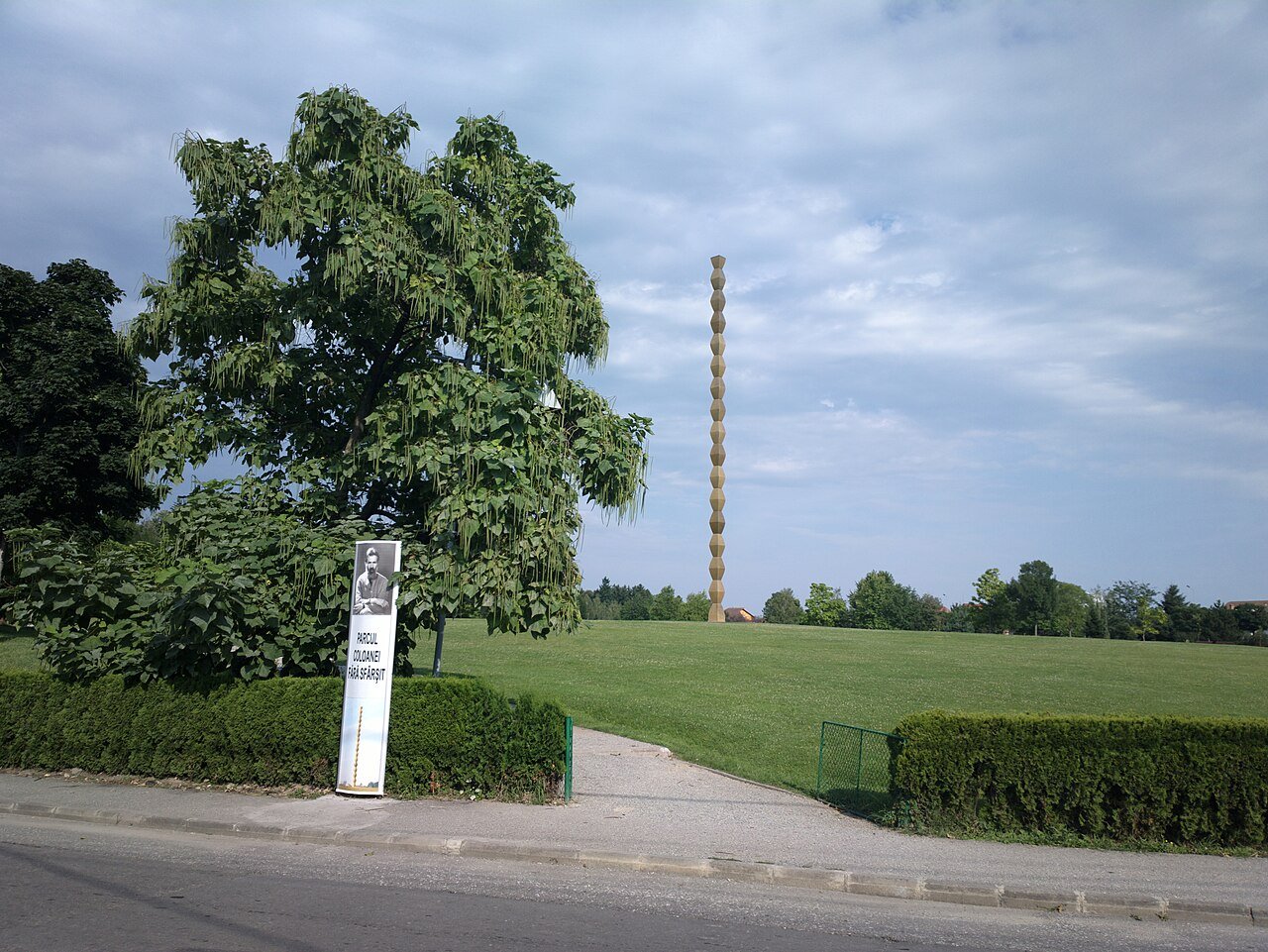
The Column of Infinity (Coloana Infinitului), located in a park at the eastern end of the ensemble axis, is the most celebrated and internationally recognised of the three sculptures. It stands 29.35 metres tall, composed of 16 rhomboid cast iron modules stacked vertically around a central steel spine anchored in a concrete foundation. Each module is an exact repetition of the one below — the same proportions, the same swelling and narrowing profile — creating a visual rhythm that seems to continue beyond the top of the column into the sky and simultaneously to continue below the ground into the earth. The module form is derived from the traditional Romanian wooden funeral pillar (the troiţă), a folk art object familiar to Brâncuși from his Oltenian childhood, abstracted and industrialised into a modernist vertical that resonates simultaneously as a traditional ancestral marker and as a futurist symbol of infinite ascent. The column was originally gilded with brass-coloured paint; the current appearance results from a controversial restoration in the 1990s that altered the original surface finish.
The Gate of the Kiss
At the western end of the pedestrian Calea Eroilor (Heroes Road), the Gate of the Kiss (Poarta Sărutului) marks the entrance to the Constantin Brâncuși Public Garden. The gate is a travertine stone arch, 5.13 metres high and 5.45 metres wide, carved on all surfaces with a repeating pattern derived from Brâncuși the sculptural motif of the Kiss — two faces in profile meeting at the lips, reduced to a pair of circular eyes and a shared mouth — that he had first realised as a free-standing sculpture in 1907 and returned to throughout his career. The gate frame, lintels, and posts are entirely covered with repetitions of this embrace motif, transforming a functional architectural element into an all-over sculptural surface in the tradition of Romanian vernacular gate carving. The Gate of the Kiss functions within the ensemble as a threshold — a passage from the public street into the memorial garden — and its imagery of union and love provides a counterpoint to the sacrifice memorialised by the Column of Infinity.
The Table of Silence and the Twelve Chairs
The Table of Silence (Masa Tăcerii) is a circular travertine disc, 80 centimetres high and 215 centimetres in diameter, surrounded by twelve hourglass-shaped seats also carved from travertine and arranged in a perfect circle around the central table. The number twelve carries multiple symbolic resonances: the twelve months of the year, the twelve apostles, the twelve hours of the day. The hourglass form of the seats recalls both an ancient Romanian chair form and the universal symbol of time passing. The Table of Silence stands at the western extreme of the ensemble, in a park overlooking the Jiu River, and its scale — intimate in comparison to the towering Column of Infinity — invites contemplation and stillness rather than awe. Brâncuși referred to the table in his notes as a place for the community to gather in silence to remember the dead, a function that the surrounding park continues to serve as a local gathering space.
The Axis Alignment Through the City
One of the most remarkable aspects of the Brâncuși ensemble is the deliberate urban axis that links the three sculptures through the body of the city of Târgu Jiu. The Table of Silence, the Gate of the Kiss, and the Column of Infinity are arranged along a single east-west line approximately 1,400 metres long, intersecting the main park, the Calea Eroilor boulevard, the Church of the Holy Apostles Peter and Paul (which Brâncuși incorporated as an architectural element within the ensemble), and the city park where the Column stands. This axial arrangement transforms the journey between the three sculptures into a processional experience, moving from contemplative silence at the Table through the threshold of the Gate, down the ceremonial boulevard, to the aspiring vertical of the Column. The axial thinking — reminiscent of Baroque garden design and ancient sacred landscape planning — shows Brâncuși thinking as an urban artist rather than simply as a maker of objects, and elevates the ensemble above the status of public sculpture to that of a total environmental work.
Modernist Significance in Art History
The Brâncuși ensemble at Târgu Jiu occupies a unique position in twentieth-century art history. As a large-scale outdoor work by one of the defining figures of European modernism, realised in a medium — cast iron, travertine stone, urban landscape planning — that engaged directly with both industrial production and traditional craft, it stands at the intersection of the major currents of interwar art. The Column of Infinity anticipates by decades the Minimalist sculpture of Donald Judd and Carl Andre, with its serial repetition of identical modules and its refusal of compositional hierarchy. The Gate of the Kiss prefigures the all-over sculptural surface of post-war abstract work. Yet simultaneously the ensemble is deeply rooted in the specific cultural landscape of Gorj and in the folk art traditions of rural Romania, and it was created as a memorial to real people who died in a real war — a particularity that separates it from the programmatic universalism of later abstract movements. This double anchoring in both modernist formal language and a specific cultural and historical context is what makes the ensemble an achievement of exceptional universal value.
Visiting Târgu Jiu Today
Târgu Jiu is the capital of Gorj county in southwestern Romania, approximately 370 kilometres west of Bucharest. The city is connected to Bucharest by train (approximately 5 to 6 hours on regional services) and by road via the E79 national route. Direct bus connections link Târgu Jiu to Craiova, Pitești, and Bucharest. The three components of the Brâncuși ensemble are spread through the city centre and are accessible on foot; the suggested route follows the symbolic axis from west (Table of Silence) to east (Column of Infinity), mirroring the processional logic Brâncuși intended. The adjacent Constantin Brâncuși House Museum in the nearby village of Hobiţa — his birthplace — is included in most heritage visit itineraries and provides biographical context for the ensemble. Since the UNESCO inscription in 2023, visitor infrastructure has been improving, with new interpretation signage and guided tour programmes being developed. The best time to visit is spring or autumn, when the park vegetation frames the travertine sculptures at their most photogenic.
Find it on the map
See this place and what’s around it →📷 Diventa un fotografo di Cultural Heritage Online
Condividi le tue foto dei luoghi: restano pubblicate con la tua firma come autore. Più vengono viste, più ti fai conoscere — e presto un concorso premierà le foto più apprezzate.
Accedi o registrati gratis per aggiungere una foto