
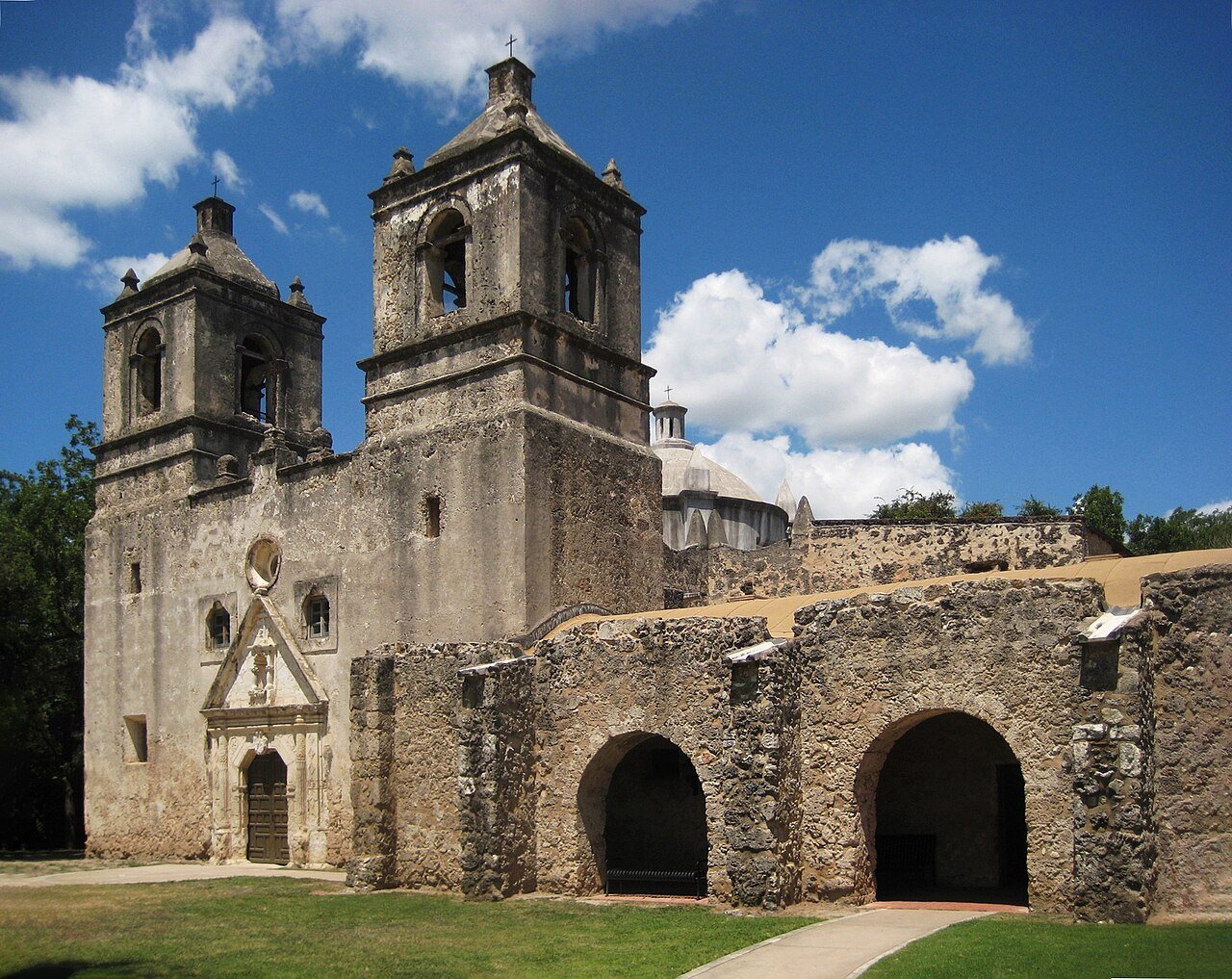
Spain’s Northernmost Frontier in the Americas
In the early 18th century, the Spanish Crown established a chain of five Franciscan missions along the San Antonio River in what is now south-central Texas — then the remote northern frontier of New Spain. Inscribed by UNESCO in 2015, the San Antonio Missions represent the largest concentration of Spanish colonial missions remaining in the United States, and they continue to function as active Catholic parishes more than three centuries after their founding. Their inscription recognises the complex cultural exchange they embodied between European colonisers, Franciscan missionaries, and the Indigenous Coahuiltecan-speaking peoples of southern Texas.
The Alamo: Mission San Antonio de Valero
Founded in 1718 as the first mission in the chain, Mission San Antonio de Valero is universally known today simply as the Alamo — a name derived from the cottonwood trees (álamos) that shaded the site. Though its fame rests largely on the 1836 battle during Texas's war for independence from Mexico, its heritage significance lies in its role as a functioning mission community for much of the 18th century. The compound's distinctive limestone chapel, with its elaborately carved doorway, is the most recognisable historic structure in Texas.
Mission San José: Queen of the Missions
Founded in 1720 on the west bank of the San Antonio River, Mission San José y San Miguel de Aguayo is often called the “Queen of the Missions” for the quality and completeness of its surviving fabric. Its church features one of the most ornate examples of Spanish colonial Baroque decoration in North America — the “Rose Window” (Ventana de Rosa), an exquisitely carved stone grille attributed by legend to sculptor Pedro Huízar. The granary, Indian quarters, mill, and defensive perimeter wall are among the best-preserved mission infrastructure anywhere in the country.
Architecture and Urban Planning
Each mission compound was conceived as a self-contained community — a small town in miniature — containing a church, friary, Indian living quarters, workshop buildings, irrigation canals (acequias), and agricultural fields. The architecture blends Spanish Baroque ecclesiastical forms with techniques and materials adapted to the local limestone geology and the skills of Indigenous builders. The missions collectively illustrate a distinctive regional adaptation of Spanish colonial urbanism that influenced settlement patterns across the Texas frontier.
The Alamo — From Mission to Symbol
Mission San Antonio de Valero, the oldest of the five San Antonio missions, is known worldwide today by its popular name: the Alamo. In 1836, during Texas’s war of independence from Mexico, a small garrison of Texan and volunteer fighters held the Alamo compound for thirteen days against a much larger Mexican army under General Santa Anna before being overwhelmed on 6 March. The battle became a defining moment in Texas history, and the rallying cry “Remember the Alamo” galvanised the Texan forces who defeated Santa Anna weeks later at San Jacinto. The Alamo’s mission-era limestone chapel, the only major surviving structure of the original compound, remains one of the most visited historic sites in the United States and a powerful symbol of resistance and sacrifice.
The Acequias: Engineering the Desert
The missions
Find it on the map
See this place and what’s around it →📷 Become a Cultural Heritage Online photographer
Share your photos of places: they stay published under your name as the author. The more they're seen, the more you get noticed — and soon a contest will reward the most appreciated photos.
Log in or sign up free to add a photoIs this page about you?
This page is read by travellers and heritage enthusiasts who find it on Google. Tell us how you are connected to this place and we will take it from there.