
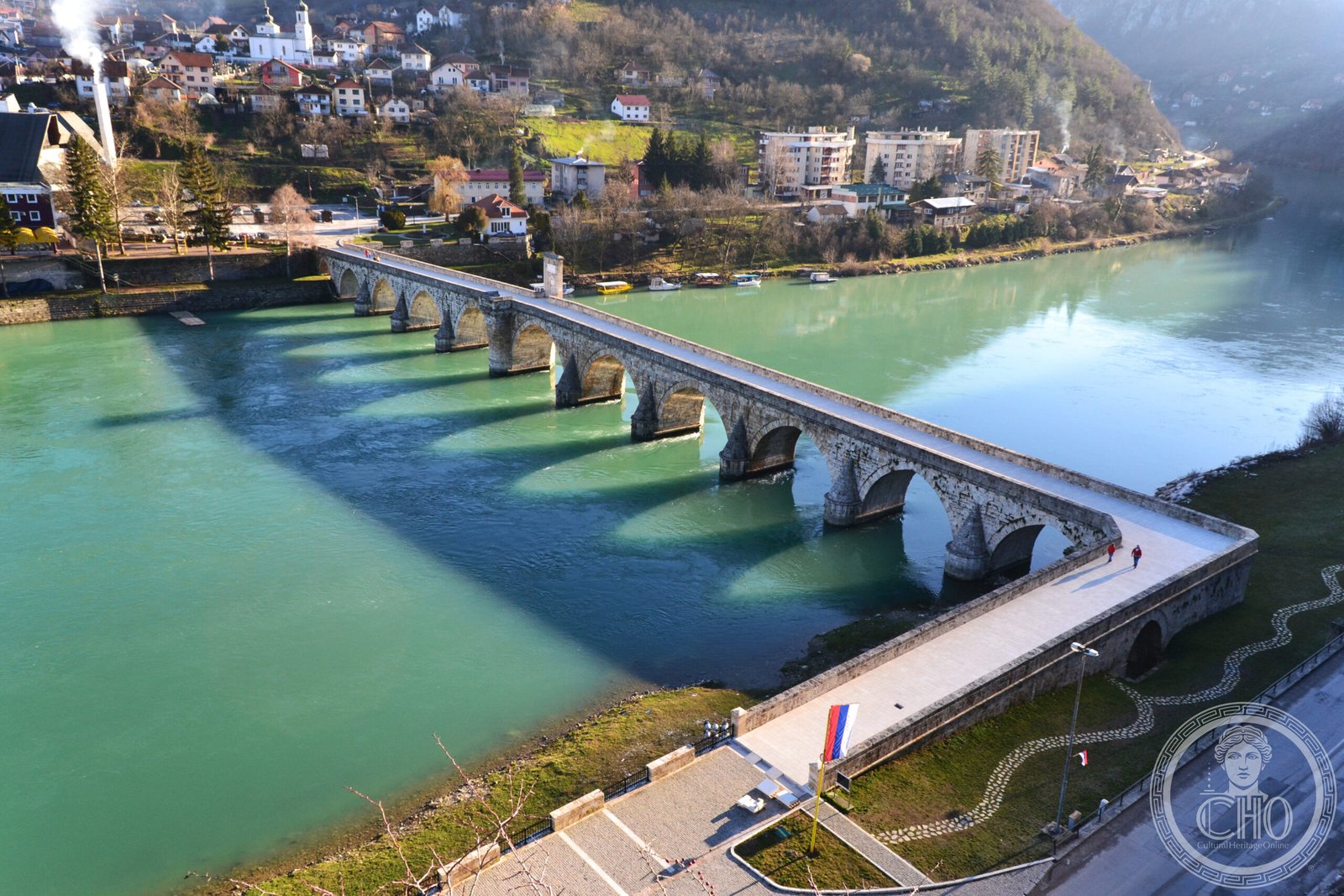
The Bridge That Spans Empires and Literature
The Mehmed Paša Sokolović Bridge at Višegrad, spanning the emerald-green Drina River in eastern Bosnia and Herzegovina, is one of the finest surviving examples of Ottoman civil engineering in the Balkans. Built between 1571 and 1577 by the supreme court architect Mimar Sinan — the same master builder who designed the Süleymaniye Mosque in Istanbul and the Selimiye Mosque in Edirne — the bridge became immortalised in Ivo Andrić’s Nobel Prize-winning novel “The Bridge on the Drina” (1945). UNESCO inscribed the bridge in 2007.
Mimar Sinan and the Architecture of the Bridge
The bridge is 179.5 metres long and 6.2 metres wide, carried on eleven pointed arches of finely dressed limestone. At the centre of the structure, a wider arch creates a sheltered stone platform (sofa) where people traditionally gathered to rest, talk, and watch the river — the social heart of the bridge described with such precision by Andrić. The structural elegance of Sinan’s design lies in the proportional relationship between the arches, the way the roadway rises and falls gently over the river, and the transition between the masonry piers and the water below.
Grand Vizier Sokolović: The Man Who Built It
Mehmed Paša Sokolović was one of the most remarkable figures of the Ottoman Empire — born Bajica Nenadić to a Serbian Orthodox family in the village of Sokolović near Višegrad, taken in the devshirme (the levy of Christian boys for Ottoman service) as a child, and risen through the Janissary corps and the imperial administration to become Grand Vizier under three successive sultans: Suleiman the Magnificent, Selim II, and Murad III. He commissioned the bridge over the Drina as a monumental gift to his birthplace — a project that took six years and employed hundreds of workers.
Ivo Andrić and “The Bridge on the Drina”
Ivo Andrić (1892–1975), a Bosnian-born Yugoslav author, set his greatest novel at this bridge, tracing four centuries of life in Višegrad from the bridge’s construction through World War I. The novel — written in Belgrade during the Nazi occupation and published in 1945 — uses the bridge’s sofa as the fixed point around which generations of Bosnians, Serbs, Turks, and Jews live out their histories. Andrić was awarded the Nobel Prize for Literature in 1961 in part for this novel. The bridge is thus simultaneously a work of architecture and the subject of one of the 20th century’s great works of prose.
The Drina River and the Landscape of the Site
The Drina at Višegrad runs through a dramatic landscape of limestone gorges and wooded hills, its waters a distinctive blue-green colour from dissolved limestone. Upstream, the Višegrad Dam creates a reservoir used for hydroelectric power. The river’s character at the bridge location — wide, relatively calm, flanked by steep forested banks — gives the structure its natural setting. The play of light on the water and the reflections of the eleven arches make the bridge one of the most photographed monuments in Bosnia.
Restoration and Conservation
The bridge survived various conflicts and floods over four and a half centuries, requiring periodic repair and restoration. The most recent major restoration took place in the late 20th century. The bridge remains in active use as a road crossing over the Drina and is the central monument of Višegrad’s urban life. Conservation challenges include the management of traffic loads on a 16th-century structure and the protection of the stone from weathering and pollution.
The Ottoman Legacy in the Western Balkans
The Mehmed Paša Sokolović Bridge stands as evidence of the Ottoman Empire’s capacity for monumental civil engineering in its European provinces. Sinan designed hundreds of bridges, mosques, hammams, and caravanserais across the empire from Hungary to Arabia, but the Balkans concentration of his civil works — particularly in Bosnia, which was a frontier province requiring investment in infrastructure — is exceptional. The bridge at Višegrad represents the transmission of Ottoman building culture to the westernmost edge of the empire’s European reach.
Visiting Višegrad and the Bridge
Višegrad is accessible by road from Sarajevo (approximately 100 km southeast) and from the Serbian border. The bridge is the focal point of the Andrićgrad complex — a neo-Ottoman “city within the city” built adjacent to the bridge by the film director Emir Kusturica, inaugurated in 2014, which includes a cinema, hotels, restaurants, and monuments to Andrić. The combination of the UNESCO bridge, the literary pilgrimage, and the dramatic Drina landscape makes Višegrad a compelling stop on any itinerary through the cultural heart of Bosnia and Herzegovina.
Find it on the map
See this place and what’s around it →📷 Become a Cultural Heritage Online photographer
Share your photos of places: they stay published under your name as the author. The more they're seen, the more you get noticed — and soon a contest will reward the most appreciated photos.
Log in or sign up free to add a photo