
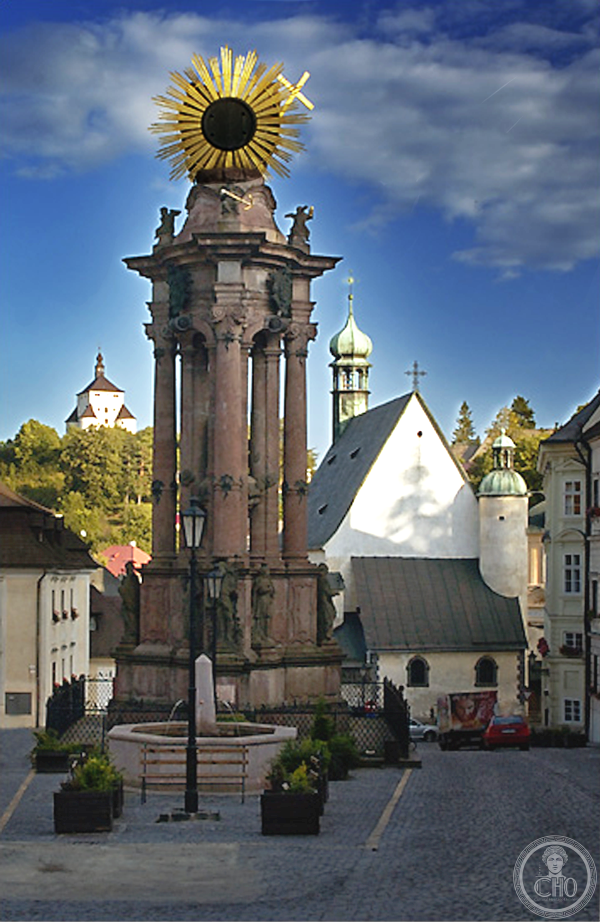
In the volcanic hills of central Slovakia, Banská Štiavnica is one of the most extraordinary industrial heritage towns in Central Europe — a former silver and gold mining metropolis that was, from the 13th to the 19th century, one of the wealthiest and most technically advanced cities in the Habsburg Empire. Its beautifully preserved medieval and Baroque townscape, together with the remarkable water management system of 60 artificial lakes that powered the mines, form a UNESCO World Heritage site of exceptional significance. UNESCO 1993.
Significance and overview
Banská Štiavnica (German: Schemnitz; Hungarian: Selmécbanya) is a historic mining town in the Shtiavnica Mountains of central Slovakia, set among extinct volcanic cones and surrounded by a landscape of artificial lakes (tajchy) built to power the mines. UNESCO inscribed it in 1993 (ref. 618) for its outstanding ensemble of medieval and Baroque urban architecture, for the unique water management system (Banský vodohospodársky systém — 60 artificial lakes, channels, and water wheels built between the 16th and 18th centuries), and for its importance as the birthplace of modern mining science and engineering.
The town was home to the world’s first mining academy (Banská akadémia, founded 1762), which trained mining engineers from across Europe and introduced systematic scientific methods to underground mining. Innovations developed at Banská Štiavnica — including the first use of black powder (gunpowder) for blasting in mining (1627), and sophisticated ventilation and drainage systems — spread throughout European mining and shaped the Industrial Revolution.
Historical background
Silver and gold were mined in the Shtiavnica Mountains since at least the 12th century; the town received its first royal charter from King Béla IV of Hungary in 1237, establishing it as one of the oldest mining towns in the Carpathian Basin. Under the Habsburg Empire (from 1526), Banská Štiavnica became the empire’s most important source of silver and gold and grew into a city of over 20,000 inhabitants — one of the largest in Hungary at the time. The Baroque building campaign of the 17th and 18th centuries gave the town its current magnificent architectural character, with grand church towers, noble houses, and civic buildings rising above the valley.
The decline of mining in the 19th century, as the most accessible ore veins were exhausted and competition from South American silver grew, led to the gradual depopulation of the town. This decline paradoxically preserved the historic fabric: there was no money for demolition and redevelopment. Today Banská Štiavnica has a population of approximately 10,000 and is known primarily for tourism and as a cultural heritage destination.
Key features
The town centre is dominated by the Stary Zamok (Old Castle) and Nový Zámok (New Castle) — two fortified structures from the medieval and early modern periods. The Trinity Square (Námestie Svätej Trojice) is the elegant Baroque heart of the town, with a plague column and surrounded by the facades of merchant houses, churches, and the former town hall. The Kammer Hof (later the Slovak Mining Museum) is the most important secular Baroque building, housing a comprehensive collection of mining artefacts, geological specimens, and historical models.
The surrounding landscape is equally remarkable: the 60 artificial lakes (tajchy) were built over two centuries to regulate water supply for the mines, providing power for pumping and ore processing in summer and draining excess water in winter. The network of underground mining galleries, some of which can be visited (the Glanzenberg mine tour), is one of the most extensive in Central Europe.
Cultural importance
The Mining Academy of Banská Štiavnica (1762) was the first technical university in the world devoted to mining and metallurgy, and its founding marked the transformation of mining from a craft tradition into a scientific discipline. Graduates of the academy — including many from Austria, Germany, and Hungary — carried its methods across Europe. The academy’s legacy lives in the Technical University of Banská Bystrica, which traces its lineage directly to the 1762 foundation. The town is also associated with the Slovak literary tradition: the poet Andrej Sládkovič (1820–1872), author of the Slovak national epic Matrína, studied and lived here.
UNESCO criteria
Banská Štiavnica was inscribed under criteria (iv) and (v). Criterion (iv) recognises the town and its technical monuments as an outstanding ensemble illustrating a significant stage in European industrial and scientific history — specifically, the birth of systematic mining engineering. Criterion (v) acknowledges the cultural landscape of the mining town and its water management system as an outstanding example of a traditional human settlement representing the intersection of industrial technology, Baroque urban culture, and Central European mining heritage.
Visitor experience
Banská Štiavnica is a compact, walkable town ideal for exploration on foot. The Slovak Mining Museum manages several sites, including the Old Castle, the Kammer Hof, and the Glanzenberg underground mine tour (helmets and lamps provided; highly recommended). The Calvary of Banská Štiavnica — a Baroque pilgrimage complex of 22 chapels climbing a volcanic hill above the town — is one of the most impressive Baroque ensembles in Slovakia. The tajchy lakes in the surrounding hills offer hiking and, in summer, swimming.
Getting there
Banská Štiavnica is 200 km north-east of Bratislava. By car: 2.5 hours via the D1 motorway and R1 expressway to Banská Bystrica, then south on the R1/E77. By bus from Banská Bystrica: 45 minutes (frequent service). No direct trains to Banská Štiavnica; train to Zvolen then bus is the easiest public transport option. GPS: 48.458° N, 18.894° E.
Nearby context
Banská Bystrica (45 km north) is the regional capital with excellent museums, a historic centre, and the Slovak National Uprising Museum. The Tatra Mountains (High Tatras UNESCO site) are approximately 150 km to the north-east. The other Slovak UNESCO mining town, Vlkolínec (a living folk architecture village), is 80 km north. Bratislava (200 km south-west) offers flights and onward connections.
Find it on the map
See this place and what’s around it →📷 Become a Cultural Heritage Online photographer
Share your photos of places: they stay published under your name as the author. The more they're seen, the more you get noticed — and soon a contest will reward the most appreciated photos.
Log in or sign up free to add a photo