

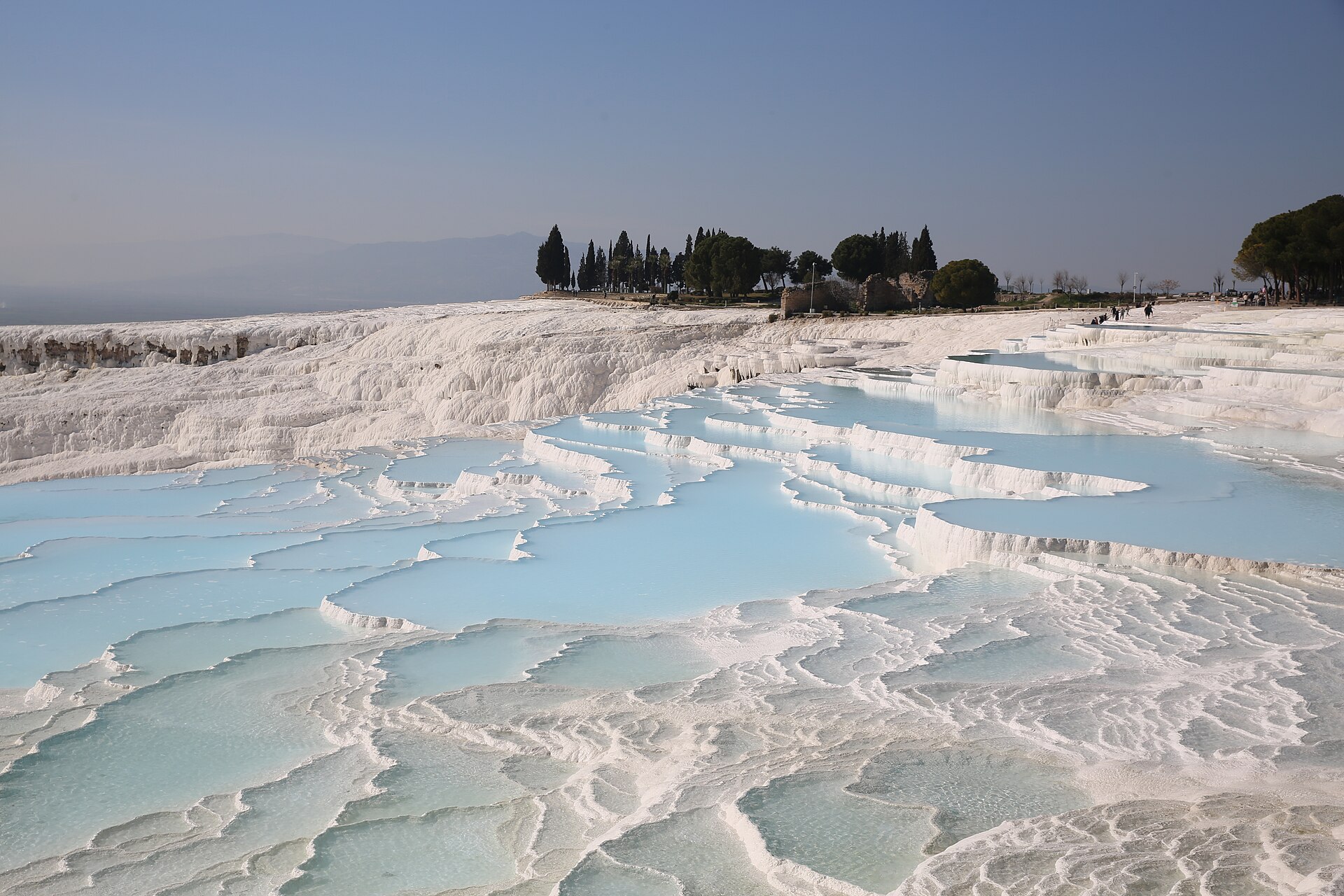
A natural wonder of white travertine terraces cascading down a mountainside in south-western Turkey, crowned by the ruins of the ancient city of Hierapolis.
At a glance
Pamukkale—”cotton castle” in Turkish—is a geological spectacle stretching 2,700 metres long and 160 metres high in the province of Denizli. The site combines dramatic natural formations with substantial archaeological remains. Visible from up to 20 kilometres away, it ranks among Turkey’s most distinctive landmarks and UNESCO World Heritage Sites.
History
The ancient city of Hierapolis was built atop the white travertine plateau, taking advantage of its commanding position and thermal springs. Tectonic activity in the Meandro river valley created both geological instability and the geothermal conditions that would define the landscape for millennia.
What you see
Thick white layers of limestone and travertine form the site’s visual character, deposited by thermal waters rich in calcium ions and carbon dioxide. As mineral-saturated water emerges from underground springs, it loses carbon dioxide and cools, causing calcium carbonate to precipitate in terraces and cascades resembling ice falls or frozen cotton. The plateau supports remains of Hierapolis above, creating a layered archaeological and geological landscape.
Cultural significance
Pamukkale represents a rare convergence of natural and cultural heritage. Few places worldwide display comparable travertine formations—among them Mammoth Hot Springs in the USA, Saturnia in Italy, and Huanglong in Sichuan Province, China. The site’s combination of active thermal springs, pristine mineral deposits, and ancient urban ruins makes it invaluable for understanding both geological processes and classical settlement patterns in the Mediterranean world.
Key facts
- Location: Denizli Province, south-western Turkey, in the Meandro river valley
- Address: Denizli 20190
- Coordinates: 37.9231146, 29.1241992
- Dimensions: 2,700 metres long, 160 metres high
- UNESCO World Heritage Site designation
Practical information
The inland Aegean location provides a temperate climate for most of the year. Pamukkale is an important tourist destination for visitors travelling from the Antalya and Aegean coasts. Opening hours, admission fees, and current facilities should be verified through official tourism channels before visiting.
Getting there
The site lies in Denizli Province, approximately 20 kilometres from Denizli city. It is accessible from major coastal destinations in the Aegean and Mediterranean regions. Check local transport options and road conditions before planning your visit.
Hierapolis: the ancient city
Above the travertine plateau, the ruins of Hierapolis (founded c. 190 BC by Eumenes II of Pergamon) extend for over a kilometre. The Roman theatre (2nd century AD), one of the best-preserved in Turkey, seats 12,000 and retains its carved stage building. The necropolis stretches 1.2 km with over 1,200 tombs — one of the largest ancient cemeteries in Asia Minor. The Antique Pool (Cleopatra’s Pool) lets visitors swim in 35°C thermal water among submerged Roman marble columns. Most remarkably, the Plutonium — a cave fissure emitting CO2 that killed animals entering it — was revered as the entrance to the underworld; priests of Cybele demonstrated divine protection by surviving what livestock could not. Rediscovered by Italian archaeologists in 2013, the cave still emits its toxic breath. The octagonal martyrium of Saint Philip the Apostle (5th century AD) marks the traditional site of the apostle’s death. For a dedicated account of Hierapolis, see the Hierapolis place card.
See the place
Sources & resources
- Cultural Heritage Online
- UNESCO World Heritage Centre
Find it on the map
See this place and what’s around it →📷 Become a Cultural Heritage Online photographer
Share your photos of places: they stay published under your name as the author. The more they're seen, the more you get noticed — and soon a contest will reward the most appreciated photos.
Log in or sign up free to add a photo