
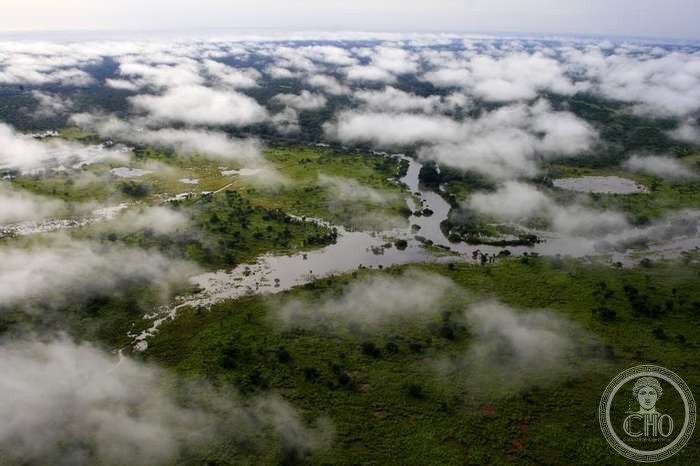
Nella punta nordorientale della Repubblica Democratica del Congo, al confine con il Sudan del Sud e la Repubblica Centrafricana, il Parco Nazionale di Garamba custodisce uno dei paesaggi di savana più importanti dell’Africa centrale: 4.920 km² di prateria aperta, foresta-galleria e zone umide lungo i fiumi Garamba e Dungu. Qui viveva l’ultima popolazione selvatica del rinoceronte bianco del nord (Ceratotherium simum cottoni) — la sottospecie più rara di mammifero della Terra, ora tecnicamente estinta in natura. La storia del Garamba è inseparabile da quella di questi rinoceronti, e dal disperato sforzo di salvarli. Patrimonio UNESCO dal 1980.
At a glance
Garamba National Park is a protected area of 4,920 km² in north-eastern Democratic Republic of Congo, near the borders with South Sudan and the Central African Republic. UNESCO inscribed it in 1980 (ref. 136) as one of Africa’s oldest national parks (established 1938) and for its exceptional savanna ecosystem and wildlife. The park was once the last refuge of the northern white rhinoceros (Ceratotherium simum cottoni); the subspecies is now functionally extinct in the wild, with only two elderly females surviving in captivity at the Ol Pejeta Conservancy (Kenya). Garamba was also the first DRC park to be placed on the UNESCO Danger List (1984), removed twice and placed back repeatedly due to ongoing security crises.
Key facts
- UNESCO: World Heritage since 1980 (Garamba National Park, ref. 136); on/off Danger List since 1984
- Northern white rhino: the park held the world’s last wild population until the 2000s; now functionally extinct in the wild (2 captive females remain at Ol Pejeta, Kenya)
- Wildlife: African forest elephants, Kordofan giraffes, lions, hippos, African wild dogs, Nile crocodiles
- Kordofan giraffe: one of the park’s key species; estimated fewer than 2,000 remain worldwide
- Size: 4,920 km² plus 1,000+ km² of adjacent hunting concessions and buffer zones
- Managed by: African Parks Network since 2005
History
Garamba was established as a Belgian colonial reserve in 1938 and was one of the first national parks in Africa. Its landscape of open savanna and gallery forest was typical of the Sudanian zone but rare in the Congo. UNESCO inscription in 1980 coincided with growing alarm over the northern white rhinoceros population, which had dropped from thousands to a few hundred in the early 20th century. By the 1980s only about 20 individuals remained in Garamba.
Intensive anti-poaching efforts in the 1980s briefly stabilised the population at about 30 animals. But DRC’s repeated civil wars (1996–2003, 2004–ongoing) devastated conservation: armed groups including the Lord’s Resistance Army operated in the park, killing wildlife and rangers. The last confirmed sighting of a wild northern white rhinoceros in Garamba was in 2006. African Parks took over management in 2005 and has rebuilt ranger capacity. The park’s remaining wildlife — elephants, giraffes, lions — has stabilised but remains threatened by ongoing insecurity.
What you see
Garamba’s open savanna is strikingly different from the dense Congo Basin forest: rolling grassland under enormous African skies, with gallery forest ribbons along the rivers and isolated outcrops of older woodland. The Kordofan giraffe — the tallest subspecies and one of the rarest — is regularly seen in small groups. Forest elephants and hippos are found along the Garamba River. Lions have been recolonising the park after near-extirpation.
Helicopter patrols and aerial monitoring are now central to park operations; ground access remains limited due to security risks. Authorised visits can be arranged through African Parks.
Practical information
- Security: the park is in one of DRC’s most insecure zones; consult current advisories and book exclusively through African Parks
- Access: charter flights from Nairobi or Entebbe to Nagero (park HQ); road access from Dungu (100 km south) possible in dry season
- Best time: January–March (dry season; grass low; better visibility)
- African Parks: garamba@african-parks.org
Getting there
Charter flight from Entebbe (Uganda) or Nairobi (Kenya) to Nagero airstrip inside the park is the safest option. Overland from Dungu (100 km south) is possible in dry season with armed escort. GPS (park centre): 4.20° N, 29.48° E.
Nearby
- Virunga National Park (UNESCO) — the other great DRC national park, 1,500 km south-west, with mountain gorillas and active volcanoes
- Dungu — the nearest Congolese town; administrative centre of Haut-Uélé province
- Ol Pejeta Conservancy (Kenya) — the home of the last two northern white rhinoceroses on Earth; 1,500 km east
Sources
- UNESCO World Heritage Centre — “Garamba National Park” (ref. 136)
- African Parks Network — Garamba conservation updates
- Encyclopaedia Britannica — northern white rhinoceros; Garamba National Park
Find it on the map
See this place and what’s around it →📷 Become a Cultural Heritage Online photographer
Share your photos of places: they stay published under your name as the author. The more they're seen, the more you get noticed — and soon a contest will reward the most appreciated photos.
Log in or sign up free to add a photo