

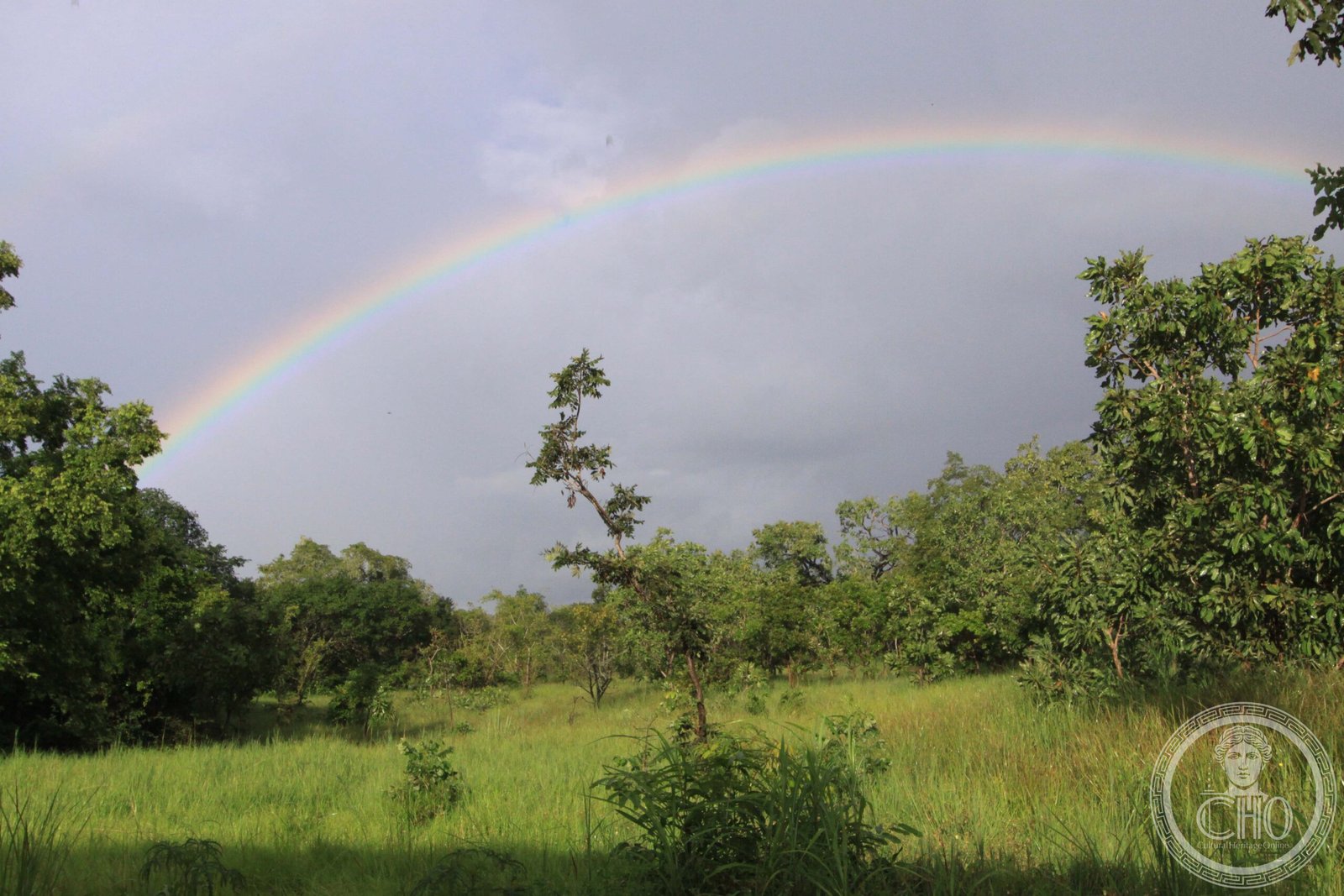
In the north-east of Côte d’Ivoire, where the river Comoé runs 230 km through a mosaic of savannah, gallery forest and open grassland, Comoé National Park is the largest in West Africa: 11,500 km² of interwoven habitats found nowhere else in such a concentration. A place of transition between the Sahel and the equatorial forest: here the lion crosses paths with the chimpanzee, the Congo kob shares the grassland with the defassa waterbuck, and in the dry season the Comoé brings herds of hippopotamus that turn the shallows black. A UNESCO World Heritage site since 1983.
At a glance
Comoé National Park is a protected area of 11,500 km² in north-eastern Côte d’Ivoire, centred on the Comoé River, which runs north to south through the park. UNESCO inscribed it in 1983 (ref. 227) for its exceptional diversity of plant communities — from Sahelian scrub and guinea savanna to dense gallery forests along the river — and for its outstanding wildlife. The park is the largest in West Africa and one of the most biodiverse; it lies at the ecological boundary between the northern Sahel zone and the southern Guinea rainforest zone, producing an extraordinary overlap of species from both biomes. It was placed on the UNESCO List of World Heritage in Danger (2003) and removed in 2017 after successful conservation recovery.
Key facts
- UNESCO: World Heritage since 1983 (Comoé National Park, ref. 227); removed from Danger List 2017
- Size: 11,500 km² — the largest national park in West Africa
- Mammals: lions, leopards, cheetahs, African wild dogs, hippopotamuses, African elephants, chimpanzees, colobus monkeys
- Birds: over 500 species recorded; including saddle-billed storks, martial eagles, helmeted guineafowl
- Plant diversity: over 620 plant species; the park straddles the boundary of three major vegetation zones
- The Comoé River: 230 km of the river flow through the park; seasonal flooding creates critical wetland habitats
History
The lands of the Comoé River valley were inhabited by various Senufo, Lobi and Koulango peoples, who used the area for agriculture and hunting. French colonial administration established a hunting reserve in 1926; it was upgraded to a national park in 1968. UNESCO inscription in 1983 recognised the park’s exceptional ecological significance.
During the political instability of the 1990s–2000s, the Comoé Park suffered severe poaching and habitat loss; its lion, elephant and cheetah populations declined sharply. UNESCO placed it on its Danger List in 2003. A major recovery programme led by the Wild Chimpanzee Foundation and the Ivorian government, combined with improved security after 2011, led to the restoration of wildlife populations. UNESCO removed the park from the Danger List in 2017, citing the recovery of wildlife numbers and improved park governance.
What you see
The Comoé landscape shifts dramatically through the park: the far north is dry Sudanian woodland; the centre is open guinea savanna with scattered trees; and along the river, dense gallery forest creates corridors where chimpanzees, western African forest buffalo and red river hogs live. The Comoé itself in the dry season (December–April) shrinks to pools where hippos congregate in extraordinary numbers.
Game viewing is best in the late dry season (March–April): animals concentrate around the river, and lion prides are reliably seen at dawn and dusk. Guided vehicle safaris and walking safaris are available from the park’s research station near Gansé.
Practical information
- Base: Bouna (the nearest town, 60 km from the park entrance); basic guesthouses available
- Best time: November–April (dry season; roads accessible; game concentrated by water)
- Access from Abidjan: 800 km north via Bouaké; fly from Abidjan to Korhogo, then drive east (3 hrs)
- Guides: compulsory for all game drives; contact the park office at Kakpin or Gansé research station
Getting there
From Abidjan fly to Korhogo (1.5 hrs; Air Côte d’Ivoire), then drive 250 km east to Bouna. Or drive from Abidjan to Bouna via Bouaké (800 km). GPS (park centre): 8.82° N, 3.59° W.
Nearby
- Taï National Park (UNESCO) — the great rainforest park in south-western Côte d’Ivoire, 800 km south-west
- Pendjari Biosphere Reserve (Benin) — the contiguous wildlife complex to the east; excellent lion and elephant viewing
- W National Park (UNESCO/Niger) — the trans-boundary park complex that includes Comoé’s Benin and Niger sectors
Sources
- UNESCO World Heritage Centre — “Comoé National Park” (ref. 227)
- Encyclopaedia Britannica — Comoé River; Côte d’Ivoire
- Wild Chimpanzee Foundation — Comoé Conservation Zone
Find it on the map
See this place and what’s around it →📷 Become a Cultural Heritage Online photographer
Share your photos of places: they stay published under your name as the author. The more they're seen, the more you get noticed — and soon a contest will reward the most appreciated photos.
Log in or sign up free to add a photo