
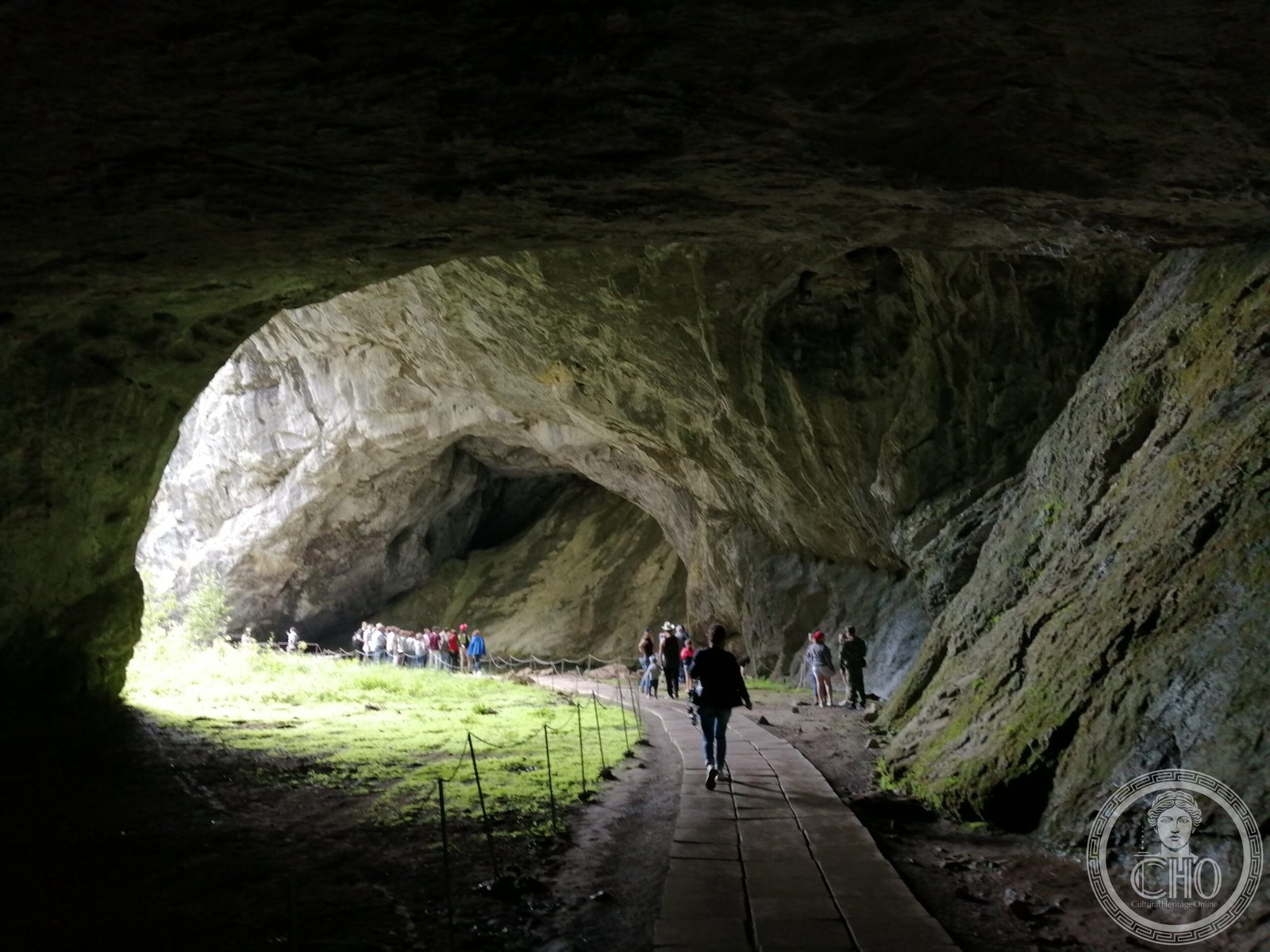
Deep in the southern Urals, along the banks of the river Belaya, the Kapova cave — Shulgan-Tash in the Bashkir language — holds one of the most extraordinary complexes of Palaeolithic rock art on the planet. More than 200 images painted in red ochre, datable between 19,000 and 14,500 years ago: mammoths with curving tusks, woolly rhinoceroses, wild horses, bison, geometric signs. Scientifically discovered in 1954, the cave had already been sacred to Bashkir tradition for centuries. A UNESCO World Heritage site since 2023, as part of the “Rock paintings of Kapova and Ignatievskaya”.
At a glance
Kapova Cave (also known as Shulgan-Tash, meaning “Stone of the River God” in Bashkir) is a multi-level limestone cave on the Belaya River in the southern Urals, in the Republic of Bashkortostan, Russia. It extends 3 km into the mountain and reaches three floors of galleries. The cave contains over 200 known Palaeolithic painted images spread across three galleries, including mammoths (the most numerous subject), woolly rhinoceroses, horses, bison, deer and geometric signs. UNESCO inscribed Kapova and the nearby Ignatievskaya cave in 2023 (ref. 1743) as an exceptional example of Palaeolithic cave art in Eastern Europe.
Key facts
- UNESCO: World Heritage since 2023 (Kapova and Ignatievskaya Palaeolithic Painted Caves, ref. 1743)
- Age: paintings dated 19,000–14,500 years BP (Upper Palaeolithic)
- Images: over 200 painted figures; mainly mammoths, woolly rhinos, horses, bison
- Pigment: red ochre (iron oxide); some yellow and black areas
- Length: 3 km of galleries on three levels
- Discovery: A. V. Ryumin, 1954 (first systematic documentation of the paintings)
History
The cave has been known to local Bashkir people since ancient times: in Bashkir mythology, Shulgan-Tash is the domain of the underground spirit Shulgan, god of the river and the underworld. Traditional honey-gatherers entered the cave to collect wild honey from bees nesting in the entrance zone for centuries. The deeper galleries with the paintings were known only to shamans.
European scientific discovery came in 1760, when the naturalist Pyotr Rychkov described a cave on the Belaya River. But the existence of Palaeolithic paintings was only recognised in 1954, when zoologist Alexander Ryumin documented the images. The discovery was sensational: Russia had no known major Palaeolithic painted cave. Systematic excavations since the 1960s revealed that the cave had been used by Palaeolithic humans over a long period, with the deepest paintings (on the third level, rarely visited) dating to the oldest phase. A copy of the main gallery paintings is displayed in the Kapova Cave Museum at the site entrance. UNESCO inscription in 2023 placed the cave alongside Altamira and Lascaux in the international canon of Palaeolithic art.
What you see
The cave entrance is a spectacular low arch above the Belaya River, framed by white limestone cliffs. The first gallery (public, accessible) shows geological formations — stalactites, underground lakes — and reproductions of the paintings. The actual Palaeolithic paintings are in restricted galleries; access is limited to researchers and small permitted groups to protect the fragile pigments from humidity and human breath.
The surrounding Shulgan-Tash Nature Reserve (established 1958) protects the limestone karst landscape, the Belaya River valley, wild bee colonies and dense mixed forest. The nature reserve visitor centre has exhibits on both the cave art and the local ecosystem.
Practical information
- Cave access: the first gallery is open to visitors in small groups; painted galleries restricted to researchers
- Reserve: Shulgan-Tash Nature Reserve visitor centre open May–October; guided walks available
- Best time: May–September (reserve accessible); cave temperature constant at 8°C year-round
- Base: Ufa (capital of Bashkortostan), 300 km north; Beloretsk, 100 km north (nearest town)
Getting there
From Ufa (300 km north) by road via Beloretsk: take the M5 motorway south, then local roads to the village of Irgizly. Ufa has rail connections from Moscow (18 hrs) and domestic flights. The cave entrance is 200 m from the main road on the Belaya River. GPS: 53.04° N, 57.06° E.
Nearby
- Ignatievskaya Cave — the second UNESCO painted cave in the region, 100 km west in Chelyabinsk Oblast
- Ufa — the capital of Bashkortostan, with the National Museum of the Republic of Bashkortostan
- South Ural State Nature Reserve — pristine Ural wilderness with the highest peak in the southern Urals (Yamantau, 1,638 m)
Sources
- UNESCO World Heritage Centre — “Palaeolithic Painted Caves of Kapova and Ignatievskaya” (ref. 1743)
- Encyclopaedia Britannica — Kapova Cave
- Shulgan-Tash Nature Reserve — official documentation
Find it on the map
See this place and what’s around it →📷 Become a Cultural Heritage Online photographer
Share your photos of places: they stay published under your name as the author. The more they're seen, the more you get noticed — and soon a contest will reward the most appreciated photos.
Log in or sign up free to add a photo