

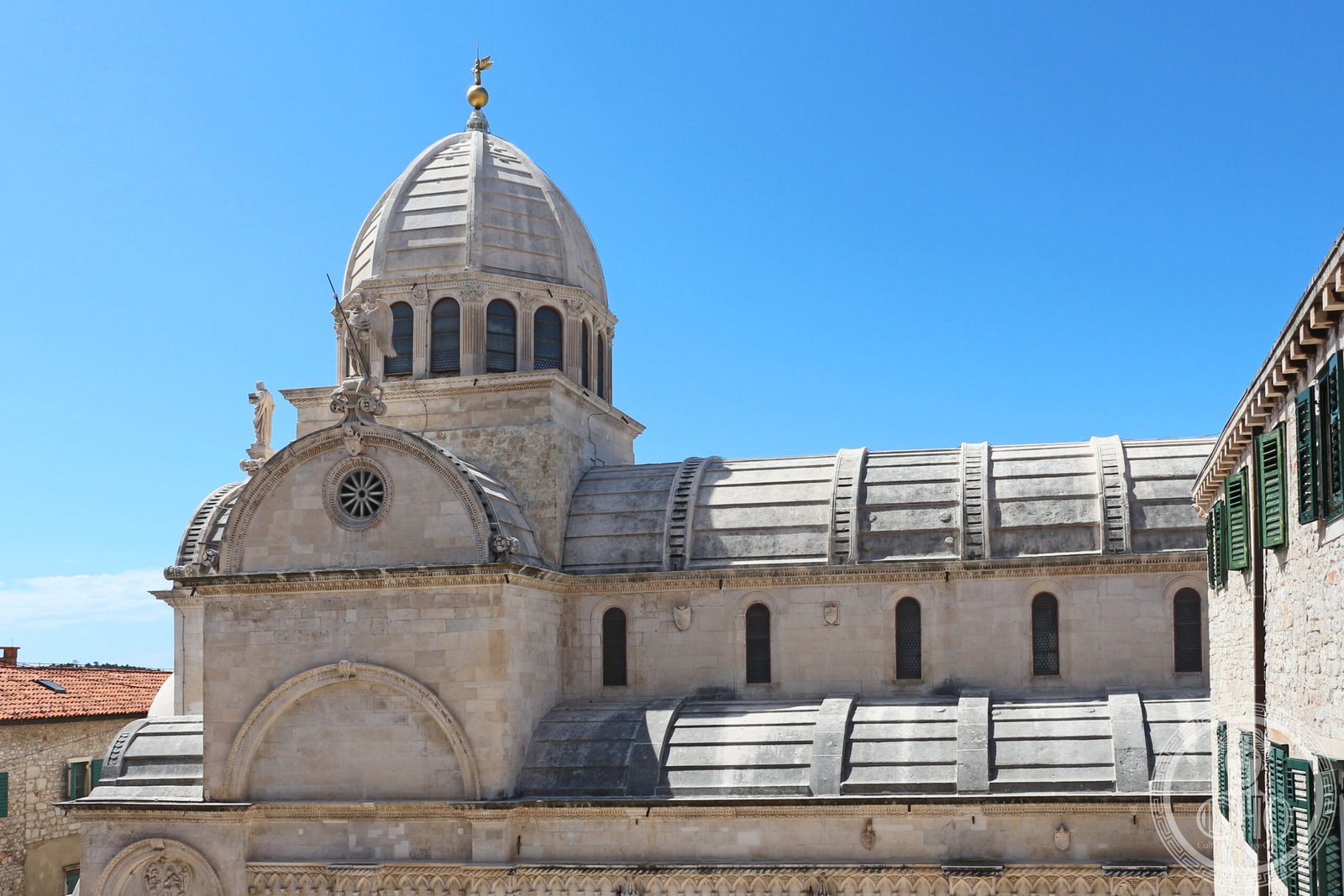
On the hill of old Šibenik stands a cathedral that changed the history of European architecture: St James, built between 1402 and 1536, is the first great church in the world raised entirely of cut limestone, without brick or mortar. Born of the dialogue between Venetian Gothic and Tuscan Renaissance, it bears the signature of two masters — Juraj Dalmatinac and Nikola Firentinac — and has been a UNESCO World Heritage site since 2000.
At a glance
The Cathedral of St. James in Šibenik is the first large church in the world built entirely of cut stone, without brick or mortar — a revolutionary structural innovation introduced by sculptor-architect Juraj Dalmatinac from 1441. Construction began in 1402 and took 134 years to complete; the dome was finished in 1536 by Nikola Firentinac. The building is a unique transitional work between Venetian Gothic and Tuscan Renaissance, inscribed by UNESCO in 2000. Its most celebrated feature is a frieze of 72 sculpted stone heads on the exterior apses.
Key facts
- UNESCO: World Heritage since 2000 (Cathedral of St. James in Šibenik)
- Built: 1402–1536 — 134 years of continuous construction
- Architects: Juraj Dalmatinac (from 1441) and Nikola Firentinac (dome, 1536)
- Innovation: first large church built entirely of interlocking cut-stone slabs, no mortar
- 72 heads: a distinctive frieze of portrait busts on the three exterior apses
- Style: Venetian Gothic transitioning to Tuscan Renaissance
History
Šibenik was founded in the 10th century and became a major Dalmatian city under Venetian rule. The cathedral project began in 1402, replacing a Romanesque predecessor, and struggled through decades of changing architects and interrupted funding. From 1441, Juraj Dalmatinac transformed the building with his brilliant innovation: instead of mortared masonry, the entire structure was assembled from precisely fitted, interlocking limestone slabs quarried from the islands of Brač and Korčula — a technique never attempted on such a scale before.
After Dalmatinac’s death in 1473, Nikola Firentinac — a Florentine trained in Tuscany — completed the project with a Renaissance dome and barrel-vaulted ceiling (1505–1536), giving the building its distinctive mixed character. The cathedral survived Venetian-Ottoman conflicts and later the Croatian War of Independence (1991–1995), during which it suffered serious damage. An international restoration effort preceded its UNESCO inscription in 2000.
What you see
The cathedral rises above the tightly packed old town of Šibenik in pale, gleaming limestone. Its three exterior apses are decorated with the famous frieze of 72 sculpted heads — believed to be portraits of citizens who refused to contribute to construction costs. Inside, three naves of equal height create a solemn space; the baptistery, carved almost entirely by Dalmatinac, is one of the finest examples of Gothic-Renaissance sculpture on the Adriatic.
The drum and dome, visible from the harbour, have defined the Šibenik skyline for five centuries. The technical perfection of the stone jointing — still visible today — speaks to the extraordinary skill of medieval Dalmatian masons.
Practical information
- Open: daily, hours vary by season; check locally in winter
- Entry: small admission fee for interior; exterior always visible
- Best time: spring or autumn; summer brings cruise crowds
- Setting: pedestrian old town, Šibenik, central Dalmatian coast
Getting there
Šibenik lies on Croatia’s Dalmatian coast, 80 km south of Zadar and 80 km north of Split, served by regular buses and ferries. The cathedral is a short walk from the main bus station through the pedestrian old town. GPS: 43.74° N, 15.89° E.
Nearby
- St. Nicholas Fortress — the UNESCO-listed 16th-century sea fortress guarding the Šibenik channel
- Krka National Park — spectacular waterfalls and medieval monastery, 25 km inland
- Split & Diocletian’s Palace — the great UNESCO Roman palace on the coast, 80 km south
Sources
- UNESCO World Heritage Centre — “Cathedral of St. James in Šibenik” (ref. 963)
- Encyclopaedia Britannica — Cathedral of St. James, Šibenik
- Croatian Ministry of Culture — official site documentation
Find it on the map
See this place and what’s around it →📷 Become a Cultural Heritage Online photographer
Share your photos of places: they stay published under your name as the author. The more they're seen, the more you get noticed — and soon a contest will reward the most appreciated photos.
Log in or sign up free to add a photoIs this page about you?
This page is read by travellers and heritage enthusiasts who find it on Google. Tell us how you are connected to this place and we will take it from there.