Ghana has two UNESCO World Heritage Sites, both cultural, both inscribed within a year of each other in the late 1970s and early 1980s. Together they tell a story that stretches from the Ashanti heartland north of Kumasi to a chain of coastal fortifications that once anchored one of history’s most consequential and devastating trading networks. From Cultural Heritage Online.
Why Ghana’s list looks the way it does
Ghana ratified the World Heritage Convention on 4 July 1975, among the earliest African nations to do so, and sent representatives to the World Heritage Committee during its founding years. That early engagement accelerated the first nominations, which reached the committee at its third and fourth sessions in 1979 and 1980. Since then, no further site has been inscribed — though Mole National Park, Kakum National Park, the Navrongo Catholic Cathedral, and several historical trade routes appear on Ghana’s tentative list, meaning the total of two could eventually grow.
The two sites that did make the list were selected under criterion (vi), which recognises places directly associated with events or living traditions of outstanding universal significance. Neither is a natural site: Ghana currently holds no inscribed natural World Heritage properties, although the country’s forest and savanna ecosystems are among West Africa’s most ecologically significant.
The first inscriptions
Both of Ghana’s World Heritage Sites were inscribed in quick succession during the convention’s early years:
- Forts and Castles, Volta, Greater Accra, Central and Western Regions — inscribed 1979
- Asante Traditional Buildings — inscribed 1980
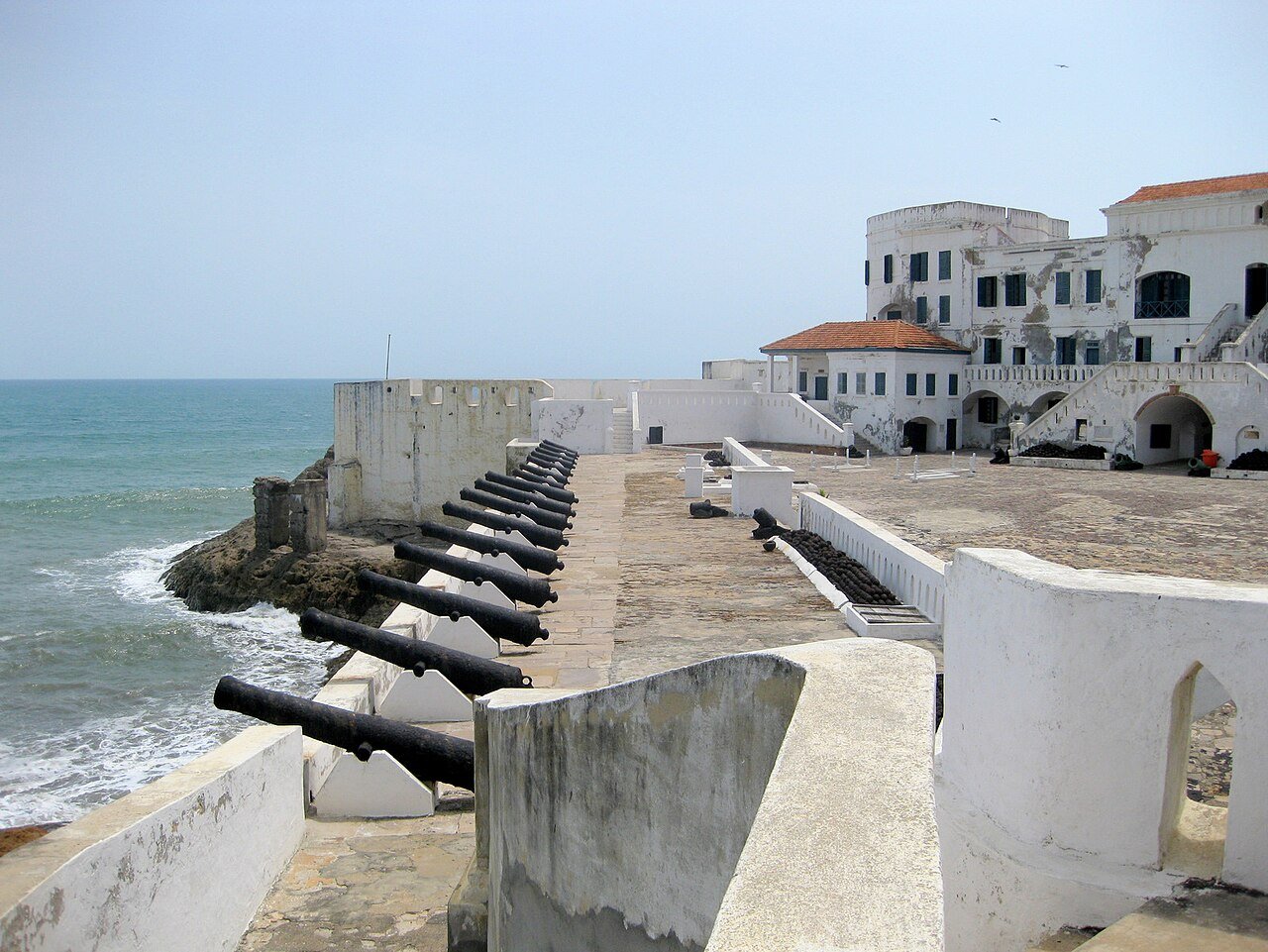
The 1979 inscription came first and remains the larger of the two in physical scope. It recognised a serial group of fortified coastal structures built by Portuguese, Dutch, British, and other European powers from the fifteenth century onward. The 1980 inscription followed with a focus on the interior of the country, anchoring the list’s representation of Ghana’s precolonial African heritage alongside its colonial one.
The most visited — and the alternatives
Cape Coast Castle draws the most international visitors of any site within the 1979 inscription. Constructed by the Swedish Africa Company in the 1650s and later held by the Dutch and British, it became a central holding point in the transatlantic slave trade. The Door of No Return — the sea-facing gate through which enslaved people were loaded onto ships — has become one of the most emotionally significant thresholds in the Atlantic world. Elmina Castle, also included in the serial inscription and the oldest European-built structure in sub-Saharan Africa, dates to 1482 and draws comparable attention for similar reasons.
Less prominent but historically substantial are several of the site’s smaller forts. Fort Good Hope at Senya Beraku is one of the more intact smaller fortifications along the coast, built by the Dutch in 1703. Fort Orange at Sekondi, also Dutch in origin, predates it by several decades. Christiansborg Castle in Accra, seat of Ghanaian governments into the post-independence era, functions differently from the coastal trade forts yet belongs to the same inscription. Each of these three carries a distinct chapter of the Gold Coast’s colonial history that the better-known castles alone cannot convey.
Natural and shared sites
Ghana currently holds no inscribed natural World Heritage Sites, which is notable given the ecological range of the country. Mole National Park in the north — Ghana’s largest wildlife reserve — has appeared on the tentative list for years, as has Kakum National Park in the Central Region, known for its forest canopy. Neither has advanced to inscription as of 2026. There are no transnational or serial inscriptions shared between Ghana and neighbouring countries on the current list, though the historical trade routes on the tentative list could eventually take that form.
The absence of natural sites reflects both nomination priorities and the considerable resources required to prepare a credible dossier. Several West African nations face the same imbalance: rich in natural areas that meet the ecological criteria in principle but without the institutional capacity to complete the nomination process at pace with cultural submissions.
How to find them
Both inscribed sites are accessible by road from major Ghanaian cities. The coastal forts are distributed along the Gulf of Guinea between Accra and the western border, with Cape Coast and Elmina reachable in roughly three hours from the capital. The Asante Traditional Buildings are clustered near Kumasi, Ghana’s second city, within a few hours’ drive from Accra or accessible by rail and air. Several of the ten traditional structures included in the inscription remain active shrines, so visitor access depends on local religious calendars and community protocols.
Ghana’s World Heritage sites sit alongside thousands of other places on CHO’s interactive map, with GPS and sourced editorial history for each. See also our guides to Italy’s and France’s UNESCO sites, and our piece on cultural travel beyond mass tourism.
Frequently Asked Questions
How many UNESCO World Heritage Sites does Ghana have?
Ghana has two UNESCO World Heritage Sites, both cultural. They are the Forts and Castles of the Volta, Greater Accra, Central and Western Regions, inscribed in 1979, and the Asante Traditional Buildings, inscribed in 1980. Ghana has no natural or mixed World Heritage Sites as of 2026.
What was Ghana’s first UNESCO World Heritage Site?
Ghana’s first UNESCO World Heritage Site was the Forts and Castles, Volta, Greater Accra, Central and Western Regions, inscribed in 1979 at the third session of the World Heritage Committee. This serial inscription covers a collection of European-built coastal fortifications — including Cape Coast Castle and Elmina Castle — associated with the gold trade and the transatlantic slave trade.
What are the Asante Traditional Buildings and why are they significant?
The Asante Traditional Buildings are a group of ten structures near Kumasi representing the material legacy of the Ashanti Empire at its eighteenth- and nineteenth-century peak. Built using wattle and daub — timber frames packed with mud plaster — and decorated with bas-reliefs and Adinkra symbols, they are the last surviving examples of a building tradition largely destroyed during the British occupation between 1806 and 1901.
Does Ghana have any natural UNESCO World Heritage Sites?
No. Ghana’s two inscribed World Heritage Sites are both cultural. Mole National Park and Kakum National Park have appeared on Ghana’s tentative list, meaning the government has formally proposed them as candidates, but neither has advanced to inscription as of 2026.
Sources used in this article
- UNESCO — State Party Ghana — World Heritage list.
- UNESCO — Ghana: World Heritage Sites.
- CHO magazine — What is a World Heritage Site?
- CHO — Interactive map of heritage sites.