Myanmar has two UNESCO World Heritage Sites as of 2022 — a figure that seems modest for a country whose landscape is layered with ancient cities, sacred pagodas, and millennia of continuous civilisation. Both inscriptions are cultural, and together they span nearly two thousand years of Burmese history: from the brick-walled Pyu city-states of the early Common Era to the extraordinary temple plain of Bagan. From Cultural Heritage Online.
Why Myanmar’s list looks the way it does
Myanmar’s inscription count reflects a combination of political isolation, ongoing conflict in border regions, and a comparatively recent engagement with the World Heritage process. The country submitted its first successful nomination only in 2014, decades after many of its Southeast Asian neighbours had built substantial lists. UNESCO inscription requires sustained government capacity for documentation, conservation planning, and boundary management — conditions that proved difficult to maintain across years of military rule and international sanctions.
The situation is not for lack of candidates. Myanmar’s Tentative List, last updated in 2020, includes fifteen properties spanning Buddhist monuments, colonial-era urban fabric, palaeontological sites, and major natural corridors. Several of these have been under preparation for years. The pace of future inscriptions will depend on both political stability and the technical capacity of the Department of Archaeology, National Museum and Libraries.
The first inscriptions
Myanmar’s entry into the World Heritage system came in 2014 with a serial nomination that linked three ancient cities under a single designation. The inscription recognised the Pyu as the earliest known urban civilisation in mainland Southeast Asia.
- Pyu Ancient Cities (2014) — a serial site comprising three urban centres: Beikthano, Halin, and Sri Ksetra. Each was a walled city of the Pyu people, inhabited between roughly the second century BCE and the ninth century CE, with brick architecture, elaborate hydraulic systems, and Buddhist funerary monuments.
- Bagan (2019) — the second inscription, and the one that had been anticipated for the longest time. Bagan was first submitted as a tentative site in 1996; more than two decades of revision to its conservation framework followed before UNESCO approved the nomination.
The most visited — and the alternatives
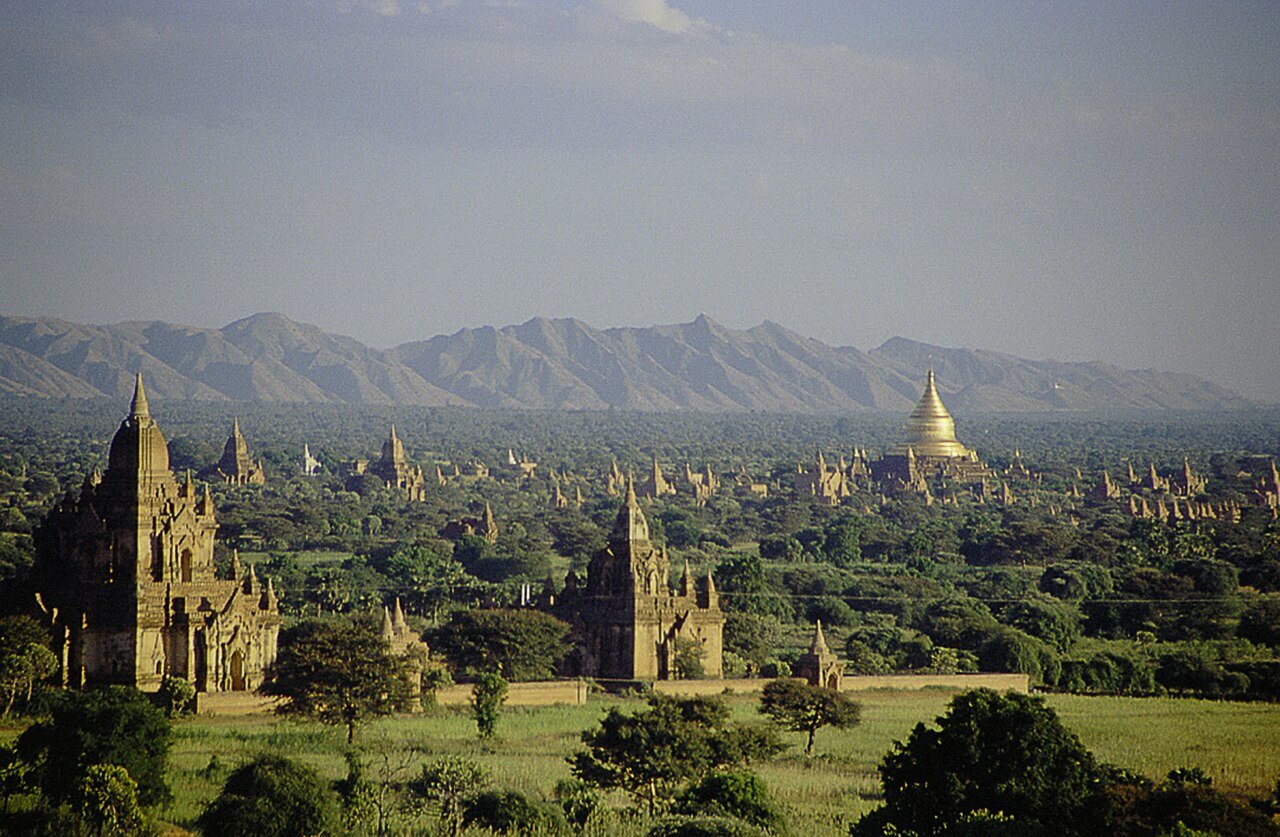
Bagan is the site that draws the majority of international visitors to Myanmar’s World Heritage properties. The archaeological zone on the Irrawaddy plain preserves over three thousand Buddhist temples, stupas, and monasteries built between the ninth and thirteenth centuries, when Bagan was the capital of the first Burmese kingdom. The concentration of standing structures across a flat, semi-arid landscape is without close parallel in Asia.
Beyond Bagan, the Pyu Ancient Cities offer a very different experience — less visited, and more archaeologically demanding. Sri Ksetra, near the modern city of Pyay, is the most accessible of the three Pyu sites and contains the largest known Pyu stupa, the Bawbawgyi. Halin, in the Sagaing Region, preserves city walls and a moat system. Among the properties on the Tentative List, Mrauk-U stands out: an early-modern capital in Rakhine State that served as a major maritime trade hub in the sixteenth and seventeenth centuries, connecting the Bay of Bengal with inland Burma. The Pondaung anthropoid primate sites in the Magway Region contain forty-million-year-old fossils regarded as significant evidence for early primate evolution.
Natural and shared sites
Myanmar currently has no inscribed natural World Heritage Sites. The Tentative List includes several properties that would, if nominated successfully, represent some of the most biodiverse landscapes in the region. These include Hkakabo Razi, in the far north, where glaciated peaks meet subtropical forest; the Hukaung Valley Wildlife Sanctuary, one of the largest tiger reserves in Asia; the Myeik Archipelago, an island chain in the Andaman Sea with coral reef systems largely undocumented by science; and Indawgyi Lake Wildlife Sanctuary, home to one of Southeast Asia’s largest freshwater lakes. Myanmar does not currently participate in any transnational World Heritage inscriptions, though the cross-border continuity of forest corridors with China, India, and Thailand has been noted in regional conservation discussions.
How to find them
Both inscribed sites are located in central Myanmar. Bagan is reached by air from Yangon or Mandalay, or by overnight river boat from Mandalay — a journey that itself follows the Irrawaddy corridor that UNESCO has considered for tentative nomination. The Pyu cities require more planning: Sri Ksetra is a half-day trip from Pyay, while Halin and Beikthano demand overland travel in areas where infrastructure is limited.
Myanmar’s World Heritage sites sit alongside thousands of other places on CHO’s interactive map, with GPS and sourced editorial history for each. See also our guides to Italy’s and France’s UNESCO sites, and our piece on cultural travel beyond mass tourism.
Frequently Asked Questions
How many UNESCO World Heritage Sites does Myanmar have?
Myanmar has two UNESCO World Heritage Sites as of 2022: the Pyu Ancient Cities, inscribed in 2014, and Bagan, inscribed in 2019. Both are classified as cultural sites; Myanmar has no inscribed natural World Heritage properties at present.
What was Myanmar’s first UNESCO World Heritage Site?
The Pyu Ancient Cities were Myanmar’s first UNESCO World Heritage inscription, receiving the designation in 2014. The site is a serial nomination encompassing three ancient Pyu urban centres — Beikthano, Halin, and Sri Ksetra — dating from roughly the second century BCE to the ninth century CE.
What is the Pyu Ancient Cities site?
The Pyu Ancient Cities is a serial World Heritage Site comprising three early urban settlements built by the Pyu people in what is now central Myanmar. The cities feature brick architecture, sophisticated water management infrastructure, and Buddhist stupas, and are considered the earliest known urban civilisation in mainland Southeast Asia.
Does Myanmar have any natural UNESCO World Heritage Sites?
No. As of 2022, Myanmar’s two inscribed sites are both cultural designations. However, the country’s Tentative List includes several natural properties, among them Hkakabo Razi in the north, the Hukaung Valley Wildlife Sanctuary, the Myeik Archipelago, and Indawgyi Lake Wildlife Sanctuary.
Sources used in this article
- UNESCO — State Party Myanmar — World Heritage list.
- UNESCO — Myanmar: World Heritage Sites.
- CHO magazine — What is a World Heritage Site?
- CHO — Interactive map of heritage sites.