
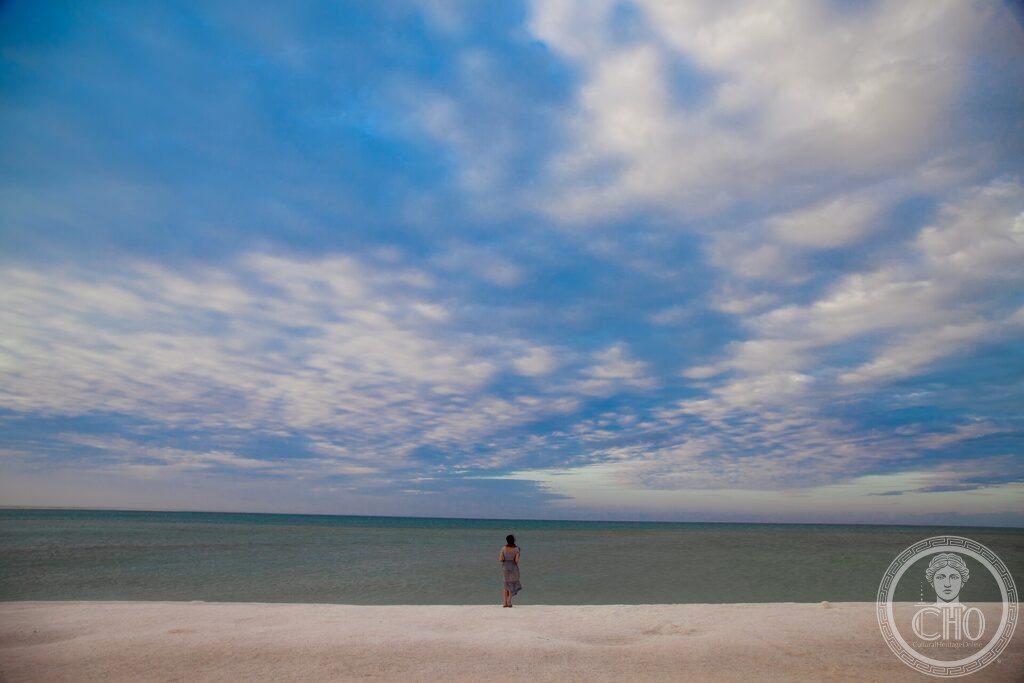
Nel punto più occidentale dell’Australia, baie turchesi e spiagge di conchiglie custodiscono un prodigio: le stromatoliti, cupole costruite da microbi come quelli che ossigenarono la Terra primordiale. Attorno, le più vaste praterie marine del mondo nutrono migliaia di dugonghi e tartarughe.
At a glance
Shark Bay, at the westernmost point of Australia, is a vast complex of turquoise bays, peninsulas and islands of outstanding natural value. Its sheltered, salty waters hold the famous stromatolites of Hamelin Pool — living rock-like domes built by microbes much like those that first oxygenated the early Earth — and the largest and richest seagrass meadows in the world, which feed huge populations of dugong, as well as turtles, dolphins and rays. Shell beaches made of countless tiny cockles line the shore. It was inscribed by UNESCO in 1991.
Key facts
- UNESCO: World Heritage since 1991 (Shark Bay, Western Australia)
- Living stromatolites: microbial domes like those of the early Earth
- Seagrass meadows: the largest and richest in the world
- Dugongs: one of the largest populations on Earth
- Shell beaches: beaches built of countless tiny cockle shells
- Westernmost Australia: at Steep Point, the continent’s western tip
History
Shark Bay’s unusual conditions — sheltered, very salty water — have preserved a window onto the deep past. In Hamelin Pool, where few grazing animals can live, microbes build stromatolites just as their ancestors did billions of years ago, when such organisms transformed the atmosphere by producing oxygen; living examples like these are rare in the world.
The same waters grow vast seagrass meadows that sustain thousands of dugongs and other marine life, while beaches of compacted cockle shells stretch for kilometres. The Malgana and other Aboriginal peoples have long known this coast. Recognised for this combination of geological, biological and ecological wonders, Shark Bay was inscribed by UNESCO in 1991.
What you see
At Hamelin Pool a boardwalk leads over the living stromatolites; at Shell Beach the shore is pure white cockle shells metres deep; at Monkey Mia dolphins come close to the beach. Lookouts over the turquoise bays and the cliffs of Cape Peron, and boat trips to see dugongs and turtles, complete the experience.
The strangeness of the breathing stromatolites and the brilliance of the bays make Shark Bay unforgettable.
Practical information
- Area: a large region; Denham and Monkey Mia are the main bases
- Best time: the cooler months (April–October)
- Time needed: two or more days
- Note: remote; distances are long, so plan fuel and water
Getting there
Shark Bay is on the central coast of Western Australia, around Denham and Monkey Mia, about 800 km north of Perth. The nearest airport is at Monkey Mia/Denham. GPS: 25.50° S, 113.50° E.
Nearby
- Monkey Mia — famous for its wild dolphins
- Hamelin Pool — the stromatolite reserve
- Kalbarri — gorges and coastal cliffs to the south
Sources
- UNESCO World Heritage Centre — “Shark Bay, Western Australia” (ref. 578)
- Western Australia Parks and Wildlife Service — official body
- Encyclopaedia Britannica — Shark Bay
Find it on the map
See this place and what’s around it →📷 Become a Cultural Heritage Online photographer
Share your photos of places: they stay published under your name as the author. The more they're seen, the more you get noticed — and soon a contest will reward the most appreciated photos.
Log in or sign up free to add a photo