
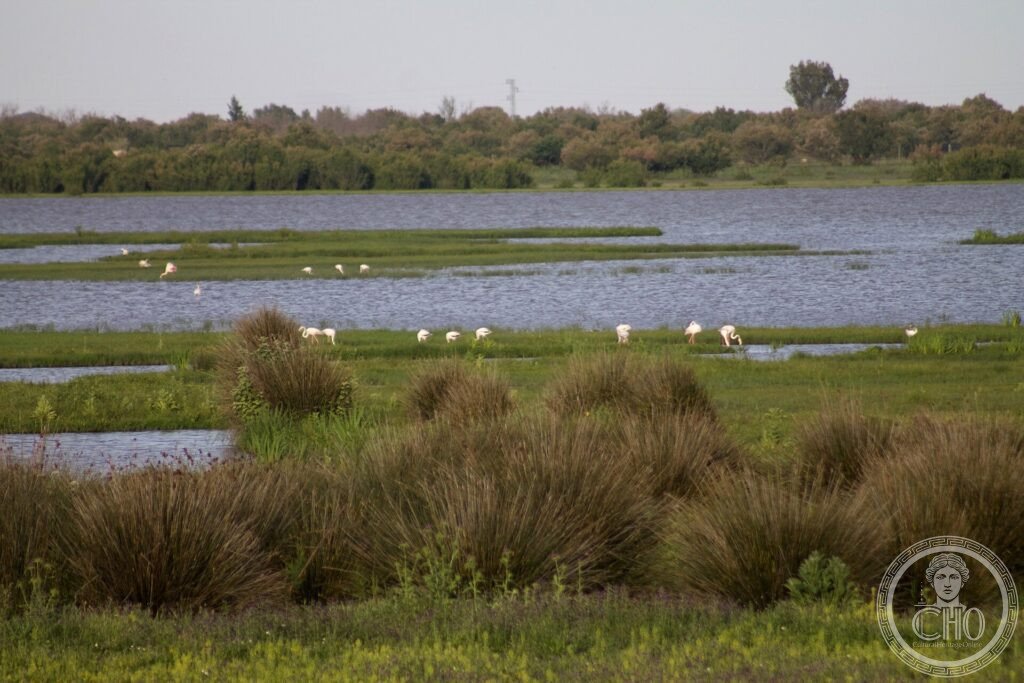
Alla foce del Guadalquivir, fra dune mobili, pinete e immense paludi, Doñana è una delle più importanti zone umide d’Europa. Crocevia delle rotte migratorie fra Europa e Africa, accoglie centinaia di migliaia di uccelli e custodisce uno degli ultimi rifugi della lince iberica, il felino più raro del mondo.
At a glance
Doñana National Park, in Andalusia at the mouth of the Guadalquivir, is one of the most important wetlands in Europe. A mosaic of seasonal marshes (marismas), shifting dunes, beaches, pine woods and scrub, it lies on the migratory route between Europe and Africa and shelters hundreds of thousands of waterbirds — including great flocks of flamingos — as well as one of the last strongholds of the Iberian lynx, the world’s most endangered cat. It was inscribed by UNESCO in 1994.
Key facts
- UNESCO: World Heritage since 1994 (Doñana National Park)
- Wetland of Europe: the vast seasonal marshes of the Guadalquivir delta
- Bird migration: a key stop between Europe and Africa
- Flamingos: large flocks among many hundreds of thousands of birds
- Iberian lynx: one of the last refuges of the rare cat
- Varied habitats: marsh, mobile dunes, beach and pine woodland
History
The Doñana wetlands take their name from a 16th-century noblewoman whose family held the land as a hunting estate, and for centuries the marshes and woods were preserved as a royal and aristocratic hunting ground — a fortunate accident that spared them from drainage and development.
In the 20th century, as plans to drain and farm the marshes advanced, conservationists campaigned to save Doñana, and a national park was established in 1969. Recognised for its birdlife and its lynx, it was inscribed by UNESCO in 1994. The park remains under pressure from water extraction and surrounding agriculture, making its protection a continuing struggle.
What you see
From visitor centres and on guided tours by four-wheel-drive, visitors cross the marshes alive with flamingos, herons, spoonbills, ducks and waders, the dunes and the umbrella-pine woods where deer and wild boar roam and, very rarely, a lynx may be glimpsed. The marshes change dramatically with the seasons, from flooded sheets to dry mud.
The sheer abundance of birds, set against the wide Andalusian sky, is the wonder of Doñana.
Practical information
- Park: visitor centres; the interior is seen on guided 4×4 tours
- Best time: spring and autumn for birds; winter for wildfowl
- Time needed: a day
- Note: book guided tours in advance; bring binoculars
Getting there
Doñana lies between Huelva and Seville in western Andalusia, Spain, on the Atlantic coast at the mouth of the Guadalquivir. The main gateways are El Rocío and Matalascañas, reached by road. GPS: 37.00° N, 6.45° W.
Nearby
- Seville — the great Andalusian city, to the north-east
- El Rocío — the pilgrimage village on the edge of the marshes
- Huelva — the coast and the Columbus sites
Sources
- UNESCO World Heritage Centre — “Doñana National Park” (ref. 685)
- Organismo Autónomo Parques Nacionales (Spain) — official body
- Encyclopaedia Britannica — Doñana National Park
Find it on the map
See this place and what’s around it →📷 Become a Cultural Heritage Online photographer
Share your photos of places: they stay published under your name as the author. The more they're seen, the more you get noticed — and soon a contest will reward the most appreciated photos.
Log in or sign up free to add a photo