
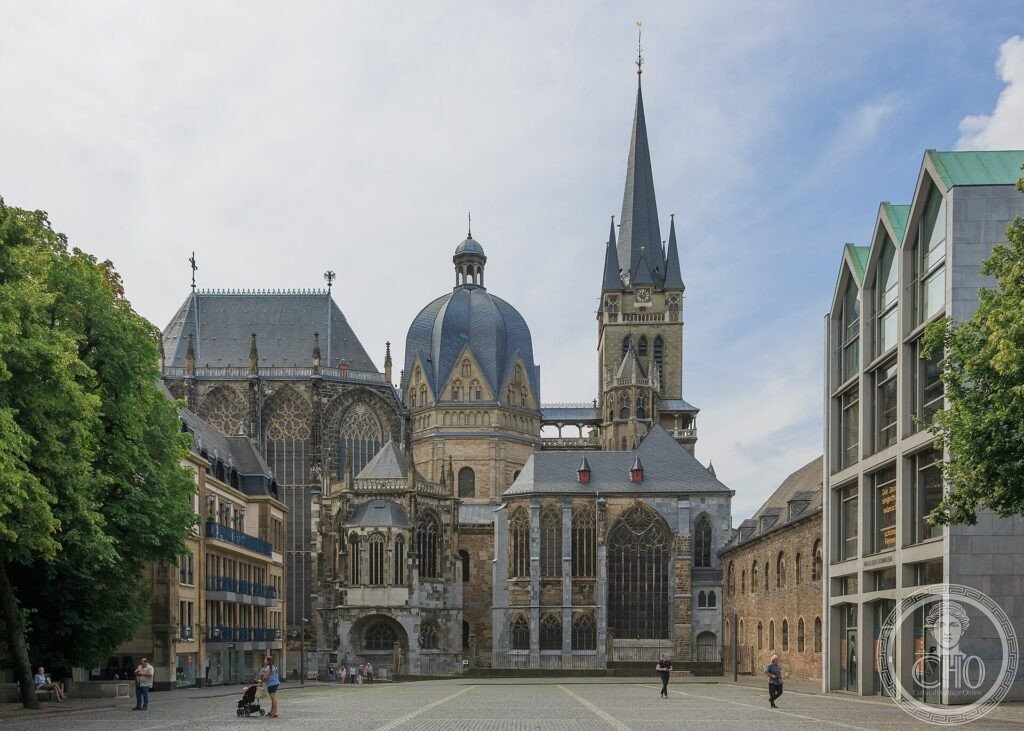
Aquisgrana (796–805): la Cappella Palatina di Carlo Magno, primo sito tedesco UNESCO
Quando fu costruita, l’Europa non vedeva una cupola simile da secoli. La Cappella Palatina di Carlo Magno fu il cuore del suo impero e divenne, per oltre seicento anni, il luogo dell’incoronazione dei re tedeschi. Nel 1978 fu il primo monumento della Germania iscritto fra i Patrimoni dell’Umanità.
At a glance
Aachen Cathedral grew around the Palatine Chapel of Charlemagne, built around 796–805 as the centre of his renewed Western empire. Its octagonal, domed core was the most ambitious vaulted structure north of the Alps since antiquity, modelled on the imperial churches of Ravenna and Byzantium. Charlemagne was buried here in 814, and from 936 to 1531 the chapel was the coronation church of the German kings. A soaring Gothic choir was added in the 15th century. In 1978 it became one of the first twelve World Heritage Sites and the first in Germany.
Key facts
- UNESCO: World Heritage since 1978 — the first site in Germany
- Palatine Chapel: built c. 796–805 under Charlemagne, an octagon under a dome
- Burial of Charlemagne: the emperor was interred here in 814
- Coronation church: some thirty German kings were crowned here, 936–1531
- Gothic choir: the glazed “glass house” choir hall, consecrated 1414
- Treasures: the Shrine of Charlemagne, the Barbarossa chandelier and the marble throne
History
Charlemagne made Aachen the principal seat of his court, drawn by its hot springs, and around 796 began a palace complex with a chapel at its heart. Completed about 805, the octagonal chapel expressed his ambition to renew the Roman empire in the West: columns and marbles were brought from Italy, and the design echoed San Vitale in Ravenna. On his death in 814 Charlemagne was buried in the chapel.
The building’s prestige made it the coronation site of the kings of the East Frankish realm and later the Holy Roman Empire, from Otto I in 936 to Ferdinand I in 1531. In the late Middle Ages the modest Carolingian choir was replaced by a tall Gothic hall, and over the centuries chapels and a spire were added around the original octagon.
What you see
The interior is dominated by the Carolingian octagon, ringed by two storeys of arches with bronze railings and topped by a glittering 19th-century mosaic dome. Above hangs the great Barbarossa chandelier, given in the 12th century. In the upper gallery stands the plain marble throne on which the kings were enthroned.
The Gothic choir beyond, walls almost entirely of stained glass, holds the golden Shrine of Charlemagne, where the emperor’s remains were placed in 1215.
Practical information
- Entry: the cathedral is free; a small fee applies for photography and for the Treasury
- Guided tours: required to see the upper gallery and the marble throne
- Time needed: 1–2 hours with the Treasury
- Note: as an active church, access may be limited during services
Getting there
Aachen lies in the far west of Germany, at the border with Belgium and the Netherlands, on the high-speed line between Cologne and Brussels/Paris. From Aachen main station the cathedral is about a 15-minute walk into the old town. GPS: 50.7747° N, 6.0839° E.
Nearby
- Aachen Town Hall — built on the foundations of Charlemagne’s palace hall, beside the cathedral
- Cathedral Treasury — one of the most important church treasuries north of the Alps
- Cologne — its own UNESCO cathedral, under an hour east by train
Sources
- UNESCO World Heritage Centre — “Aachen Cathedral” (ref. 3)
- Domkapitel Aachen — official cathedral chapter and Domschatzkammer
- Encyclopaedia Britannica — Aachen; Charlemagne
Find it on the map
See this place and what’s around it →📷 Diventa un fotografo di Cultural Heritage Online
Condividi le tue foto dei luoghi: restano pubblicate con la tua firma come autore. Più vengono viste, più ti fai conoscere — e presto un concorso premierà le foto più apprezzate.
Accedi o registrati gratis per aggiungere una foto