

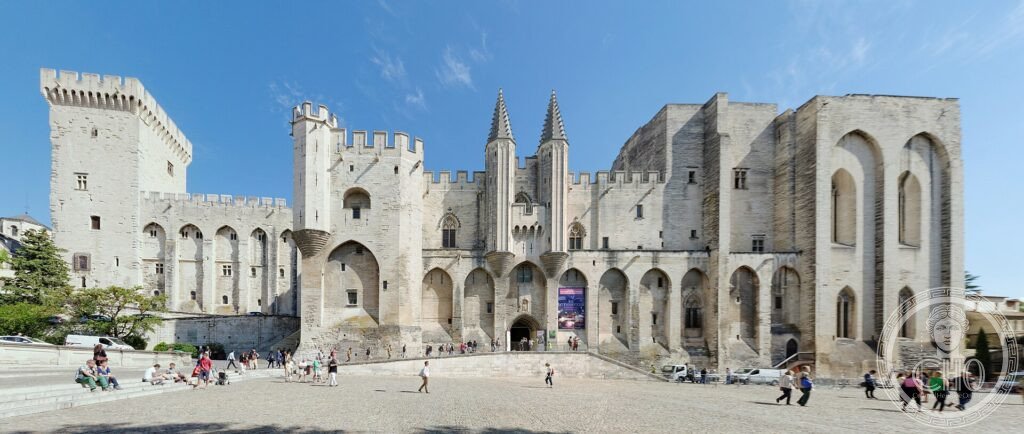
For almost seventy years, in the fourteenth century, the seat of the papacy was not Rome but Avignon: seven French popes built there the largest Gothic palace in the world, half fortress and half royal residence, frescoed by the finest Italian painters. Below its walls, the famous bridge of «sur le pont d’Avignon», which the Rhône has almost entirely carried away.
At a glance
For most of the 14th century the seat of the popes was not Rome but Avignon, on the Rhône in Provence. Between 1309 and 1377 seven French popes ruled the Western Church from here, and the palace they built — the Palais des Papes — is the largest Gothic building of the Middle Ages, at once an impregnable fortress and a sumptuous court decorated by Italian masters. With the cathedral, the bishop’s ensemble and the famous broken bridge of Saint-Bénézet, it forms the historic centre of Avignon, inscribed by UNESCO in 1995.
Key facts
- UNESCO: World Heritage since 1995 (Historic Centre of Avignon: Papal Palace, Episcopal Ensemble and Avignon Bridge)
- The Avignon Papacy (1309–1377): seven French popes, beginning when Clement V moved the Curia from a chaotic Rome to Avignon
- The palace: built 1335–1364 in two parts — the austere “Palais Vieux” of Benedict XII and the lavish “Palais Neuf” of Clement VI — the largest Gothic palace in the world
- Italian frescoes: Simone Martini worked at Avignon and Matteo Giovanetti frescoed the papal chapels and the “Chambre du Cerf” (Stag Room) with secular hunting scenes
- Schism: after the popes returned to Rome in 1377, antipopes (Clement VII, Benedict XIII) kept Avignon as a rival papal seat until 1403
- Pont Saint-Bénézet: the 12th-century bridge of the song “Sur le pont d’Avignon”; once 22 arches across the Rhône, repeatedly swept away by floods, now reduced to four
History
When Clement V, a Gascon, was elected in 1305, the turmoil of Rome and his ties to the French king led him to settle the papal court at Avignon, then a town of the Comtat Venaissin on the edge of the kingdom of France. His successors stayed: Benedict XII began the great palace as a fortified monastery-like residence, and Clement VI — the most princely of the Avignon popes — doubled it with the opulent Palais Neuf, buying the town outright in 1348. The Avignon papacy made the city a capital of art, learning and finance, drawing Italian painters and the poet Petrarch, who both admired and denounced it.
Gregory XI returned the papacy to Rome in 1377; his death triggered the Great Western Schism, and a line of antipopes held Avignon until 1403. The palace later served as a barracks and prison — its frescoes whitewashed and damaged — before its 20th-century restoration as a monument and the home of the Avignon theatre festival.
What you see
The palace presents blank fortress walls and towers to the town, then opens inside into vast ceremonial spaces: the Grand Tinel (banqueting hall), the Consistory, the papal chapels, and the private apartments of the pope — among them the Chambre du Cerf, frescoed with woodland hunting scenes of astonishing freshness. Twenty-five rooms are open along the visitor route, now often staged with digital projections that restore the lost colour and furnishing.
Outside, the Rocher des Doms gardens look down on the Rhône and the four surviving arches of the Pont Saint-Bénézet, with its little chapel of St Nicholas; the Romanesque cathedral of Notre-Dame des Doms, crowned by a gilded Virgin, stands beside the palace.
Practical information
- Visiting: the Palais des Papes and the Pont Saint-Bénézet are ticketed (combined ticket available); the digital “Histopad” tablet reconstructs the rooms
- Festival: the Festival d’Avignon (July) fills the palace courtyard and the city with theatre
- Time needed: half a day for palace, bridge and old town
Getting there
TGV trains reach Avignon TGV from Paris in about 2h40 (and from Marseille/Lyon); a shuttle links the TGV station to Avignon Centre, a short walk from the palace. GPS: 43.9507° N, 4.8077° E.
Nearby
- Villeneuve-lès-Avignon — the “city of cardinals” across the Rhône, with the Tour Philippe le Bel and the Chartreuse
- Pont du Gard — the great Roman aqueduct, 25 km west
- Châteauneuf-du-Pape & the Luberon — the popes’ vineyards and the hill villages of Provence
Sources
- UNESCO World Heritage Centre — “Historic Centre of Avignon” (ref. 228)
- Palais des Papes / Avignon Tourisme (palais-des-papes.com)
- Encyclopaedia Britannica — Avignon papacy
Find it on the map
See this place and what’s around it →📷 Become a Cultural Heritage Online photographer
Share your photos of places: they stay published under your name as the author. The more they're seen, the more you get noticed — and soon a contest will reward the most appreciated photos.
Log in or sign up free to add a photoIs this page about you?
This page is read by travellers and heritage enthusiasts who find it on Google. Tell us how you are connected to this place and we will take it from there.