

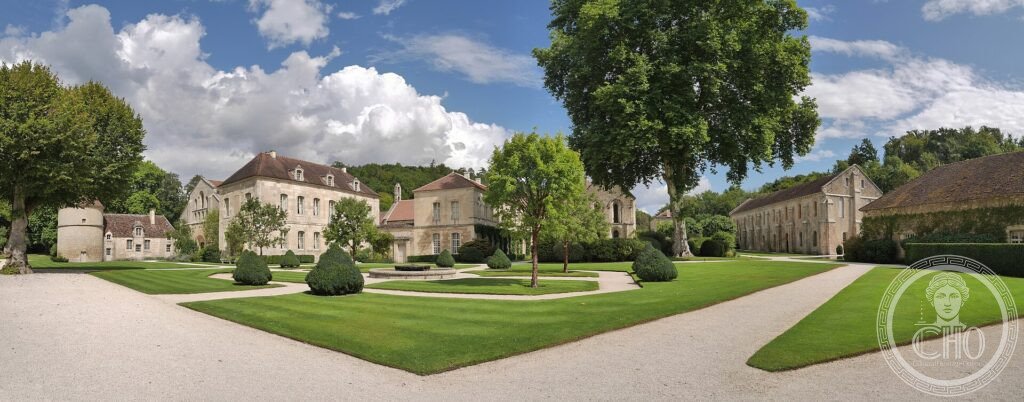
Founded by Bernard of Clairvaux himself in 1118, Fontenay is the oldest Cistercian abbey in the world to have come down to us intact: church, cloister, chapter house, dormitory and even the forge — one of the oldest industrial buildings in France. Everything here speaks the Cistercian rule: no ornament, only stone, proportion and silence.
At a glance
The Abbey of Fontenay, hidden in a wooded valley of northern Burgundy near Montbard, is the oldest surviving Cistercian abbey in the world. It was founded in 1118 by Bernard of Clairvaux himself; its church, built between 1139 and 1147, was consecrated by Pope Eugene III, a Cistercian and former disciple of Bernard. Almost the entire complex survives — church, cloister, chapter house, monks’ dormitory, the heated room (caldarium), the dovecote and the forge — making Fontenay the most complete picture we have of the self-sufficient life of the first Cistercians. UNESCO inscribed it in 1981.
Key facts
- UNESCO: World Heritage since 1981 (one of the first French monuments listed)
- Founded 1118 by Bernard of Clairvaux; the oldest Cistercian abbey preserved intact
- Church (1139–47): consecrated by Pope Eugene III; pure Cistercian Romanesque — no tower, no figurative sculpture, no colour, only proportion and light
- The forge: a late-12th-century ironworks, one of the oldest industrial buildings in France, recalling the Cistercians’ role in medieval technology (water-powered hammers)
- Completeness: church, cloister, chapter house, dormitory, caldarium, dovecote and forge all survive (only the refectory is lost)
- Modern history: after the Revolution the abbey became a paper mill run by the Montgolfier family; bought in 1906 by the Lyon banker Édouard Aynard and restored by 1911, it is still privately owned and open to visitors
History
Bernard of Clairvaux founded Fontenay in 1118 as a daughter-house of his own abbey of Clairvaux, in exactly the kind of remote, watered valley the Cistercians sought. The monks drained the marsh, channelled the stream to drive their mills and forge, and built in the severe manner the order required — the antithesis of the sculpted splendour of nearby Cluniac houses like Vézelay. By the 13th century Fontenay was prosperous, its iron and its farms supporting a large community.
Decline came with the commendam system and the wars of the later Middle Ages. Suppressed at the Revolution, the abbey was sold and turned into a paper mill by the Montgolfier brothers’ family. In 1906 the banker and art-lover Édouard Aynard bought it, removed the industrial buildings, and restored the medieval abbey; his descendants still own it and open it to the public.
What you see
The church is the heart of the visit: a barrel-vaulted nave of bare golden stone, lit only by plain windows, with no decoration to distract from its proportions — the Cistercian ideal made visible. Off the church opens the cloister, four ranges of round-arched bays around a green garth, and the chapter house with its ribbed vaults where the community met each morning. The long monks’ dormitory runs above, under a great oak roof.
Beyond, the forge stands by the stream — a vast hall where water-driven hammers once worked the iron the monks smelted — and the gardens, the dovecote and the abbot’s lodging complete one of the most peaceful and complete monastic sites in Europe.
Practical information
- Visiting: privately owned but open daily; ticketed; guided tours and free-flow visits
- Setting: the gardens and valley are part of the experience — allow time to walk them
- Time needed: 1.5–2 hours
Getting there
Fontenay is near Marmagne, by Montbard in the Côte-d’Or. TGV trains from Paris reach Montbard (about 1 hour); the abbey is 6 km away by taxi. By car, via the A6 (exit Bierre-lès-Semur). GPS: 47.6400° N, 4.3895° E.
Nearby
- Montbard — the town of the naturalist Buffon and his park, 6 km away
- Semur-en-Auxois — a fine fortified Burgundian town, 20 km south
- Alise-Sainte-Reine (Alesia) — the site of Vercingetorix’s last stand and its MuseoParc, to the south-east
Sources
- UNESCO World Heritage Centre — “Cistercian Abbey of Fontenay” (ref. 165)
- Abbaye de Fontenay — official site (abbayedefontenay.com)
- Burgundy Tourism / France.fr — Fontenay Abbey
Find it on the map
See this place and what’s around it →📷 Become a Cultural Heritage Online photographer
Share your photos of places: they stay published under your name as the author. The more they're seen, the more you get noticed — and soon a contest will reward the most appreciated photos.
Log in or sign up free to add a photoIs this page about you?
This page is read by travellers and heritage enthusiasts who find it on Google. Tell us how you are connected to this place and we will take it from there.