
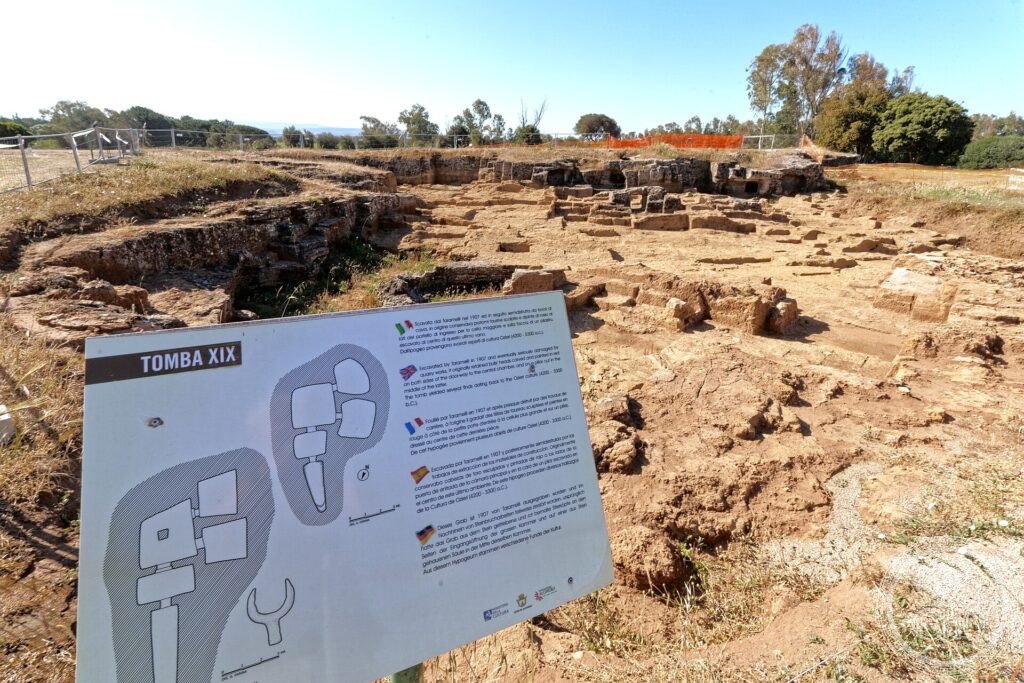
I sardi le chiamano case delle fate, le janas: piccole stanze scavate nella roccia seimila anni fa per i morti, decorate con corna di toro, false porte e spirali. Nel luglio 2025 le domus de janas sono diventate il 61° sito italiano UNESCO — e il primo Patrimonio Mondiale della Sardegna.
At a glance
The domus de janas — “houses of the fairies” in Sardinian — are rock-cut tombs hollowed out of cliffs and outcrops across Sardinia between the 4th and 3rd millennia BC. There are some three and a half thousand of them on the island, and in July 2025 a selection of seventeen necropolises was inscribed by UNESCO as “Funerary Tradition in the Prehistory of Sardinia — The Domus de Janas.” It is the 61st Italian World Heritage site and the first for Sardinia. Carved with the tools of the Neolithic, decorated with symbols and shaped like houses for the dead, they are among the oldest funerary architecture in Europe.
Key facts
- Inscribed: 12 July 2025 (UNESCO 47th session); the 61st Italian World Heritage site and Sardinia’s first
- What: a serial cultural site of 17 rock-cut necropolises across the island
- Date: carved between the 4th and 3rd millennia BC (Middle Neolithic to the Bronze Age)
- Number: about 3,500 domus de janas survive across Sardinia, most in the centre and north
- Decoration: carved bull’s horns, false doors, spirals and reliefs that echo the form of Neolithic houses
- Key necropolises: Anghelu Ruju (Alghero), Sant’Andrea Priu (Bonorva), Montessu (Villaperuccio), Mesu ’e Montes (Ossi)
About the tombs
To the prehistoric Sardinians, death was a passage. They carved chambers into the living rock — single cells or sprawling underground complexes of many rooms — and shaped them like the houses of the living, with imitation roof beams, doorways and hearths. On the walls they cut the symbols of their beliefs: the bull’s horns of a protective deity, false doors for the journey beyond, spirals and concentric circles. Later folklore reimagined the carvers as janas, tiny fairy-women who wove on golden looms inside the rock — hence the name.
The necropolis of Anghelu Ruju, near Alghero, was found by chance in 1903 during farm work; its 38 tombs, cut into soft limestone, are among the largest and most spectacular groups, several carved with bull’s horns and false doors. Elsewhere, Sant’Andrea Priu near Bonorva includes a vast “chief’s tomb,” and Montessu in the Sulcis opens like an amphitheatre of tombs in red trachyte. Together the seventeen sites trace a funerary tradition that lasted for more than a thousand years.
What you see
At Anghelu Ruju a low rise is honeycombed with openings: you stoop through small doorways into chambers linked by passages, some with carved pilasters and the unmistakable curve of bull’s horns above a niche. The rock is soft and warm-coloured, the spaces intimate and silent. Different sites show different stone and scale — the pale limestone of Alghero, the red trachyte of Montessu, the monumental chambers of Sant’Andrea Priu, later partly reused as a church — but all share the same idea: a home cut from rock for those who had died.
Practical information
- Anghelu Ruju: an archaeological area near Alghero (close to the Alghero-Fertilia airport), with a ticket and opening hours — check the local management
- Other sites: Sant’Andrea Priu (Bonorva), Montessu (Villaperuccio) and others are open as archaeological areas across the island
- On site: uneven ground and low chambers — flat shoes and care; bring water in summer
- Time needed: about an hour per necropolis
Getting there
The Anghelu Ruju necropolis is a few kilometres north of Alghero, in north-west Sardinia, on the road toward Porto Torres near the Fertilia airport. The other inscribed necropolises are spread across the island, from the Sassari area to the Sulcis in the south-west. GPS (Anghelu Ruju): 40.6186° N, 8.2964° E.
Nearby
- Alghero — the Catalan-speaking walled seaport, with its old town and coral coast
- Nuraghe di Palmavera — a Bronze Age nuraghe complex near Alghero
- Grotte di Nettuno — the sea caves at Capo Caccia, reached by boat or the Escala del Cabirol
Sources
- Domus de Janas UNESCO — official candidacy site (domusdejanasunesco.org)
- Regione Autonoma della Sardegna — press release on the 2025 inscription
- MiC — “Domus de janas, 61° sito italiano nella lista del patrimonio mondiale”
- Direzione regionale Musei Nazionali Sardegna — site information
Find it on the map
See this place and what’s around it →📷 Become a Cultural Heritage Online photographer
Share your photos of places: they stay published under your name as the author. The more they're seen, the more you get noticed — and soon a contest will reward the most appreciated photos.
Log in or sign up free to add a photo