
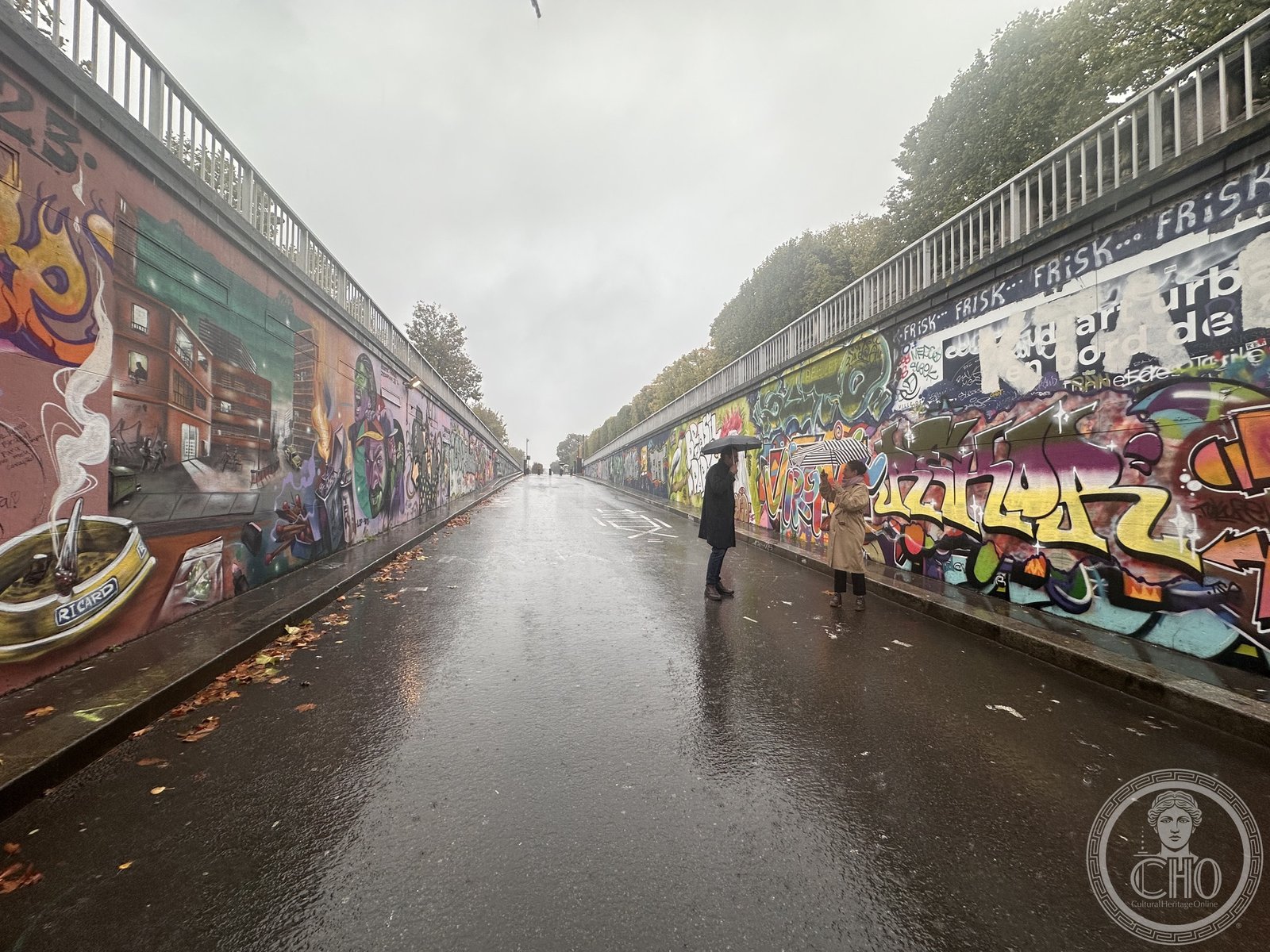
A two-kilometre itinerary through the oldest core of Paris, connecting the Musée d’Orsay’s Belle Époque railway station on the Left Bank, the Gothic Sainte-Chapelle on the Île de la Cité, and the Art Nouveau La Samaritaine at the foot of the Pont Neuf.
At a glance
This walk concentrates three distinct architectural eras within two kilometres: the 1248 Sainte-Chapelle built by Louis IX to house the Crown of Thorns; the 1900 Musée d’Orsay, originally the Gare d’Orsay railway terminus, whose cast-iron and glass sheds now contain the world’s largest collection of Impressionist art; and La Samaritaine, the department store designed by Frantz Jourdain (1905) and Henri Sauvage (1925) that was closed for structural repairs in 2005 and reopened in 2021 after a complete restoration. The route runs along the Seine quays — themselves a UNESCO-listed heritage zone since 1991 — and the covered passages of the Île de la Cité.
Key facts
- Sainte-Chapelle: 1248, Gothic Rayonnant, commissioned by Louis IX — the finest intact Gothic chapel in Paris
- Musée d’Orsay: 1900, Gare d’Orsay by Victor Laloux; converted to museum 1986 (Gae Aulenti interior)
- La Samaritaine: 1905 by Frantz Jourdain (Art Nouveau) + 1925 by Henri Sauvage (Art Deco); reopened 2021
- Seine Quays: UNESCO World Heritage since 1991 — “Paris, Banks of the Seine”
- Walk duration: 2.5–3 hours including brief interior visits
- Best time: Morning (fewer crowds at Sainte-Chapelle) or late afternoon (golden light on the Orsay facade)
History
The Île de la Cité is the geographical and historical origin of Paris — the Roman Lutetia, the Frankish Merovingian seat, the medieval royal capital. Sainte-Chapelle was built between 1242 and 1248 as part of the Palais de la Cité (now the Palais de Justice) to house the relics of the Passion, including the Crown of Thorns purchased by Louis IX from the Latin Emperor of Constantinople. Its upper chapel, where light enters through 15 metres of stained glass, was accessible only to the royal court; the lower chapel served the palace servants.
The Left Bank quays took their present form during the Second Empire (1853–1870), when Haussmann’s transformation of Paris regularised the embankments, built the Pont de l’Alma and Pont de Solférino, and flanked the Seine with the plane trees still visible today. The Gare d’Orsay was designed by Victor Laloux for the 1900 Universal Exhibition as the Paris terminus of the Orléans railway, its Beaux-Arts facade screening the iron-and-glass train shed. Electrification of the line in 1939 ended regular traffic; the building was converted into a museum between 1980 and 1986 to designs by the Italian architect Gae Aulenti, who inserted the main gallery at track level.
La Samaritaine began as a small shop on the Pont Neuf in 1869, founded by Ernest Cognacq. Frantz Jourdain’s 1905 building for the Rue de Rivoli block introduced Art Nouveau ironwork, ceramic tile, and the transparent glass roof that became the store’s defining image. Henri Sauvage added the Art Deco Pont Neuf facade in 1925. The store closed in 2005 after failing safety inspections and reopened in 2021 after a fifteen-year restoration and the insertion of a new glass ripple facade on the Rue de Rivoli block.
What you see
Arriving from the Orsay, the walk crosses the Pont du Carrousel and enters the Louvre precinct on the Right Bank before returning to the Île de la Cité via the Pont Neuf. The Sainte-Chapelle is embedded within the courtyard of the Palais de Justice; its needle-thin silhouette is visible from the quay only in glimpses between the limestone blocks of the palace. Inside, the upper chapel — open to the public — presents fifteen windows each 15 metres tall, containing 1,113 scenes from the Old and New Testaments.
La Samaritaine on the Rue de Rivoli shows two faces: the original 1905 Art Nouveau elevation with its ceramic floral panel by Jourdain, and the 2021 glass ripple facade inserted by SANAA (Kazuyo Sejima and Ryue Nishizawa) which undulates across the Rue de Rivoli block. The Pont Neuf elevation, restored rather than replaced, presents Sauvage’s geometric Art Deco lettering in gold on dark stone.
Practical information
- Sainte-Chapelle: open daily 09:00–17:00 (to 19:00 in summer); entry fee; combined tickets with Conciergerie available
- Musée d’Orsay: Tue–Sun 09:30–18:00, Thu to 21:45; closed Mon; entry fee
- La Samaritaine: open as department store and hotel; public access to atrium
- Walk: approximately 2 km; mostly flat; Seine quays have cobblestones
Getting there
Métro: RER C Musée d’Orsay; Métro 4 Cité for Sainte-Chapelle; Métro 7 Pont Neuf for La Samaritaine. The walk connects these stations naturally without backtracking. Vélib’ bikes are available at multiple points along the Seine quays.
Nearby
- Notre-Dame de Paris — 500 metres east on the Île de la Cité (under reconstruction until 2024)
- Conciergerie — royal prison on the Île de la Cité, combined ticket with Sainte-Chapelle
- Louvre Pyramid — 10 minutes walk east along the Rue de Rivoli
- Rodin Museum — 20 minutes walk west from the Orsay
Sources
- Musée d’Orsay. “Architecture et histoire du bâtiment.” musee-orsay.fr.
- Centre des monuments nationaux. “Sainte-Chapelle.” monuments-nationaux.fr.
- LVMH. “La Samaritaine — Restauration 2021.” lasamaritaine.com.
- UNESCO World Heritage List. “Paris, Banks of the Seine,” 1991.
Gallery
Photographs by Luigi De Marchi.








Find it on the map
See this place and what’s around it →📷 Become a Cultural Heritage Online photographer
Share your photos of places: they stay published under your name as the author. The more they're seen, the more you get noticed — and soon a contest will reward the most appreciated photos.
Log in or sign up free to add a photo