
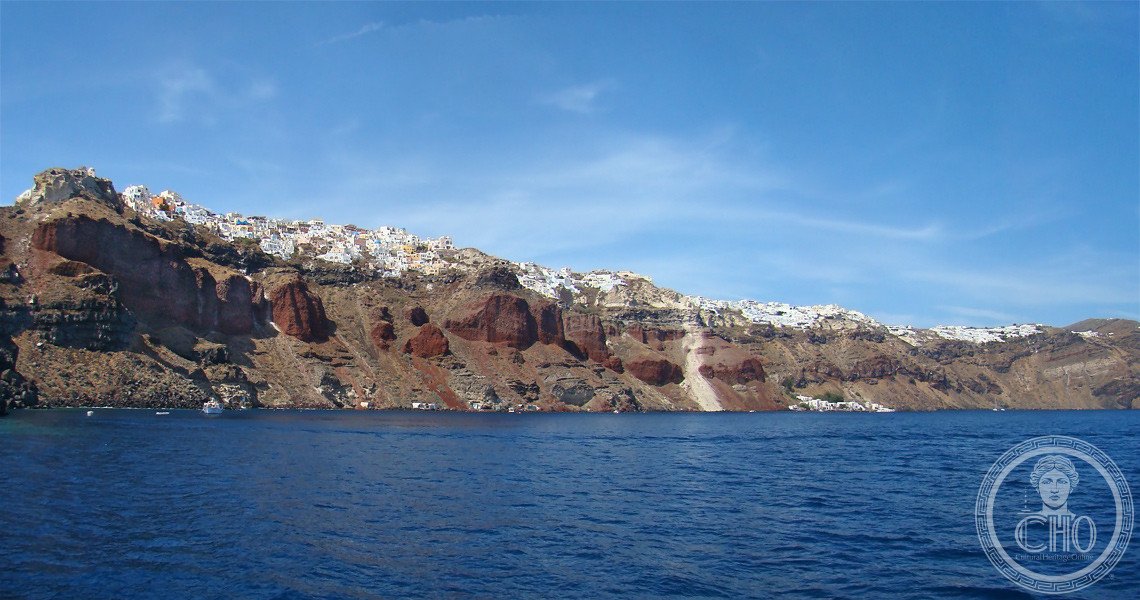
Oia clings to the northern tip of Santorini's caldera rim, its white cubic houses and azure domes stacked above 300-metre cliffs. It is the most photographed village in Greece, and the view earns every frame.
At a glance
Oia (pronounced ee-AH) sits at the northern end of Santorini's caldera, built directly into the volcanic cliff face. Its whitewashed Cycladic architecture — small-windowed, cave-like dwellings carved from pumice — reflects the Ottoman and Venetian building traditions adapted to volcanic terrain. The village is best known for its nightly sunset ritual, when visitors crowd the castle ruins to watch the sun dissolve into the Aegean. Oia has no ancient founding date; it developed as a fishing and trading village during the post-Byzantine period and was rebuilt after the 1956 earthquake that damaged much of the island.
Key facts
- Location: Northern caldera rim, Santorini (Thira), Cyclades, Greece
- Coordinates: 36.4622° N, 25.3757° E
- Architecture: Cycladic whitewashed cubic houses; cave dwellings carved into pumice
- Rebuilt: Substantially reconstructed after 1956 Amorgos earthquake
- Sunset point: Byzantine Castle of Agios Nikolaos ruins
- Access: 11 km from Fira; no cable car (donkey path or steps only to port)
History
Santorini's caldera was formed by the Minoan eruption c. 1600 BC, one of the largest volcanic events in recorded geological history. Oia's position on the caldera edge places it directly above the most dramatic section of that collapsed rim. The modern village developed in the post-Ottoman period as a maritime community; its sea captains' houses (archontika) reflected wealth from the Aegean trade routes. The 1956 Amorgos earthquake damaged much of Oia, and the current village is largely a reconstruction, though it faithfully follows the original Cycladic forms.
Oia's transformation into a global visual icon occurred after the 1980s, when photographers and travel writers fixed on its particular combination of caldera light and architectural geometry.
What you see
The village stretches along the cliff for roughly 2 kilometres. The main pedestrian lane winds between whitewashed walls, past blue-domed chapels and bougainvillea-draped terraces. The captain's houses — broader, with arched loggia and fresco-decorated interiors — stand among the more modest dwellings, marking the social geography of the old fishing economy. The Byzantine castle ruins at the western tip are where the sunset crowd gathers; the view encompasses the full caldera arc, the volcano island of Nea Kameni at its centre, and on clear evenings the silhouette of Thirassia across the water.
Below the village, 300 steps descend to the small port of Ammoudi, where fishing boats still moor and octopuses dry on lines above the terrace tavernas.
Practical information
- No admission fee; the village is a public space
- Sunset at the castle: arrive 45 minutes early in summer
- Narrow lanes are not wheelchair-accessible; donkey steps connect upper and lower village
- Best photography light: one hour before sunset (golden hour) or at dawn (no crowds)
- Overnight stays recommended: the village empties after 10 pm as day-trippers leave
Getting there
Oia is 11 km north of Fira, Santorini's capital. By bus: KTEL services run from Fira Bus Station (journey ~25 minutes). By car or ATV: the island road follows the caldera rim. By foot: a 10 km caldera-edge path connects Fira to Oia (3–4 hours; not recommended in summer midday heat). Santorini airport (JTR) and ferry port at Athinios are both near Fira.
Nearby
- Fira (11 km south) — Santorini's capital, with the Archaeological Museum of Thera
- Nea Kameni — the active volcano island at the centre of the caldera, reachable by boat from Fira
- Akrotiri (26 km) — the Bronze Age Minoan city buried by the 1600 BC eruption
Sources & resources
Find it on the map
See this place and what’s around it →

📷 Become a Cultural Heritage Online photographer
Share your photos of places: they stay published under your name as the author. The more they're seen, the more you get noticed — and soon a contest will reward the most appreciated photos.
Log in or sign up free to add a photo