
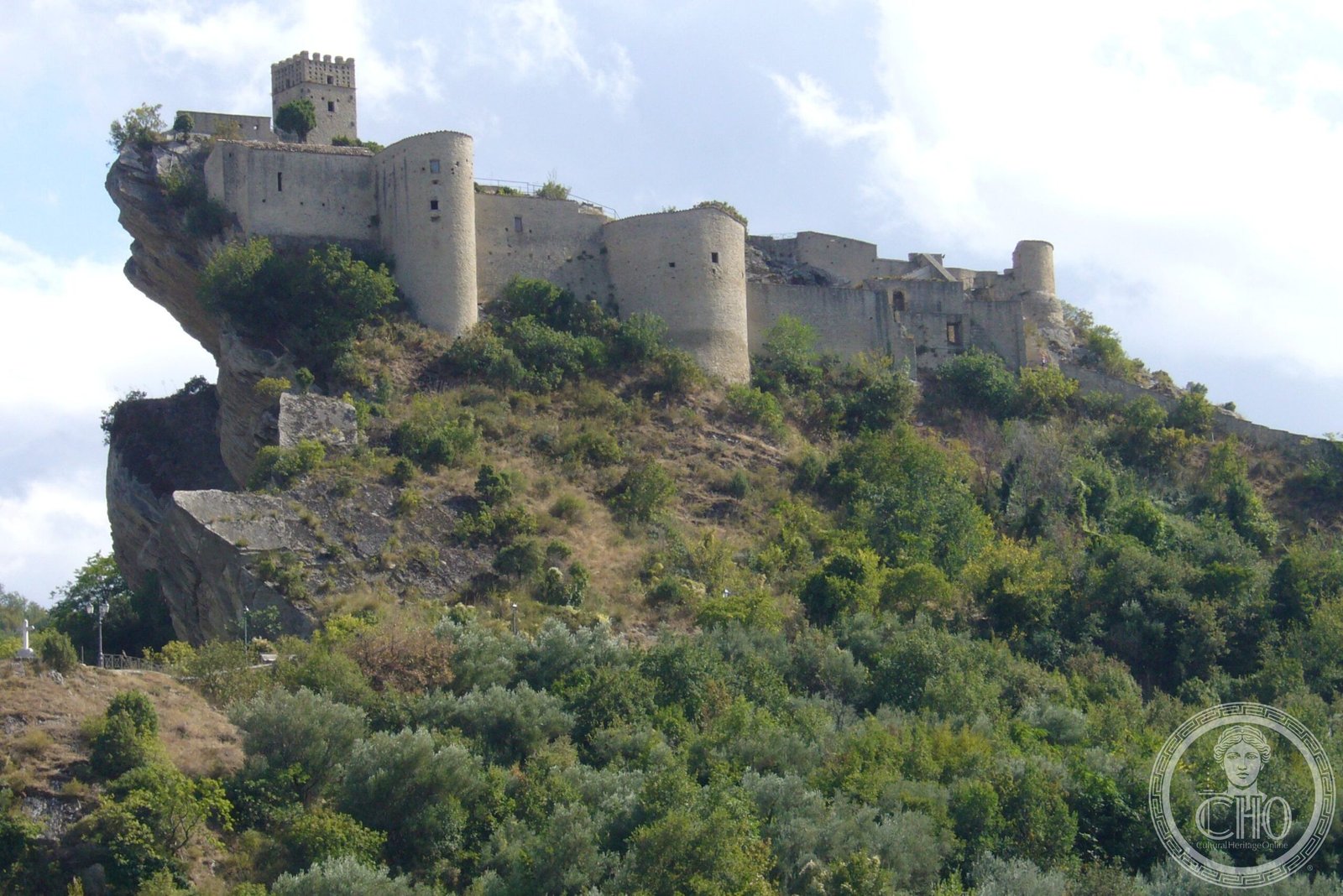
A fortified stronghold perched on a rocky outcrop above the town, transformed from a Lombard watchtower into a multi-towered defensive complex across five centuries of successive lordships.
At a glance
Roccascalegna Castle dominates the hilltop settlement of Roccascalegna in Chieti province. Rising from a natural rocky ledge, the structure evolved from humble origins into a formidable defensive post through waves of reconstruction and reinforcement. Its present form reflects centuries of strategic adaptation and aristocratic patronage.
History
The castle’s foundations date to the 11th or 12th century, when a simple Lombard watchtower was enlarged into a more substantial fortification. The first documented record appears in 1525, noting restoration work already underway.
Under the Annecchino lordship, existing towers were strengthened and a circular tower was added. The most intensive building period occurred during the Carafa barony (1531–1600), when the chapel of the Most Holy Rosary was erected in 1577 and water management systems were improved.
The Corvi family’s lordship (1600–1717) brought further modifications, particularly after 1705 when the drawbridge was destroyed and defensive works at the entrance—a sentry box and protective wall—were reconstructed, as documented in notarial records. The 20th century brought decline: the Torre del Cuore collapsed in 1940. In 1985, the Croce Nanni family donated the castle to the municipality, which undertook restoration work completed in 1996.
What you see
The castle presents a composite defensive design built across multiple periods. Multiple towers of varying forms—including the distinctive circular tower added during the Annecchino period—punctuate the skyline. Sixteenth-century walls stand higher than their predecessors, though without crenellations.
The chapel of the Most Holy Rosary, erected in 1577 within the fortification, represents the religious dimension of aristocratic lordship. Later modifications include the entrance sentry box and access ramp, while the collapsed Torre del Cuore (named for its heraldic device) marked the structure’s decline before modern restoration. The castle commands views across the surrounding landscape from its elevated position.
Cultural significance
Roccascalegna Castle illustrates the evolution of defensive architecture in southern Italy, from early medieval watchtowers to sophisticated early modern strongholds. Its successive owners—from the Annecchino through the Carafa and Corvi families—shaped the structure according to contemporary military and aristocratic needs.
The castle embodies layered social history: ecclesiastical space through its chapel, feudal power through its towers, and domestic life within its walls. Its near-ruination and subsequent recovery in the late 20th century reflect broader patterns of heritage preservation in rural southern Italy.
Key facts
- Address: Piazza Umberto I, 66040 Roccascalegna
- Coordinates: 42.0626167, 14.3049395
- Website: https://www.castelloroccascalegna.com/
- Phone: 335 876 7589
Practical information
The castle is now open to visitors following its restoration completion in 1996. Contact details and opening hours are available through the official website and phone number listed above.
Getting there
Roccascalegna is located in Chieti province, Abruzzo. The castle sits prominently on the hilltop above the town centre on Piazza Umberto I. Consult local transport links and parking availability before your visit.
See the place
Sources & resources
Find it on the map
See this place and what’s around it →📷 Become a Cultural Heritage Online photographer
Share your photos of places: they stay published under your name as the author. The more they're seen, the more you get noticed — and soon a contest will reward the most appreciated photos.
Log in or sign up free to add a photoIs this page about you?
This page is read by travellers and heritage enthusiasts who find it on Google. Tell us how you are connected to this place and we will take it from there.