

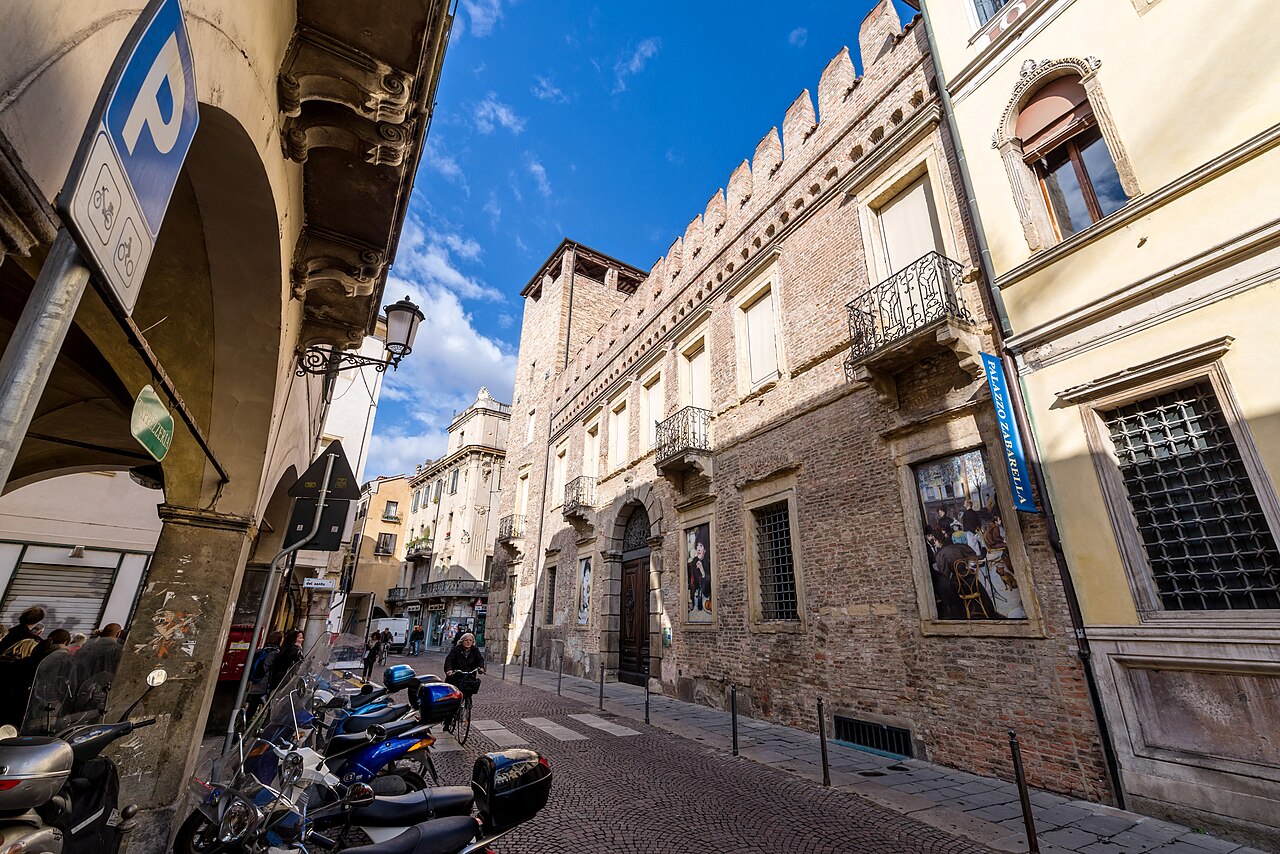
A medieval palace in Padova’s historic center, built atop Roman foundations and transformed across centuries into a cultural and commercial landmark.
At a glance
Zabarella Palace stands as a layered monument to Padovan history. Roman structures form its base; a medieval tower rises from the medieval city’s municipal period. The interiors were redecorated in the nineteenth century by three prominent artists. Today the building houses galleries and cultural institutions.
History
The palace grew on Roman remains, reaching its present form during the Middle Ages when the characteristic tower was constructed. In the early nineteenth century, Giacomo Zabarella, the family’s last direct heir, commissioned interiors by Giuseppe Borsato, Giovanni Carlo Bevilacqua, and Francesco Hayez—artists of considerable renown.
Giacomo died without issue in 1846, extinguishing his dynastic line. His widow Anna and their descendants occupied the palace for several decades before it passed to private ownership. In 1920, Credito Veneto acquired the building as its headquarters, commissioning a neoclassical hemicycle expansion in 1925.
After World War II, the palazzo housed the Società del Casino Pedrocchi, becoming a cultural gathering place for Padova’s educated elite. The company relocated in 1988, prompting nearly a decade of restoration and archaeological investigation. The palace reopened in 1996 to resume its historical role as a representative venue for commerce and cultural activity.
What you see
The palace reveals its chronological complexity. Roman masonry lies beneath; the medieval tower commands attention from the façade. Nineteenth-century painted and decorative schemes by Borsato, Bevilacqua, and Hayez remain visible in the principal rooms. The 1925 hemicycle addition, built in neoclassical vocabulary, extends the palazzo’s footprint with geometric clarity and formal restraint.
Cultural significance
Zabarella Palace documents Padova’s urban continuity from Roman times through the present. The involvement of Francesco Hayez, a master of nineteenth-century Italian painting, in its interior decoration links the building to the broader artistic currents of the era. Its twentieth-century transformation into a commercial and cultural institution reflects how historic palaces adapt to modern civic life without surrendering their heritage.
Key facts
- Address: Via Zabarella, 14, 35121 Padova
- Coordinates: 45.4060055632127, 11.879305243492125
- Website: https://www.zabarella.it/
- Phone: 049 875 3100
- Foundation: Built on Roman structures; medieval tower from the municipal period; nineteenth-century redecoration; 1925 neoclassical expansion
Practical information
The palazzo is open to the public and serves cultural functions. For current hours, admission fees, and exhibition schedules, consult the official website or call the listed number.
Getting there
Zabarella Palace is located in Padova’s historic center on Via Zabarella. The city is served by rail and road connections from Venice and other major northern Italian cities. Public parking is available near the centro storico; walking from Padova’s main station takes approximately 20 minutes.
Sources & resources
Find it on the map
See this place and what’s around it →Historical events at this place (1)
📷 Become a Cultural Heritage Online photographer
Share your photos of places: they stay published under your name as the author. The more they're seen, the more you get noticed — and soon a contest will reward the most appreciated photos.
Log in or sign up free to add a photoIs this page about you?
This page is read by travellers and heritage enthusiasts who find it on Google. Tell us how you are connected to this place and we will take it from there.