
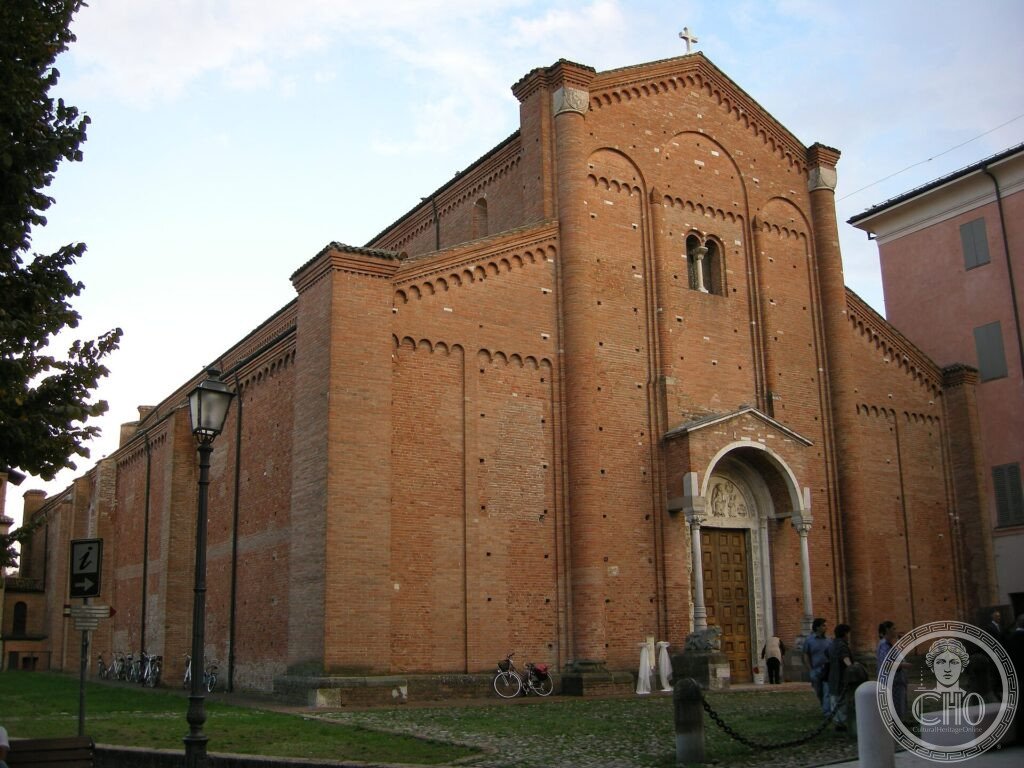
Fondata nel 752 dall'abate Anselmo (cognato di Astolfo re dei Longobardi), Nonantola divenne il grande centro monastico dell'Emilia medievale — archivio di 3.000 pergamene originali, scriptorium che produsse il Codex Nonantulanus, e custode delle reliquie di Papa Silvestro I.
At a glance
Nonantola Abbey stands in the town of Nonantola, 10 km north of Modena in the Po plain. It was founded in 752 by the nobleman Anselm (later Saint Anselm of Nonantola), brother-in-law of Aistulf, king of the Lombards, who donated land at the River Secchia for the foundation. The abbey grew rapidly under Lombard, then Carolingian, patronage to become the most important Benedictine house in the Emilian region, with vast landholdings across the Po valley and one of the richest scriptoria and libraries in northern Italy. The archive of Nonantola — over 3,000 original documents from the 8th to the 18th century, now in the Archivio di Stato di Modena — is one of the most important medieval archives in Italy. The abbey church retains a remarkable Romanesque portal of the 12th century, attributed to the school of Wiligelmus (the sculptor of the Modena Cathedral facade), depicting scenes from Genesis and the Life of Saint Sylvester.
Key facts
- Founded: 752 by Saint Anselm (Anselmo) of Nonantola, Lombard nobleman; one of the largest Benedictine houses in 8th-century Italy
- Relics: relics of Pope Sylvester I (who baptised Constantine, according to legend); also relics of Saint Adrian Martyr and other early Christian saints
- Archive: Archivio di Nonantola — over 3,000 original parchments (8th–18th century); now in Archivio di Stato di Modena; includes documents of Lombard, Carolingian and Ottonian rulers
- Codex Nonantulanus: the most important manuscript produced at the Nonantola scriptorium; a 9th-century legal compilation containing Lombard and Carolingian law
- Romanesque portal: 12th-century portal attributed to Wiligelmus school (also responsible for the Modena Cathedral facades); scenes of Genesis, Christ in Majesty, Apostles and Life of St Sylvester in high relief
- Today: active Benedictine community; church open daily; small museum in the abbey
History
The foundation by Anselm in 752 is documented by a diploma of Aistulf, king of the Lombards — one of the earliest surviving Lombard royal documents. The abbey received land from both the Lombard and later the Carolingian rulers: Charlemagne confirmed and expanded its privileges in 781, and the Carolingian connection gave Nonantola access to the finest manuscript culture of the Frankish kingdom. The scriptorium produced manuscripts in the distinctive Nonantola hand, a regional variant of the Caroline minuscule, and collected texts from across the Carolingian world; the library at its peak contained over 1,000 volumes, one of the largest in northern Italy.
The abbey was sacked by the Hungarians in 899, an event recorded with unusual precision in the annals: the monks had time to hide their most precious relics in the walls of the church, where they were recovered after the raid. Recovery from the Hungarian sack took a century; by the 11th century, under the Ottonian emperors, Nonantola was again rich enough to build the remarkable Romanesque crypt and commission the sculptural programme of the portal. The portal, attributed to the workshop of Wiligelmus (who carved the Genesis scenes on the Modena Cathedral facade c. 1099–1106), is the finest Romanesque carving in the territory and the chief visual monument of the abbey today.
What you see
The abbey church facade has been much rebuilt over the centuries, but the Romanesque portal is substantially intact: a recessed archivolt decorated with geometric patterns frames the lintel and the tympanum, which shows Christ in Majesty between the Virgin and Saint Adrian, with the Apostles ranged in two groups beneath. The side panels show scenes from Genesis (Expulsion from Paradise, Cain and Abel) and from the Life of Saint Sylvester. The crypt, below the main nave, retains columns with Lombard and late-antique capitals; the atmosphere is austere, with the tombs of the early abbots in niches along the walls. The small abbey museum contains parchments (facsimiles), liturgical objects, and a section on the scriptorium tradition.
Practical information
- Opening hours: church daily 08:30–12:00 and 15:00–18:00; museum Tue–Sun morning
- Admission: church free; museum charged
- Time needed: 45 minutes to 1 hour
Getting there
By car from Modena (10 km north): SP255. By bus from Modena (local SETA service, 20 min). GPS: 44.6770° N, 11.0409° E.
Nearby
- Modena Cathedral — Wiligelmus portal and Ghirlandina tower (UNESCO), 10 km south; compare the two Romanesque sculptural programmes
- San Benedetto Po — the other major Benedictine house of the Po plain (Polirone), 40 km north-east
Sources
- Wikipedia — “Nonantola Abbey” (en.wikipedia.org/wiki/Nonantola_Abbey)
- Archivio di Stato di Modena — Fondo Nonantola
- Benedettini di Nonantola — official website
Find it on the map
See this place and what’s around it →
📷 Become a Cultural Heritage Online photographer
Share your photos of places: they stay published under your name as the author. The more they're seen, the more you get noticed — and soon a contest will reward the most appreciated photos.
Log in or sign up free to add a photoIs this page about you?
This page is read by travellers and heritage enthusiasts who find it on Google. Tell us how you are connected to this place and we will take it from there.