
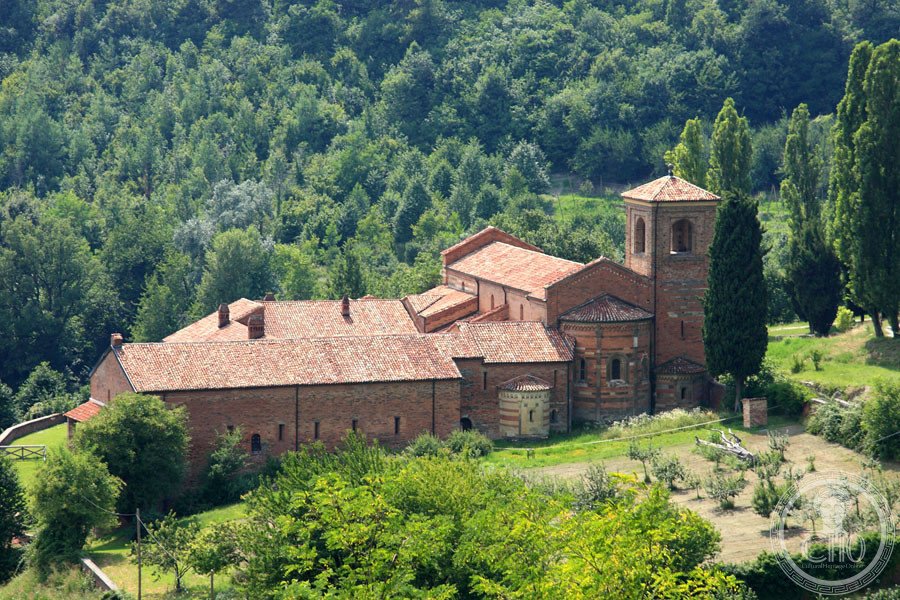
On a hill of the Monferrato, among vineyards and oaks, survives the finest Romanesque rood screen in Piedmont: a sculpted wall dividing nave from choir in the abbey of Vezzolano, with figures of apostles and prophets of a quality comparable to the great French Cistercian workshops of the twelfth century.
At a glance
Vezzolano Abbey stands on a gentle hill above the village of Albugnano in the Monferrato hills, 30 km east of Turin and 20 km north-west of Asti. The present Romanesque church was built in the 12th century, replacing an earlier foundation that tradition attributes — with obvious legendary elaboration — to Charlemagne, who supposedly built it in 773 as a votive offering after experiencing a divine vision on the hill. The church is Augustinian in use (Canons Regular of St Augustine, not Benedictine) and stands as the finest surviving example of Romanesque religious architecture in Piedmont. Its most remarkable feature is the pontile — a rood screen or choir barrier dividing the nave from the chancel — carved with a narrative frieze of the Adoration of the Magi and prophets, executed in the late 12th century with a plastic quality and spatial sophistication that places it among the most important Romanesque sculptural programmes in northern Italy. The cloister, with its double columns and carved capitals, is substantially intact.
Key facts
- Founded: Charlemagne tradition 773 (legendary); actual foundation documents from 11th century; present church built mid-12th century.
- Order: Augustinian Canons (Canons Regular of Saint Augustine, not Benedictine) — the only major Augustinian house in Piedmont from this period.
- Pontile (rood screen): late 12th-century sculptural screen dividing nave from chancel; lower tier depicts the Adoration of the Magi with Virgin and prophets; upper tier has blind arcading with busts of Apostles; one of the finest Romanesque reliefs in Piedmont.
- Facade: three-tier Lombard Romanesque facade with blind arcades, a projecting porch with carved capitals, and a large rose window; comparable to the Lombard churches of Pavia and Novara.
- Cloister: 12th-century, substantially intact; double columns with carved capitals depicting foliage, animals, and narrative scenes.
- Today: deconsecrated; managed by the Ministry of Culture (Direzione regionale Musei Piemonte); open Tue–Sun; small museum in the former abbey rooms.
History
The Charlemagne legend at Vezzolano is one of the richest in Piedmont: the king, according to the 12th-century chronicle, was hunting in the Monferrato hills when he experienced a divine vision of the Trinity and the Virgin on the hilltop of Vezzolano. Overcome by the vision, he dismounted and founded an oratory on the spot. The story is almost certainly fabricated — no Carolingian foundation documents survive for Vezzolano, and the historical Charlemagne is unlikely to have visited the Monferrato in the relevant years — but it reflects the powerful status of Carolingian foundation as a legitimating narrative for monastic houses in the region. The first genuine documentary evidence for the abbey dates from the 11th century, when the house was already Augustinian.
The building of the present church in the 12th century coincides with a period of intense activity in Piedmontese Romanesque architecture, when stonemasons from Lombardy (the Magistri Comacini) were building or rebuilding churches throughout the Po plain. The pontile of Vezzolano is the supreme product of this Lombard-Piedmontese sculptural tradition in the region: a sophisticated narrative programme that appears to draw on both French Cistercian models (the figure style of the prophets) and Lombard technical traditions (the treatment of the architectural frame). After the suppression of the Augustinian community in the Napoleonic period, the abbey passed through private ownership before being acquired by the Italian state in 1939; since 2014 it has been managed by the Ministry of Culture (Direzione regionale Musei Piemonte).
What you see
The approach from the car park below offers a clear view of the three-tier facade: blind arcades at ground level, a gallery of arched openings at the second tier, and a large rose window above. The porch, slightly projecting, rests on columns with elaborately carved capitals. The interior of the church leads immediately to the pontile — an imposing wall of pale stone that blocks the view to the chancel and creates the semi-darkness of the nave that is characteristic of the Romanesque church plan. The carvings on the rood screen are the key object: the lower register shows the Adoration of the Magi in high relief, with the three kings in elaborate court costume offering gifts to the Virgin and Child; flanking prophets hold unfurled scrolls with texts from their prophecies; the upper register has blind arcading with busts of the twelve Apostles in roundels. The quality of carving — the drapery folds, the variety of posture, the spatial depth achieved in high relief — is far above the provincial norm for the region.
The cloister, reached through a door from the nave, is intact on three sides: double columns with carved capitals, a central well, and above the east walk a loggia with paired windows overlooking the Monferrato hills. The view from the cloister — vineyards, hills, the occasional stone tower — is characteristic Piedmontese rural landscape.
Practical information
- Opening hours: Tue–Sun 09:00–13:00 and 14:00–18:00 (summer); 09:00–12:30 and 14:00–17:00 (winter); closed Monday.
- Admission: charged (regional heritage site); check current tariff.
- Managed by: Ministero della Cultura – Direzione regionale Musei Piemonte (not an active monastery).
- Best season: spring and autumn; the surrounding vineyards (Freisa d’Asti DOC) are spectacular in October.
- Time needed: 1–1.5 hours.
Getting there
By car from Turin (30 km east): SP6 to Albugnano; last 2 km on a narrow hill road. By car from Asti (20 km north-west): SS457 to Pino d’Asti, then SP road to Albugnano. No public transport to the abbey. GPS: 45.1149° N, 8.0126° E.
Nearby
- Asti — the Palio town with the medieval Torre Troyana and Battistero di San Pietro, 20 km south-east.
- Chieri — the textile-industry town with Gothic cathedral, 10 km west.
- Colli del Monferrato — the UNESCO wine landscape (Barbera d’Asti, Freisa, Grignolino) surrounding the abbey; wine estates visible from the cloister.
Sources
- Wikipedia — “Abbey of Vezzolano” (en.wikipedia.org/wiki/Abbey_of_Vezzolano).
- Roberto Bossaglia et al., Il Romanico in Piemonte, Fondazione Cassa di Risparmio di Torino, 1992.
- Regione Piemonte — official site (regione.piemonte.it/abbazia-vezzolano).
- Giovanni Romano (ed.), Piemonte romanico, Fondazione Cassa di Risparmio di Torino, 2002.
Find it on the map
See this place and what’s around it →📷 Become a Cultural Heritage Online photographer
Share your photos of places: they stay published under your name as the author. The more they're seen, the more you get noticed — and soon a contest will reward the most appreciated photos.
Log in or sign up free to add a photoIs this page about you?
This page is read by travellers and heritage enthusiasts who find it on Google. Tell us how you are connected to this place and we will take it from there.