
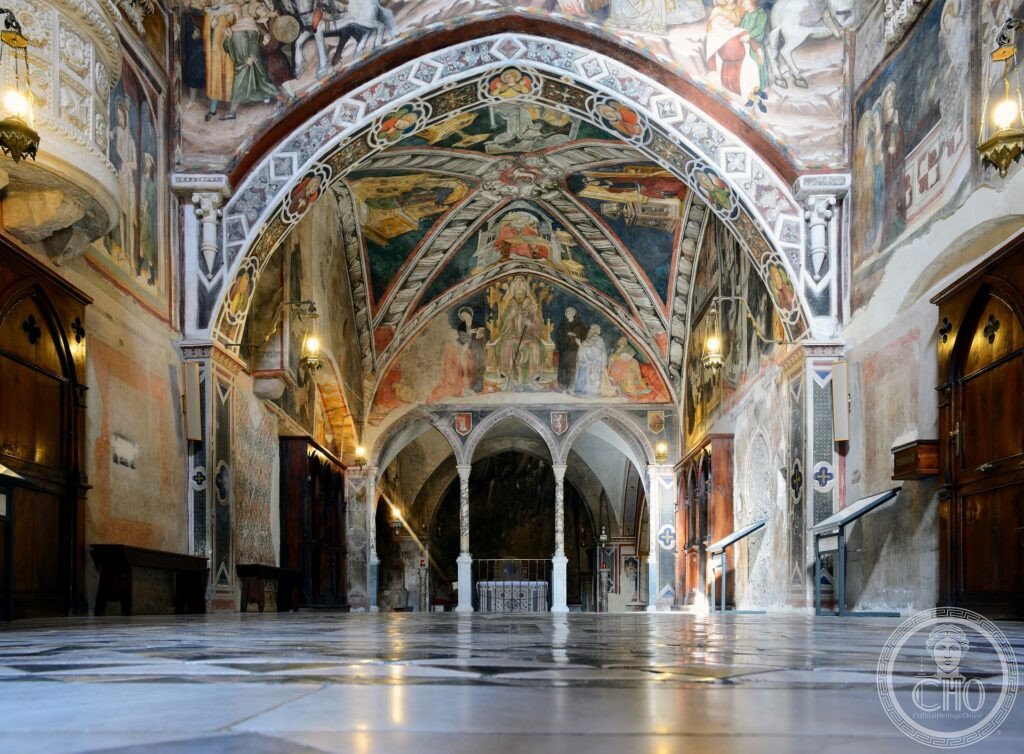
Before founding Montecassino, Benedict of Nursia took refuge for three years in a cave above the Aniene — that cave is still there, hinged into a medieval monastery on five levels that climbs the rock face like a house of the spirit hung above the gorge of the stream.
At a glance
The Sacro Speco (Holy Cave) is a Benedictine monastery built into a cliff above a gorge of the River Aniene at Subiaco, 70 km east of Rome. It is the most ancient site in Benedictine monasticism: according to Gregory the Great’s Dialogues, the young Benedict of Norcia came to Subiaco around 500 AD after fleeing the pleasures of student life in Rome and lived as a hermit in a cave above the gorge for three years, fed by a monk named Romanus from the monastery above. On this cave — the Speco (from Greek σπήλαιον) — the complex of monastery and church was progressively built from the 10th century onward. The present buildings occupy five levels of the cliff face, the lower church enclosing the cave itself; the upper church has a remarkable cycle of 13th-century frescoes (including the earliest-known portrait of Saint Francis of Assisi, painted from life around 1220), and the cloister hangs above the gorge with a view of exceptional drama. The monastery is still inhabited by Benedictine monks.
Key facts
- Holy Cave: the hermitage of Saint Benedict, c. 500–503 AD; the Speco itself is enclosed in the lower church; contains a statue of Benedict carved by Raggi (17th c.) and the original rock where he slept.
- Monastery complex: built progressively from 10th century; five building levels on the cliff face; upper and lower churches, cloister, grottoes.
- Portrait of Saint Francis: fresco in the upper church, c. 1220, attributed to Conxolus; the earliest surviving portrait painted from life — Francis is shown without halo, as he was still living when it was made.
- Frescoes: 13th century (lower church, attributed to Conxolus) and 14th century (upper church); unusual combination of Byzantine and Romanesque influence.
- Gregory the Great: his Dialogues (Book II, 593 AD) are the primary source for Benedict’s life at Subiaco — the first biography of Benedict.
- Today: active Benedictine monastery; open daily to visitors; guided visits on request.
History
Gregory the Great, writing 50 years after Benedict’s death, describes the young man’s three years at Subiaco with vivid detail: the cave where he slept on the bare rock, the monk Romanus who lowered bread to him on a rope with a bell to signal mealtime, the temptation overcome by rolling naked in a thorn bush (the original rose bushes, according to tradition, still bloom beside the cave). After leaving the cave, Benedict gathered disciples and founded twelve small monasteries around Subiaco before moving to Monte Cassino around 529.
The cave was venerated as a sacred site from Benedict’s own lifetime; his sister Scholastica visited him here and the first oratory was built over it shortly after his death. The progressive construction of the monastery complex on the cliff face — a building project of considerable structural ingenuity, anchoring floors and vaults into the living rock — took place mainly in the 10th to 13th centuries. The oldest printed book in Italy was produced at Subiaco: the German printers Sweynheym and Pannartz set up the first Italian printing press in the monastery of Santa Scolastica nearby in 1464 and printed the first edition of Cicero’s De Oratore — a fact that makes Subiaco a site of importance in the history of Western printing as well as Western monasticism.
What you see
The path to the Sacro Speco winds up the gorge from the car park below, giving gradually-revealed views of the monastery buildings clinging to the cliff — walls of medieval masonry seemingly anchored to the vertical rock face, the cloister balcony projecting above the void. The entry is through the upper church, decorated with 14th-century frescoes; the descent through progressively narrower corridors leads to the lower church, where the cave of Benedict is preserved behind a 17th-century baldachin. The cave itself — roughly oval, about 5 metres across — has been smoothed and decorated over the centuries, but the sense of a retreat into the rock, a withdrawal from the world into darkness and silence, is palpable.
The earliest-known portrait of Saint Francis is in a corridor of the upper church: a small fresco showing a young man without halo in a brown habit, identified by a later inscription. The absence of halo is the decisive proof of its early date — Francis was canonised in 1228, and portraits before canonisation showed no halo. The portrait was painted around 1220, while Francis was still living and apparently had visited Subiaco.
Practical information
- Opening hours: daily 09:00–12:30 and 15:00–18:00 (summer 15:00–18:30).
- Admission: free; voluntary donation.
- Combined visit: the Benedictine monastery of Santa Scolastica (site of first Italian printing press, 1464) is 800 m away; most visitors see both.
- Photography: permitted in the upper church; restricted in the cave area.
- Time needed: 1–1.5 hours.
Getting there
By car from Rome (70 km east): SS5 Tiburtina to Subiaco, then 2 km up the gorge road to the monastery car park. By bus from Rome Tiburtina station (Cotral, journey c. 1.5 hours). GPS: 41.9250° N, 13.1095° E.
Nearby
- Monastero di Santa Scolastica — the Benedictine monastery 800 m away; site of the first Italian printing press (1464, Sweynheym and Pannartz).
- Subiaco — small medieval town with civic art gallery, 3 km west.
- Abbazia di Montecassino — the monastery Benedict founded after leaving Subiaco, 120 km south.
Sources
- Wikipedia — “Sacro Speco” (en.wikipedia.org/wiki/Sacro_Speco).
- Gregory the Great, Dialogues Book II (593 AD) — primary source for Benedict’s life at Subiaco.
- Aldo Nesci, Il Sacro Speco di Subiaco, Casamari, 1990.
- Benedictine community of Subiaco — official information.
Find it on the map
See this place and what’s around it →📷 Become a Cultural Heritage Online photographer
Share your photos of places: they stay published under your name as the author. The more they're seen, the more you get noticed — and soon a contest will reward the most appreciated photos.
Log in or sign up free to add a photoIs this page about you?
This page is read by travellers and heritage enthusiasts who find it on Google. Tell us how you are connected to this place and we will take it from there.