
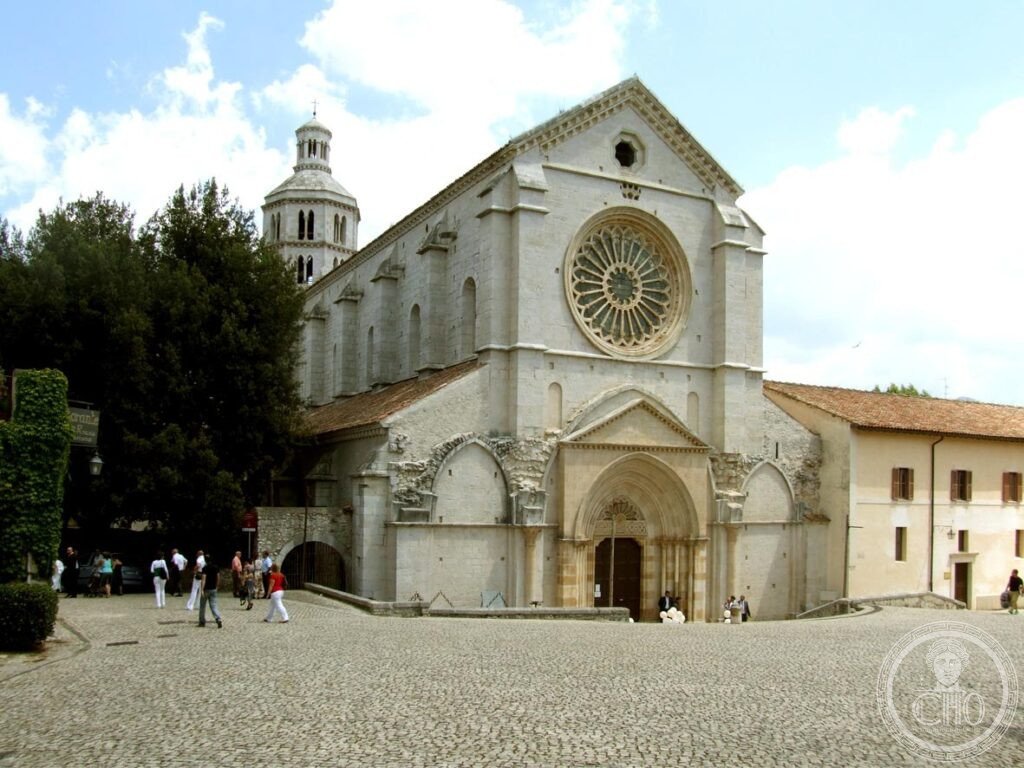
Between 1163 and 1208 the Cistercian monks of Fossanova built the first Gothic church on the Italian peninsula, a faithful copy of the Burgundian model of Clairvaux — and it was here that Thomas Aquinas, the greatest medieval philosopher, died at 49 in 1274 while carrying his answer to the pope to Lyon.
At a glance
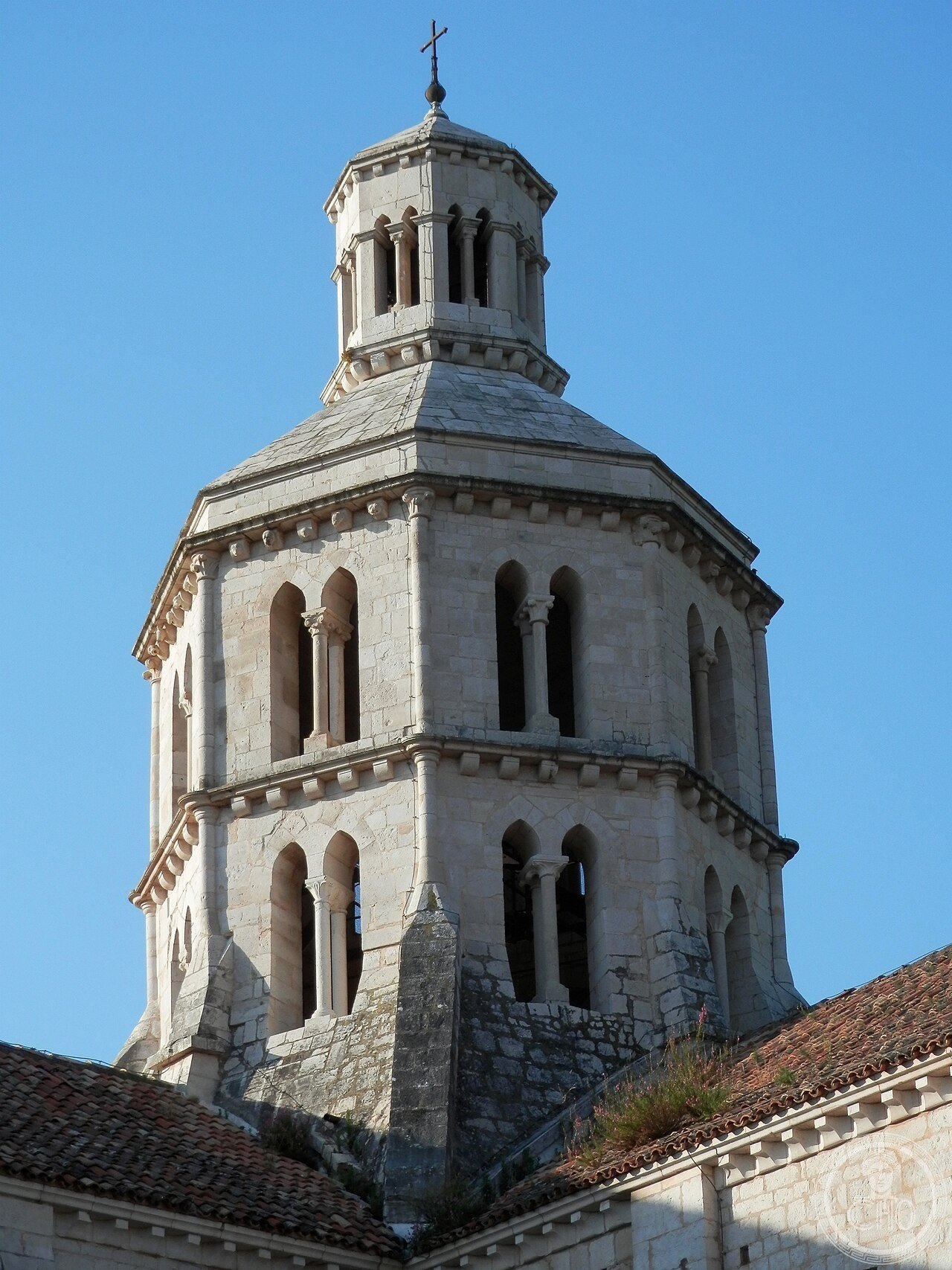
Fossanova Abbey stands in the Lazio Pontine plain near Priverno, 100 km south-east of Rome. It was established by Cistercian monks from Hautecombe in Savoy in 1135, on the site of an earlier Benedictine community, and the present church was built between 1163 and its consecration on 19 June 1208 in the presence of Pope Innocent III. It is considered the first purely Gothic church in Italy — built strictly according to the architectural rules of the Cistercian Order, which prohibited all figurative decoration, polychrome marble, towers, and any ornament not serving a structural function. The result is a building of exceptional clarity and scale: a three-nave church with pointed arches, ribbed vaulting, a lantern tower at the crossing, and lancet windows that fill the interior with cold northern light even at the height of an Italian summer. The abbey’s second claim to historical importance is that Thomas Aquinas — the greatest philosopher-theologian of the medieval West — died here on 7 March 1274, in the infirmary of the guesthouse, while travelling to the Council of Lyon with the Summa contra Gentiles.
Key facts
- Founded: 1135 by Cistercian monks from Hautecombe (Savoy); church built 1163–1208
- Consecrated: 19 June 1208 in the presence of Pope Innocent III
- Significance: considered the first Gothic church in Italy; strict Cistercian plan (no figurative ornament, no towers, no polychrome marble)
- Architect: unknown; built according to the standard Cistercian plan derived from Clairvaux and propagated by Bernard of Clairvaux’s building programme
- Thomas Aquinas: the Dominican philosopher died at Fossanova on 7 March 1274; the room of his death is preserved in the guesthouse wing; his body remained at Fossanova until 1369 when relics were transferred to Toulouse
- Today: active Cistercian monastery; church and cloister open to visitors daily
History
The Cistercian Order, founded at Cîteaux in 1098, expanded its network of daughter-houses across Europe at remarkable speed in the 12th century, largely under the influence of Bernard of Clairvaux. Each new house replicated the same simple functional plan — a church of three aisles, a chapter house, a cloister, refectory and dormitory — with strict exclusion of all ornamentation that might distract the monk from contemplation. The Fossanova community received its site from the local Frangipani family and built the church in two generations: the nave and transepts were built first (1163–1187), then the east end and the consecration completed the work in 1208.
Thomas Aquinas — born at nearby Roccasecca in 1225 and a Dominican friar since 1244 — was travelling from Naples to Lyon in early 1274, carrying a commentary on Aristotle requested by Pope Gregory X for the Council of Lyon. He fell seriously ill at the castro of Maenza and asked to be taken to the nearest monastery; the nearest was Fossanova. The monks gave him the guesthouse infirmary; he died there on 7 March 1274, aged 49. His body lay in the chapter house for some months before the monks, unwilling to give up their extraordinary possession, buried him secretly in the church. His relics were gradually dispersed: Pope Gregory XI ordered the bones transferred to Toulouse in 1369; today the skull is in the cathedral of Priverno, the hand is in Naples, and fragments are in Aquino, the town of his birth.
What you see
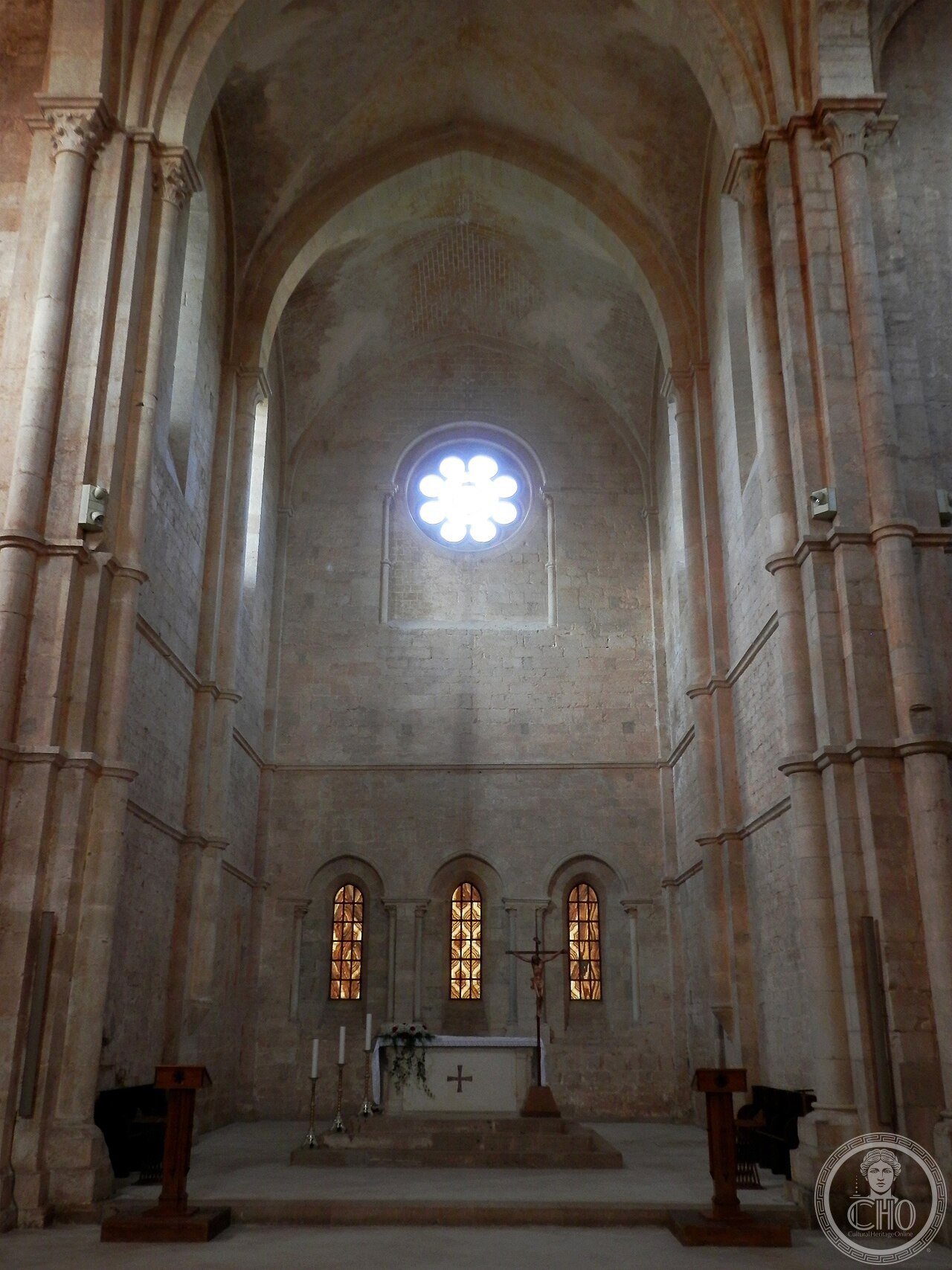
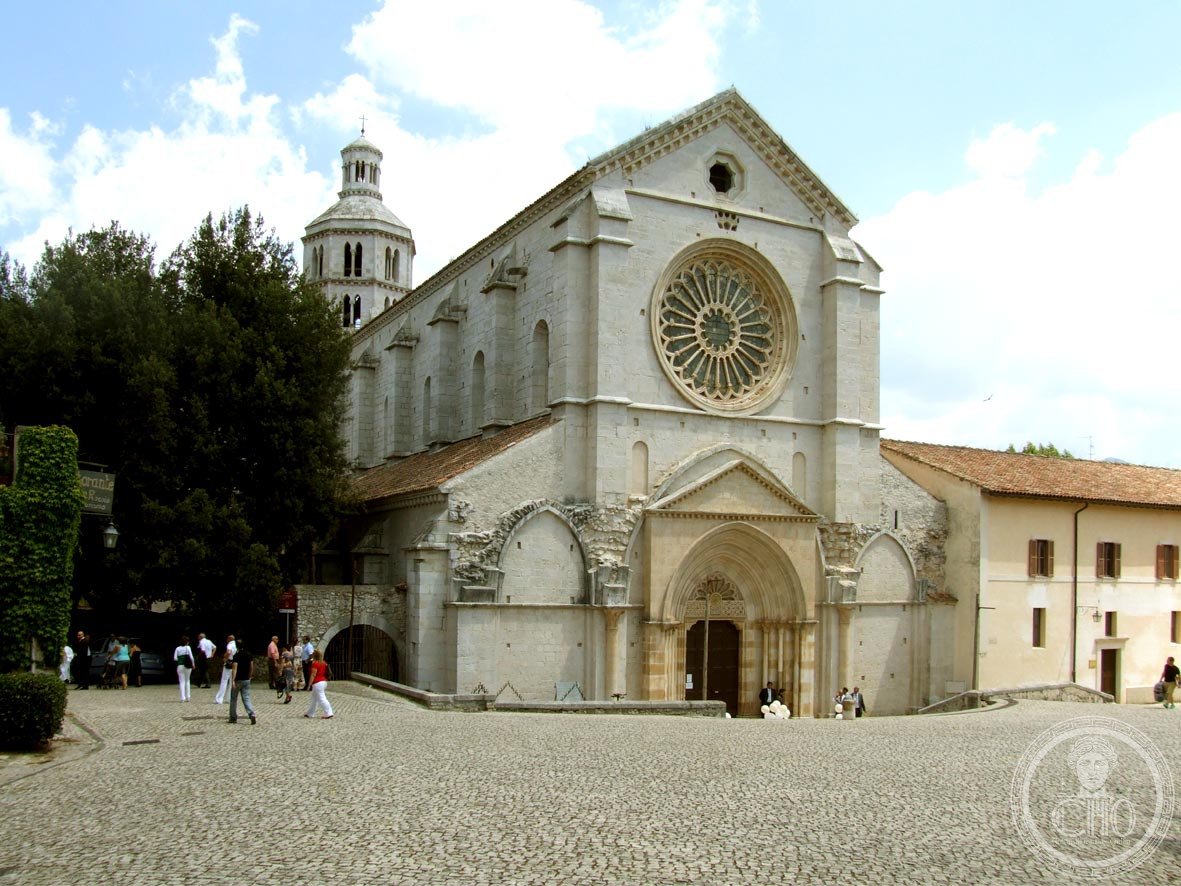
Fossanova is the most complete and best-preserved Cistercian complex in Italy — even more so than Casamari, which was built slightly later to a more evolved Cistercian plan. The three-nave church is austere to the point of severity: the pointed arches spring from plain rectangular piers, the ribs of the vaults meet in simple keystones, the windows are single lancets without tracery, the floor is undecorated stone. The only ornamental element is the small rose window in the west facade — and even this is a plain geometric composition without figurative stained glass. The effect is not austerity as privation but austerity as a deliberately achieved quality of light and space: the interior is perfectly proportioned, the rhythm of the nave bays is exact, and the light entering through the east lancets turns the presbytery into a luminous zone that reads as sacred even to visitors with no religious predisposition.
The cloister is a Romanesque-transition design with alternating single and paired columns, the arch mouldings minimal. The guesthouse wing, where Aquinas died, is visible from the cloister walk; the room of his death is marked and maintained as a place of contemplation.
Practical information
- Opening hours: daily 09:00–12:30 and 15:00–18:00 (approximately; check seasonally)
- Admission: free for church and cloister; donation box in the entrance
- Dress code: appropriate for a working monastery; shoulders and knees covered
- Time needed: 1–1.5 hours
Getting there
By car from Rome: A1 motorway south, exit Frosinone, then SS156 to Priverno/Fossanova, 100 km. By train to Priverno-Fossanova station (Rome–Napoli via Latina line), 3 km from the abbey. GPS: 41.4644° N, 13.1583° E.
Nearby
- Abbazia di Casamari — companion Cistercian abbey of almost identical plan, slightly later (1217), 30 km east at Veroli; comparing the two illustrates the development of the Cistercian building formula in Lazio
- Priverno — small medieval town with cathedral and museum, 3 km north
- Parco Nazionale del Circeo — coastal dunes, lagoons and Circeo promontory, 30 km west
Sources
- Wikipedia — “Fossanova Abbey” (en.wikipedia.org/wiki/Fossanova_Abbey)
- Wolfgang Braunfels, Monasteries of Western Europe, Thames & Hudson, 1972
- Jean-Pierre Torrell OP, Saint Thomas Aquinas Vol. 1: The Person and His Work, Catholic University of America Press, 1996
- Cistercian Heritage Network — Fossanova Abbey record
Find it on the map
See this place and what’s around it →
📷 Become a Cultural Heritage Online photographer
Share your photos of places: they stay published under your name as the author. The more they're seen, the more you get noticed — and soon a contest will reward the most appreciated photos.
Log in or sign up free to add a photoIs this page about you?
This page is read by travellers and heritage enthusiasts who find it on Google. Tell us how you are connected to this place and we will take it from there.