
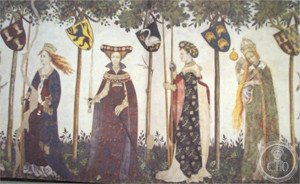
In the baronial hall of the castle of Manta, two fresco cycles of 1415–1430 preserve intact the roll of the Nine Worthies and Nine Heroines of the international chivalric cycle: sixty life-size figures in courtly dress, and a Fountain of Youth into which the old step and out of which the young come.
At a glance
Castello della Manta stands on a rocky spur above the village of Manta, in the Varaita valley south of Saluzzo in Cuneo province, Piedmont. A military tower existed here from the 12th century; the current residential castle was built by the Marquises of Saluzzo in the 14th century and enlarged in the 15th. Its exceptional importance lies in two fresco cycles in the Sala Baronale, painted around 1415–1430 by an unknown master in a style that combines the International Gothic of the Lombard courts with French and Burgundian chivalric iconography. The main cycle depicts the Nine Worthies (Neuf Preux) — the nine greatest warriors of history (three pagan, three Hebrew, three Christian) — and their female counterparts the Nine Heroines (Neuf Preuses), sixty life-size figures in courtly dress standing in an imaginary forest. The companion fresco shows a Fountain of Youth: old men and women arrive on carts, bathe in the fountain, and emerge as young people — one of the most complete survivals of this popular medieval allegory in Italy. Since 1990, the castle has been managed by the Fondo Ambiente Italiano (FAI), which restored the frescoes and opened the castle to public visits.
Key facts
- Castle built: 12th-century tower; residential castle 14th century; enlarged by Valerano di Saluzzo c. 1420
- Frescoes: Sala Baronale cycle, c. 1415–1430; painter unknown; International Gothic; attributed to Giacomo Jaquerio school
- Nine Worthies cycle: the Neuf Preux (Hector, Alexander, Julius Caesar / Joshua, David, Judas Maccabaeus / Arthur, Charlemagne, Godfrey of Bouillon) and nine female counterparts (Neuf Preuses) — sixty life-size figures
- Fountain of Youth: full-wall fresco; one of the best-preserved examples of this medieval allegorical theme in Italy
- FAI: managed by the Fondo Ambiente Italiano since 1990; restored frescoes and opened to public
- Garden: terraced Italian garden restored by FAI; herb garden and orchard in the lower court
History
The Marquises of Saluzzo were one of the most cultivated courts of late medieval Piedmont, positioned between the cultural worlds of France-Burgundy and Lombard Italy. Valerano di Saluzzo (1405–1416), natural son of Thomas III of Saluzzo, undertook the enlargement of the castle and almost certainly commissioned the fresco cycle in the Sala Baronale as part of a programme to project the Saluzzo court as a centre of chivalric culture. The thematic choice — the Nine Worthies, the Fountain of Youth — was a standard programme of International Gothic courtly decoration, documented in the same years at the courts of Berry, Burgundy, and the Visconti; the specific iconographic details (the naming of the Heroines, the landscape background, the fountain’s crowded narrative detail) suggest a painter who had worked in both French and Lombard court environments.
The Marquises of Saluzzo were absorbed by France in 1548 and by Savoy in 1601; the castle passed through various owners before ending in the hands of the Della Rovere and then the Saluzzo-Paesana family, who held it until 1990. The fresco conservation had been a problem for decades — damp and salt deposits had damaged sections of the painting — when the FAI purchased the castle and undertook a comprehensive restoration campaign that stabilised the surfaces and returned the colours to something approaching their 15th-century intensity.
What you see
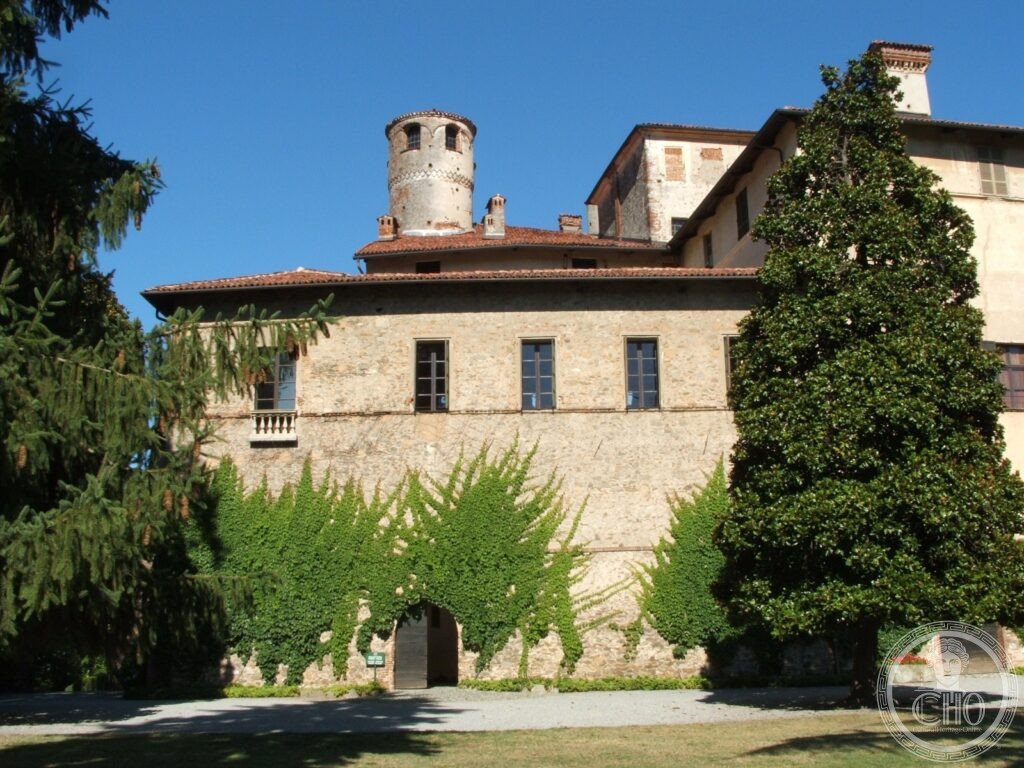
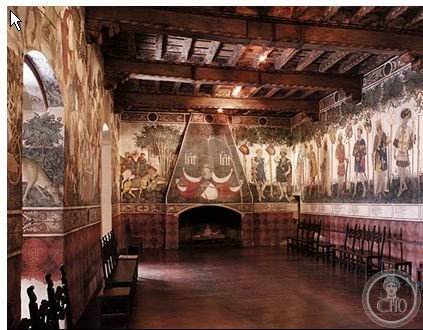
The castle presents a relatively compact exterior — a tower keep from the 12th century with 14th and 15th-century residential wings built around an irregular courtyard. The exterior is plain Piemontese military architecture of pale stone; the surprise is entirely interior. The Sala Baronale occupies the full length of the main residential wing on the first floor: a long room with a painted wooden ceiling and four windows giving onto the valley toward Monviso. The frescoes cover three walls to a height of about 4 metres: on the long wall, the sixty life-size figures of the Worthies and Heroines stand in pairs in a continuous meadow with a sky behind them; on the end wall, the Fountain of Youth fills the entire surface.
The quality of the painting is extraordinary for a provincial Italian court: the figures are carefully differentiated in costume (Hector in Trojan armour; Arthur in heraldic surcoat; the Heroines in fashionable International Gothic court dress with elaborate headdresses); the Fountain of Youth is packed with narrative incident — the arrival of the elderly on horseback and in carts, the bathing figures, the emergence of the young from the other side of the fountain basin, attendants with towels and garments. The gold and ultramarine that still remain in the better-preserved sections suggest how rich the original colouring was.
Practical information
- Opening hours: Tuesday–Sunday 10:00–17:00 (winter); 10:00–18:00 (summer); closed Mondays; check FAI calendar for seasonal variations
- Admission: FAI ticket; discounts for FAI members and under-18; booking recommended for groups
- Best season: year-round; the frescoes are an indoor attraction so weather is irrelevant; garden best in spring
- Time needed: 1.5 hours for the full castle visit including Sala Baronale
- Photography: permitted in the garden; restricted in the Sala Baronale to protect the frescoes
Getting there
By car from Cuneo (18 km): SS589 to Saluzzo, then SP461 to Manta. By bus from Saluzzo (local bus to Manta, 3 km). By train to Saluzzo station, then taxi or local bus. GPS: 44.5872° N, 7.4819° E.
Nearby
- Saluzzo — medieval marchional capital with castle, cathedral and historic centre, 3 km north
- Abbazia di Staffarda — 12th-century Cistercian abbey in the plain below, one of the best-preserved in Piedmont, 8 km
- Monviso — the “Stone King” summit (3841 m), visible from the castle; trailhead for the Monviso circuit, 35 km
Sources
- Wikipedia — “Castello della Manta” (en.wikipedia.org/wiki/Castello_della_Manta)
- FAI Fondo Ambiente Italiano — Castello della Manta (fondoambiente.it/luoghi/castello-della-manta)
- Enrica Pagella, I Prodi e le Prode: affreschi del Castello della Manta, Civiche raccolte d’arte, Torino, 1997
- Liana De Girolami Cheney, “The Nine Worthies and Their Heroines in the Castello della Manta,” Medievalia et Humanistica, 2005
Find it on the map
See this place and what’s around it →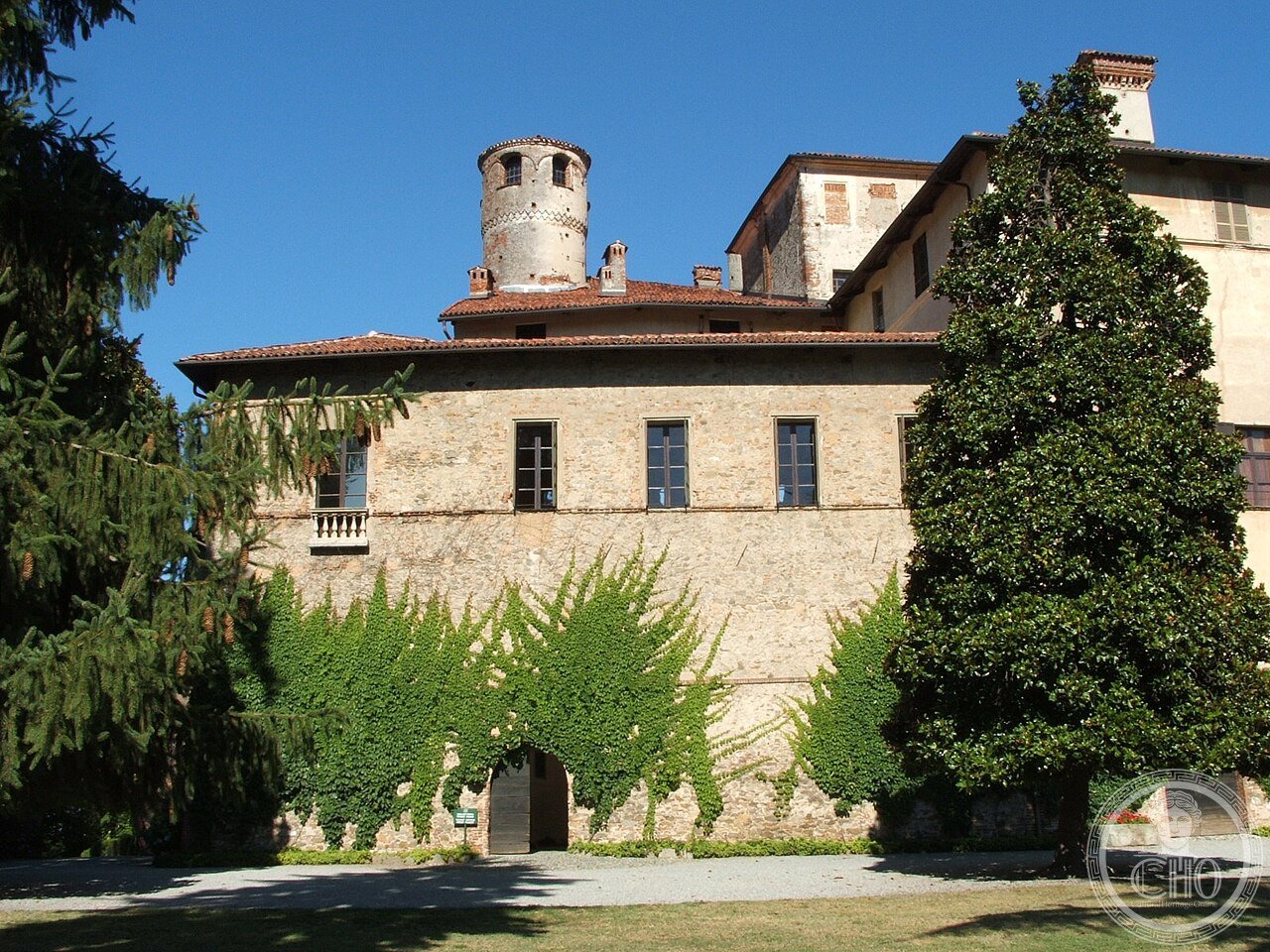
📷 Become a Cultural Heritage Online photographer
Share your photos of places: they stay published under your name as the author. The more they're seen, the more you get noticed — and soon a contest will reward the most appreciated photos.
Log in or sign up free to add a photoIs this page about you?
This page is read by travellers and heritage enthusiasts who find it on Google. Tell us how you are connected to this place and we will take it from there.