
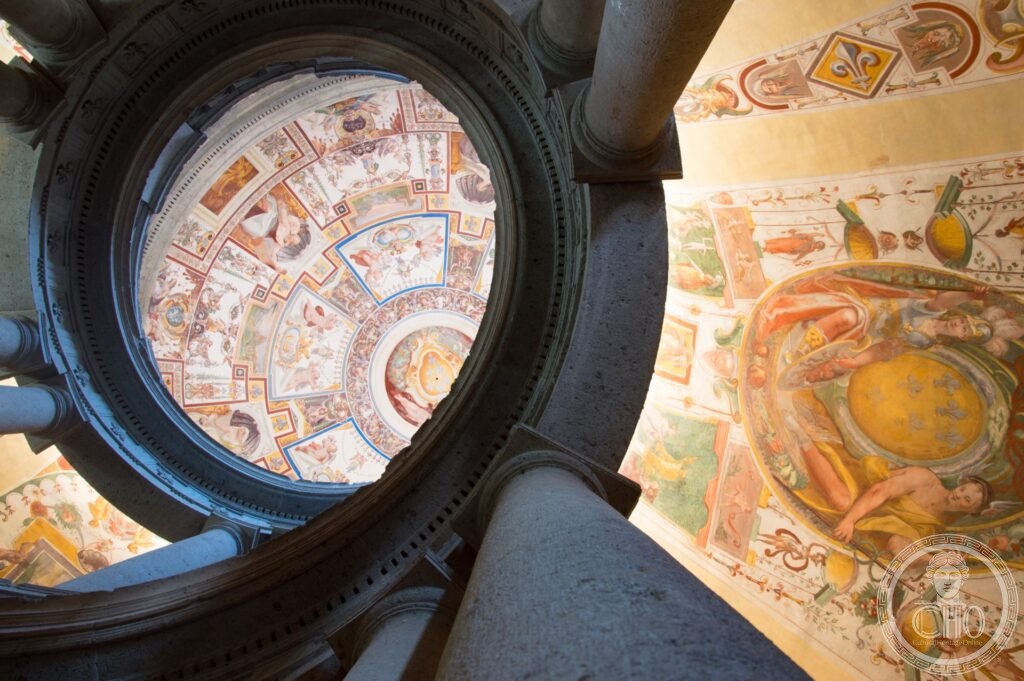
Cardinal Alessandro Farnese asked Vignola to build a villa worthy of the most powerful family in Italy: what came of it was a pentagonal fortress turned into a palace of delights, with a spiral staircase that is an absolute masterpiece in its own right.
At a glance
Palazzo Farnese at Caprarola stands on a hillside above the small town of Caprarola in northern Lazio, 50 km north of Rome. Designed by Jacopo Barozzi da Vignola between 1559 and 1573 for Cardinal Alessandro Farnese — grandson of Pope Paul III and one of the wealthiest men in 16th-century Europe — it is built on the pentagonal foundations of an earlier Sangallo military fortress, a plan Vignola converted into five linked apartments of state around a circular cortile. The interior is entirely frescoed: the Sala del Mappamondo (Room of the Map of the World), the Sala dei Fasti Farnesiani (Room of the Farnese Glories), and the Sale dei Mesi (Rooms of the Months) were decorated between 1562 and 1575 by Taddeo and Federico Zuccari and their workshop in cycles of exceptional ambition. Above the cortile rises Vignola’s masterpiece of spatial invention, the Scala Regia — a helical staircase of perfect circular form, its vault frescoed to appear as an open sky.
Key facts
- Architect: Jacopo Barozzi da Vignola (1507–1573), designed 1559; construction continued by Giacomo della Porta
- Patron: Cardinal Alessandro Farnese (1520–1589), grandson of Pope Paul III; the wealthiest Italian cardinal of his generation
- Plan: pentagonal, on Sangallo’s earlier fortress foundations; circular cortile in the centre
- Frescoes: Taddeo Zuccari (c. 1562–1566) and Federico Zuccari (c. 1566–1575) and workshop; Sala del Mappamondo, Sala dei Fasti Farnesiani, Sale dei Mesi
- Scala Regia: helical staircase with 30 paired Doric columns, vault frescoed as a sky with figures by A. Tempesta (1583)
- Garden: two formal gardens — the Summer Garden (Giardino d’Estate) and the Winter Garden — on the hillside behind the palace; designed by Vignola with later additions
History
The Farnese had owned the hilltop of Caprarola since 1504, and Pope Paul III (Alessandro Farnese senior) had commissioned Antonio da Sangallo the Younger to begin a pentagonal fortress there in 1521. The project was abandoned after Paul III’s election. His grandson Cardinal Alessandro, who inherited the property in 1534, revived the project on Sangallo’s foundations — but transformed its purpose: instead of a military fortress, he wanted a summer palace that would express the cultural and political power of the Farnese dynasty at its zenith. Vignola received the commission in 1559, aged 52, at the peak of his career.
Vignola’s solution — keeping the pentagonal plan but inserting a circular cortile within it — is the central architectural invention. The circle within the pentagon creates a dynamic tension: the cortile reads as perfectly balanced from within, while the outer facades acknowledge the irregular five-sided geometry. The Scala Regia, inserted in one of the pentagonal wings, is the purest expression of Vignola’s spatial intelligence: 30 paired Doric columns arranged in a continuous helix, rising three full turns above a balustrade that seems to float. Federico Zuccari painted the vault’s trompe-l’oeil sky in 1583, ten years after Vignola’s death.
The Farnese dynasty ended in 1731 when the last Farnese duke died without heirs; the palazzo passed to the Bourbon kings of Naples and eventually to the Italian state. Today it is managed by the Polo Museale del Lazio as a museum.
What you see
The approach from the town below is itself a designed experience: a long ramp lined with herms leads up from the piazza to the palazzo entrance, gradually revealing the five-sided mass above. The cortile, entered through a rusticated gateway, is a circular space of great calm — two tiers of loggia with Doric and Ionic orders, the upper one partially open to the sky. From the cortile, the Scala Regia rises in one wing: entering it, you are in a helical space that defies your sense of up and down as you spiral upward between the columns.
The frescoed rooms on the piano nobile are among the most complete examples of Mannerist interior decoration in Italy. The Sala del Mappamondo shows the world as the Farnese knew it — the coastlines of Europe, Africa and the Americas mapped with impressive accuracy for 1574 — while the Room of the Farnese Glories depicts the dynasty’s history in narrative panels of considerable sophistication. The Summer Garden behind the palace, reached through a garden gate on the hillside, has two circular fountains, a water cascade and a bosco — a miniature of the Villa Lante programme in a more restrained key.
Practical information
- Opening hours: Tuesday–Sunday 08:30 to 19:30 (summer); 08:30 to 16:30 (winter); closed Mondays
- Admission: entrance fee; combined Lazio museum card
- Best season: spring and autumn for garden; summer for full opening hours
- Time needed: 2–2.5 hours for palazzo interior + gardens
- Guided tours: available in Italian and English; advance booking recommended in peak season
Getting there
By car from Rome: A1 motorway north, exit Attigliano or Viterbo; Caprarola is on the SP17, 55 km from Rome. By bus from Viterbo (Cotral lines) or from Rome Saxa Rubra (suburban bus). GPS: 42.3269° N, 12.1757° E.
Nearby
- Villa Lante a Bagnaia — the finest Italian Mannerist garden, by the same architect Vignola, 25 km north-east
- Lago di Vico — volcanic crater lake and nature reserve, 5 km east; excellent bird habitat
- Viterbo — medieval papal city, 20 km north
Sources
- Wikipedia — “Villa Farnese, Caprarola” (en.wikipedia.org/wiki/Villa_Farnese,_Caprarola)
- Loren Partridge, The Art of Renaissance Rome, Abrams, 1996
- Polo Museale del Lazio — Palazzo Farnese di Caprarola
- James Ackerman, The Villa: Form and Ideology of Country Houses, Thames & Hudson, 1990
Find it on the map
See this place and what’s around it →📷 Become a Cultural Heritage Online photographer
Share your photos of places: they stay published under your name as the author. The more they're seen, the more you get noticed — and soon a contest will reward the most appreciated photos.
Log in or sign up free to add a photoIs this page about you?
This page is read by travellers and heritage enthusiasts who find it on Google. Tell us how you are connected to this place and we will take it from there.