
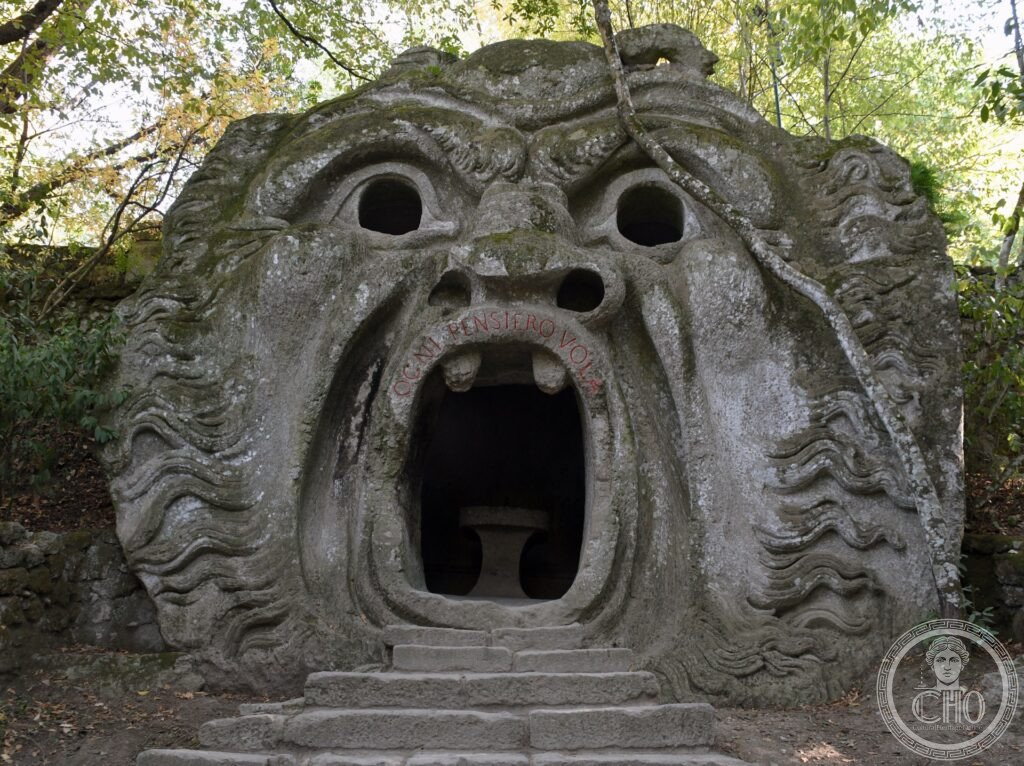
Vicino Orsini built among the chestnut trees of the Cimino seventeen sculptures of colossal monsters in volcanic peperino — an allegorical labyrinth with no known solution, which has driven critics and visitors to distraction from 1552 to today.
At a glance
The Sacro Bosco (Sacred Wood) of Bomarzo, also known as the Parco dei Mostri (Monster Park), occupies a wooded valley below the hilltop town of Bomarzo, near Viterbo. Commissioned by Pier Francesco “Vicino” Orsini, a condottiere and Mannerist poet, beginning around 1552, the garden contains seventeen colossal sculptures carved directly from the local peperino volcanic rock: monsters, giants, caryatids, a tilted house, a sphinx, an elephant crushing a Roman soldier, a dragon fighting lions, and a temple dedicated to Orsini’s dead wife Giulia Farnese. Unlike any other Renaissance garden, it has no central axis, no fountain sequence, no parterre — only a winding path through woodland from one inexplicable sculpture to the next. The garden’s inscription proclaims “sol per sfogare il core” (only to relieve the heart) and “voi che pel mondo gite errando vaghi” (you who wander the world seeking marvels). In the 20th century it was rediscovered by Salvador Dalí and the Surrealists as a proto-Surrealist landscape.
Key facts
- Created: c. 1552–1584 by Pier Francesco “Vicino” Orsini (1523–c. 1585), condottiere and humanist
- Location: woodland valley below Bomarzo, 15 km north-east of Viterbo
- Material: peperino — a soft grey-brown volcanic tuff quarried on site; the sculptures were carved directly from natural rock outcrops
- Sculptor: likely Simone Moschino (attributed) or workshop; Orsini himself may have designed the programme
- Key sculptures: Orco (monster mouth-cave, with inscription); Elefante with Roman soldier; Drago; Tartaruga (giant turtle with figure); Casa pendente (tilted house); Tempietto Orsini
- Modern fame: rediscovered by Salvador Dalí in the 1940s; visited by Jean Cocteau; inspiration for 20th-century land art and Surrealism
History
Pier Francesco Orsini, known as Vicino, was a soldier from the Roman noble house of Orsini who saw action in the wars of Charles V. Returning to his estate at Bomarzo after the Battle of Mühlberg in 1547, he began laying out his garden in the valley below the hilltop castle. The programme — if it has one — has never been satisfactorily decoded. Scholars have proposed readings based on Ariosto’s Orlando Furioso, on Orsini’s grief for his dead wife Giulia Farnese, on Neoplatonic philosophy, on Rabelaisian humour, on alchemical allegory, and on simple caprice. Orsini himself left only cryptic inscriptions carved into the sculptures and letters to his friend Annibale Caro that describe the project without explaining it.
What is clear is that the garden was a deliberate anti-garden: Orsini refused the axis, the parterre, the hierarchy, and the allegorical legibility that Vignola was simultaneously achieving at Villa Lante. Instead, the path through the bosco is a sequence of shocks — you turn a corner and meet a colossal face with a doorway for a mouth and “lasciate ogni speranza” above it; you find a tilted house that makes your body feel drunk; you discover a dragon fighting two lions in a clearing. The garden has been continuously private property, falling into ruin in the 17th and 18th centuries before the Bettini family restored and opened it to visitors in 1954.
What you see
The path winds through mature chestnut and oak woodland, the sculptures emerging at irregular intervals from the undergrowth — sometimes half-buried, sometimes draped with moss, always overscaled relative to the human body. The monster mouth (Orco) is the most famous: a bearded face 4 m high with an open mouth large enough to enter, the lower jaw serving as a bench and table, the inscription above reading “ogni pensiero vola” (all thought takes flight). The elephant crushing the Roman soldier — a reference to Hannibal’s war elephants — carries a castle tower on its back and is precise enough in its carving to show the folds of the soldier’s toga.
The Tempietto at the garden’s end is the most formally classical element: a circular domed temple dedicated to Giulia Farnese, Orsini’s wife who died in 1555. Its sober Roman geometry is a deliberate contrast with the monsters surrounding it — grief made into architecture after disorder made into sculpture.
Practical information
- Opening hours: daily from 08:30 to sunset (last entry 1 hour before closing)
- Admission: private property; ticket at gate; check current price at bomarzo.net
- Best season: spring (April–May) and autumn; the woodland atmosphere is at its best in dappled shade
- Time needed: 1.5–2 hours to see all sculptures at a reflective pace
- Children: exceptional for children — the monsters are child-scale in their drama without being frightening
Getting there
By car from Rome (85 km): A1 motorway north, exit Attigliano or Orte, then follow signs to Bomarzo. By train to Attigliano-Bomarzo station (Rome–Florence line), then taxi 6 km. GPS: 42.4906° N, 12.2494° E.
Nearby
- Villa Lante a Bagnaia — the perfect Mannerist garden, 18 km south-west; the formal order that Bomarzo deliberately refuses
- Orvieto — Umbrian hilltown with Duomo and Etruscan underground, 30 km north-east
- Civita di Bagnoregio — the “dying city” on its tufa pillar, 25 km north-west
Sources
- Wikipedia — “Parco dei Mostri” (en.wikipedia.org/wiki/Parco_dei_Mostri)
- John Shepard and Geoffrey Jellicoe, Italian Gardens of the Renaissance, Princeton, 1993
- Maurizio Calvesi, “Il Sacro Bosco di Bomarzo,” Arte e letteratura, Rome, 1955 (first modern interpretation)
- Niki de Saint Phalle, inspiration statement, 1978 (Giardino dei Tarocchi connection)
Find it on the map
See this place and what’s around it →
📷 Become a Cultural Heritage Online photographer
Share your photos of places: they stay published under your name as the author. The more they're seen, the more you get noticed — and soon a contest will reward the most appreciated photos.
Log in or sign up free to add a photo