
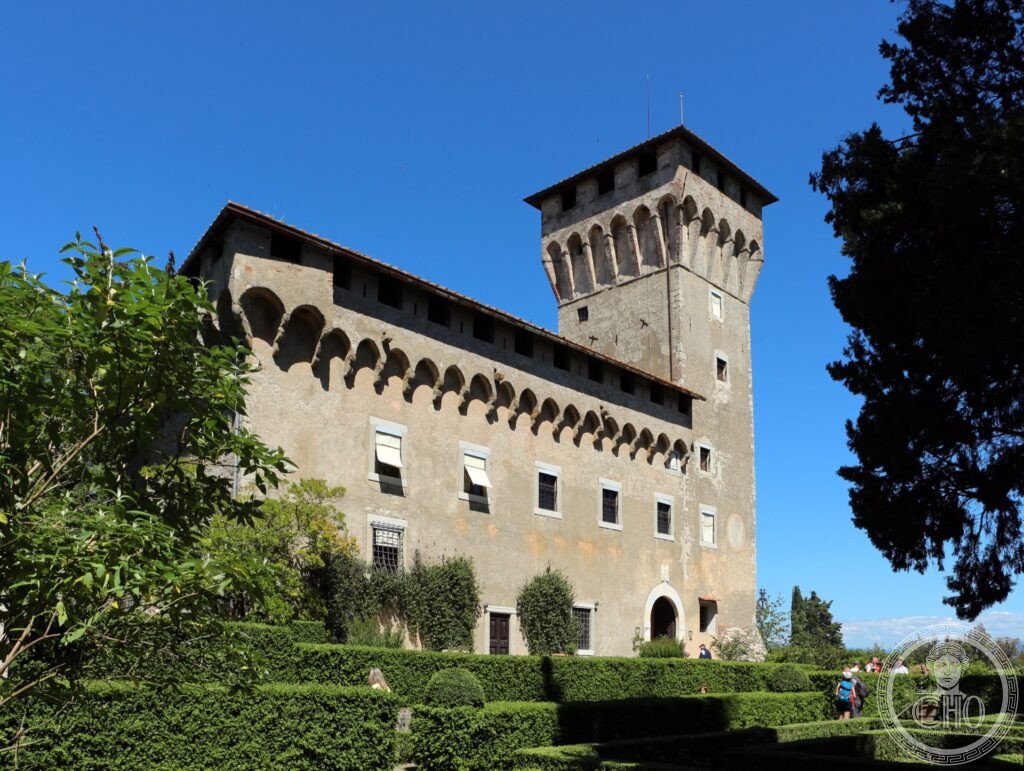
Quattro anni prima di iniziare il Palazzo Medici-Riccardi in città, Michelozzo sperimentò qui nel Mugello la sintesi tra una dimora signorile e una fattoria produttiva — il modello che definì la villa toscana per tre secoli.
At a glance
Villa il Trebbio occupies a hill above San Piero a Sieve in the Mugello valley, 4 km south-east of Villa di Cafaggiolo. It is the oldest of the Medici villas in the formal sense: Cosimo the Elder commissioned Michelozzo in 1427 to redesign an existing Medici fortified manor into a residence that combined agricultural production with aristocratic comfort. The result — a compact block with a crenellated tower, a regularised courtyard, and a loggia looking out toward the valley — became the template for subsequent Medici rural architecture. The estate remains an active wine and olive oil property (Fattoria di Trebbio), producing Chianti wines under the Trebbio label. In 2013, UNESCO inscribed it as one of the twelve Medici Villas and Gardens in Tuscany (ref. 175bis).
Key facts
- UNESCO inscription: 2013, “Medici Villas and Gardens in Tuscany,” ref. 175bis
- Date: redesigned 1427 by Michelozzo di Bartolommeo for Cosimo the Elder — the earliest securely dated Medici villa commission
- Estate: active agricultural estate (Fattoria di Trebbio); produces Chianti wine and extra virgin olive oil under the Trebbio label
- Tower: the medieval crenellated tower survives intact; it was used as a watchtower for the surrounding Mugello territory
- Plan: compact rectangular block with loggia on one side; the form Michelozzo perfected here was repeated at Cafaggiolo four years later
- Current status: private agricultural estate; wine sales and accommodation available
History
In 1427, Cosimo the Elder — just a few years before his first exile from Florence and the subsequent triumphant return that made him the city’s dominant figure — commissioned Michelozzo to redesign a Medici farmstead near San Piero a Sieve. The context was a comprehensive reorganisation of the Medici rural holdings in the Mugello: Cosimo was investing the family’s banking profits into land, following the advice of his father Giovanni di Bicci that agriculture was a more stable foundation than commerce alone. Michelozzo’s intervention at Trebbio set the pattern: retain the medieval tower for its symbolic authority, add a loggia for civilised habitation, regularise the courtyard for ceremonial use, and integrate the entire complex with productive farmland (vines, olive groves, wheat) within sight of the main building.
The result was a new building type — the Tuscan villa-fattoria — that combined the functions of a working farm with the amenities of a country residence. This combination, first articulated at Trebbio and refined at Cafaggiolo, would become the defining model of the Tuscan rural landscape for three centuries. Lorenzo the Magnificent wrote admiringly of the Mugello estates in his poetry. After the Medici exile in 1494, Trebbio changed hands but its agricultural function was never interrupted; the current owners maintain it as an active wine estate.
What you see
The villa presents the same medieval-meets-Renaissance character as Cafaggiolo: crenellated tower, high curtain walls, and a compact mass that reads more as a fortified manor than a pleasure villa. Michelozzo’s loggia — round arches on pietra serena columns, opening onto the courtyard — is the principal Renaissance intervention, and it is proportioned with the quiet elegance that marks all his work. From the loggia, the view down the Mugello valley toward San Piero a Sieve is exactly what Michelozzo intended: a composed pastoral panorama with the estate’s own vineyards and olive groves in the foreground.
The courtyard contains an ancient well and a medlar tree of considerable age; the small garden walled alongside the south facade retains box hedges and a pattern of beds consistent with Renaissance garden conventions. The working character of the estate is present everywhere: the cellar where wine is made occupies the ground floor of the main block, and the smell of fermenting grapes fills the courtyard in October.
Practical information
- Estate visits: wine and olive oil tasting by appointment (Fattoria di Trebbio)
- Accommodation: agriturismo rooms available in the estate farmhouses
- Best season: October (harvest) for the full estate atmosphere; spring for clear Mugello panoramas
- Time needed: 1–2 hours for estate tour and tasting
- Wine: produces Chianti Rufina DOCG and Trebbio Bianco under the estate label
Getting there
By car from Florence: A1 motorway north, exit Barberino di Mugello; follow SP503 toward San Piero a Sieve; Trebbio is signposted on the hill east of San Piero. By train to San Piero a Sieve (Florence–Faenza line), then taxi or estate shuttle. GPS: 43.9695° N, 11.3121° E.
Nearby
- Villa di Cafaggiolo — companion Medici Mugello villa (1451, Michelozzo), 4 km north-west; UNESCO 2013
- Fortezza di San Martino (Bosco ai Frati) — Franciscan monastery in the Mugello restored by Michelozzo for Cosimo; contains a Donatello crucifix; 3 km north
- Scarperia — medieval borgo known for traditional knife-making; 4 km south
Sources
- UNESCO World Heritage List — “Medici Villas and Gardens in Tuscany,” ref. 175bis (whc.unesco.org)
- Wikipedia — “Villa del Trebbio” (en.wikipedia.org/wiki/Villa_del_Trebbio)
- Isabelle Chabot and Giuliana Migliardi, Michelozzo di Bartolommeo, Florence, 2005
- Giusto Utens, Lunette delle Ville Medicee, 1599–1602 (Museo Storico Topografico)
Find it on the map
See this place and what’s around it →📷 Become a Cultural Heritage Online photographer
Share your photos of places: they stay published under your name as the author. The more they're seen, the more you get noticed — and soon a contest will reward the most appreciated photos.
Log in or sign up free to add a photoDo you manage this place?
This page is read by travellers and heritage enthusiasts who find it on Google. Keep it accurate — and make it work for you. Free for non-profit heritage institutions.