
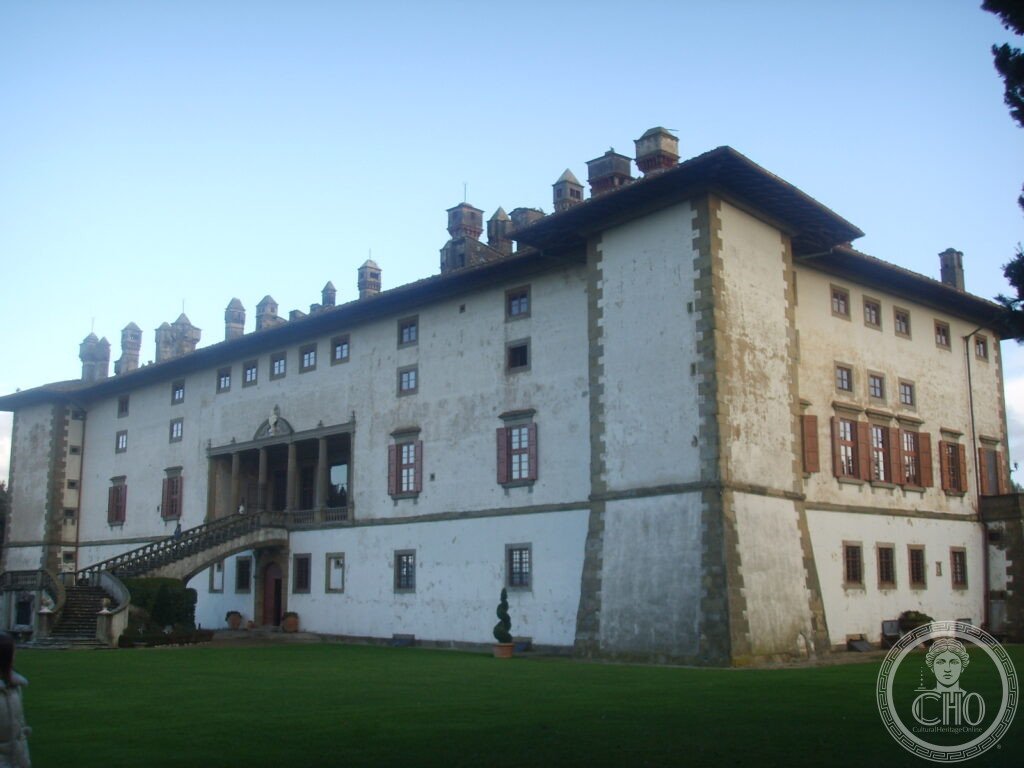
Ferdinando I de’ Medici volle una residenza estiva tra le viti del Montalbano che dominasse tutta la piana fiorentina: Buontalenti progettò un palazzo con tanti camini quante le province del granducato — e qualcuno in più.
At a glance
Villa Medicea di Artimino — known as “La Ferdinanda” after its patron Grand Duke Ferdinando I — sits on a broad ridge between the Arno and Ombrone rivers at Artimino, in the Carmignano wine district west of Florence. Built between 1594 and 1600 by Bernardo Buontalenti, the grand ducal architect, it is the largest Medici hunting lodge and is immediately recognisable by its extraordinary roofline: 37 chimneys of varying height and design rise above the cornice in a skyline that has no parallel in Italian Renaissance architecture. Legend identifies the chimneys with the provinces of the Medici Grand Duchy; architectural historians read them as a functional solution to the lodge’s many fireplaces and as a theatrical statement of Medici power on the hilltop. In 2013, UNESCO inscribed La Ferdinanda as one of the twelve Medici Villas and Gardens in Tuscany (ref. 175bis).
Key facts
- UNESCO inscription: 2013, “Medici Villas and Gardens in Tuscany,” ref. 175bis
- Built: 1594–1600, designed by Bernardo Buontalenti for Grand Duke Ferdinando I de’ Medici
- Distinctive feature: 37 chimneys of varying design and height on the roofline — unique in Renaissance Italy
- Function: hunting lodge for the Medici Grand Duchy; the surrounding hills were a managed game reserve
- Archaeological museum: basement of the villa houses the Museo Etrusco Comunale di Artimino (Etruscan artefacts from local necropoleis)
- Current use: conference centre, hotel, and museum; wedding and events venue
History
Ferdinando I was the third son of Cosimo I and the builder of the most ambitious programme of Medici villa construction: within a decade, he commissioned La Petraia (completed 1590), Villa di Cerreto Guidi (expanded), and La Ferdinanda at Artimino. Buontalenti — his court engineer, who had already designed the Forte di Belvedere, the Uffizi tribuna, and numerous hydraulic devices — drew the plans for Artimino in 1594. Construction required extensive earthworks to flatten and extend the ridge top; local stone from the Montalbano hills was used for the entire building.
The hunting grounds around Artimino were carefully managed: Ferdinando stocked the wooded hillsides with deer, boar and pheasant, and the lodge’s position on the ridge allowed hunters to survey the terrain before descending. After the extinction of the Medici line in 1737, the villa passed to the Lorraine grand dukes and then to the Italian state. In the 20th century, it was leased to private operators and converted into a hotel and conference centre; the Etruscan museum in the basement was opened in 1969 using finds from the nearby necropoli at Prato Rosello.
What you see
The approach from Artimino village reveals the chimneys first — a bristling crown that makes the building look, at a distance, like a fortified hilltop town rather than a country villa. Closer, the facade resolves into Buontalenti’s characteristic austerity: a long three-storey block with evenly spaced windows and corner towers, built in the warm grey-gold stone of the Montalbano. The chimneys, when examined individually, are each slightly different — square, round, octagonal, with stone hoods of varied profile — a subtle assertion of the craftsmen’s licence within the overall grid.
The interior retains its large-scale reception rooms and the grand staircase (scalone) that Buontalenti designed as a processional approach to the piano nobile. The basement Etruscan museum exhibits bucchero ceramics, bronze statuettes and funerary equipment from the 7th–4th century BC necropoleis uncovered in the surrounding countryside — evidence of an Etruscan settlement that preceded the Medici hilltop by two millennia.
Practical information
- Museum: Museo Etrusco Comunale di Artimino — open daily (check local hours), small admission fee
- Villa tours: guided visits to the interior available through the conference hotel; check availability in advance
- Wine: the surrounding Carmignano DOC vineyards produce one of Tuscany’s oldest controlled wines; estate wine sold on site
- Best season: autumn (harvest) and spring; summer is hot on the ridge
- Time needed: 1.5 hours for museum + exterior + village of Artimino
Getting there
By car: 25 km west of Florence via the A11 motorway (exit Prato Ovest) or via Via Pistoiese; follow signs to Carmignano then Artimino. No regular public bus service reaches Artimino directly; nearest stop is Carmignano, 5 km away. GPS: 43.7531° N, 11.0403° E.
Nearby
- Carmignano — historic wine town with the Visitazione by Pontormo (1528–1530) in the Pieve di San Michele, 5 km east
- Poggio a Caiano — Giuliano da Sangallo’s great Medici villa (1485), 10 km south-east; UNESCO 2013
- Pistoia — medieval city with cathedral and baptistery, 20 km north
Sources
- UNESCO World Heritage List — “Medici Villas and Gardens in Tuscany,” ref. 175bis (whc.unesco.org)
- Wikipedia — “Villa Medicea di Artimino” (en.wikipedia.org/wiki/Villa_Medicea_di_Artimino)
- Comune di Carmignano — Museo Etrusco Comunale di Artimino
- Henk Th. van Veen, Cosimo I de’ Medici and his Self-Representation in Florentine Art and Culture, Cambridge, 2006
Find it on the map
See this place and what’s around it →📷 Become a Cultural Heritage Online photographer
Share your photos of places: they stay published under your name as the author. The more they're seen, the more you get noticed — and soon a contest will reward the most appreciated photos.
Log in or sign up free to add a photoDo you manage this place?
This page is read by travellers and heritage enthusiasts who find it on Google. Keep it accurate — and make it work for you. Free for non-profit heritage institutions.