
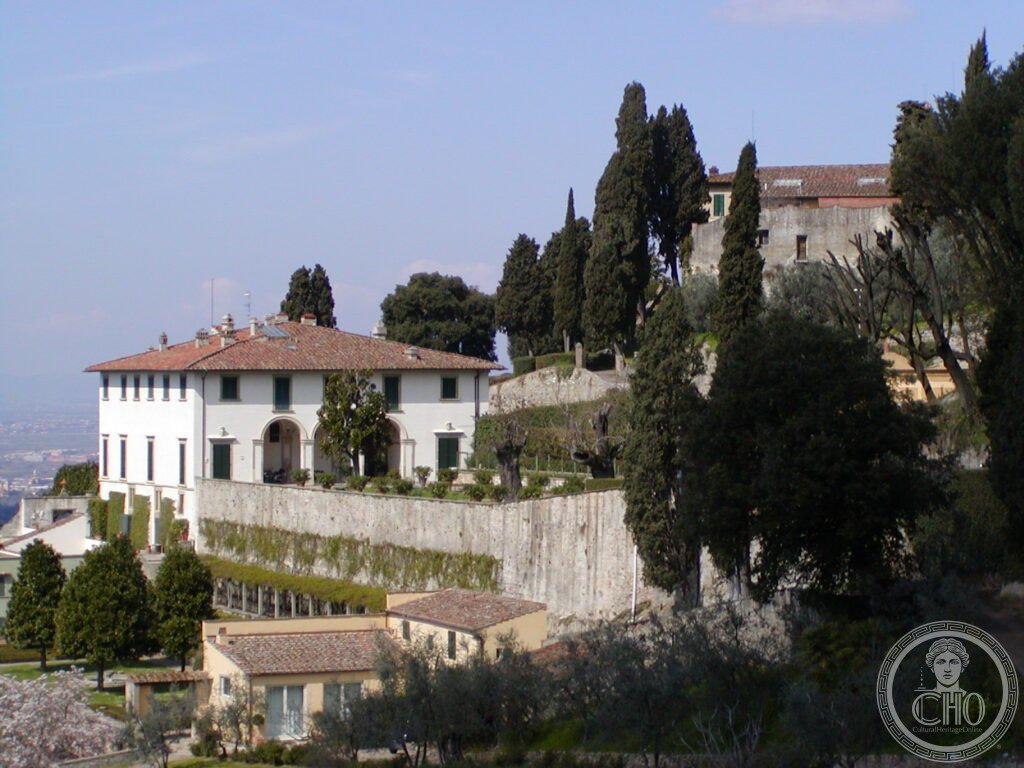
Michelozzo progettò qui la rivoluzione dell’architettura residenziale: invece di sfruttare la pianura, costruì tre terrazze nel pendio, aprendo la loggia sulla veduta di Firenze come se fosse un palco sul mondo.
At a glance
Villa Medicea di Fiesole stands on the steep hillside of Fiesole, 7 km north-east of Florence, at an elevation from which the entire Arno valley is visible on clear days from the Apennines to the sea. Built between 1452 and 1457 for Giovanni de’ Medici (younger son of Cosimo the Elder) by the architect Michelozzo di Bartolommeo, it is recognised by architectural historians as the first Renaissance villa designed to exploit a hillside slope rather than fight it: Michelozzo cut three terraces into the hill, creating a system of hanging gardens above the city, and positioned the loggia to frame the panorama of Florence as a composed landscape picture. In 2013, UNESCO inscribed the villa as one of the twelve Medici Villas and Gardens in Tuscany (ref. 175bis).
Key facts
- UNESCO inscription: 2013, “Medici Villas and Gardens in Tuscany,” ref. 175bis
- Built: 1452–1457, designed by Michelozzo di Bartolommeo for Giovanni di Cosimo de’ Medici
- Architectural significance: first Renaissance villa explicitly designed on a hillside slope with terraced gardens; model for subsequent Medici and European hillside villas
- Later owners: Angelo Poliziano (humanist, tutor to Lorenzo’s children) resided here 1478–1479; later owned by Angelo Acciaiuoli; acquired by the Marchesa Iris Origo’s family in the 20th century
- Current status: private property (Blumenthal-Miano family); garden open to the public on specific dates; UNESCO monitoring of conservation
- Setting: Fiesole hillside at ~295 m elevation; panoramic loggia faces south-west toward Florence
History
Giovanni di Cosimo de’ Medici, the younger of Cosimo the Elder’s two sons, commissioned Michelozzo — the family’s preferred architect and designer of the Palazzo Medici-Riccardi — in 1452. The brief was explicit: a country house on the hillside above Fiesole that could function as a philosophical retreat from Florence. Michelozzo’s solution was to cut three horizontal terraces into the slope, creating a lower service level, a middle garden level, and an upper level housing the residential block with its south-west-facing loggia. The garden terraces were planted with fruit trees, a bosco and a formal lower parterre — the first example of a Renaissance garden designed to incorporate the landscape panorama as its principal ornamental element.
After Giovanni’s death in 1463, the villa passed briefly to his brother Lorenzo the Magnificent. The humanist poet Angelo Poliziano, tutor to Lorenzo’s children and key figure in the Florentine Platonic Academy, stayed at the villa in 1478–79, completing his Stanze per la giostra in the garden loggia. The villa changed hands several times during the Medici exile and subsequent Florentine political upheavals. In the 20th century, it was owned by a succession of cultivated foreigners attracted by the hilltop panorama; the current owners maintain it as a private residence while opening the garden periodically.
What you see
The villa’s facade is deliberately understated by Florentine standards: three bays of pietra serena stone, Michelozzo’s characteristic grey sandstone, with the loggia at the centre of the piano nobile level. What Michelozzo understood — and subsequent villa builders across Europe copied — is that the building should be subservient to the view: the loggia is shallow, its arches sized to frame the Florentine panorama rather than enclose an independent interior space. The terrace in front of the loggia is planted with lemon trees in terracotta pots, exactly as it appears in 15th-century depictions.
From the lower garden terrace, the structure of Michelozzo’s intervention in the hillside becomes legible: three distinct horizontal platforms, each with its own character (formal parterre, citrus garden, bosco), descend in steps that follow the natural contours of the hill. The retaining walls between terraces are built in the same grey pietra serena as the villa, giving the entire complex a unity of material that makes it read as a single designed landscape rather than a building placed in a garden.
Practical information
- Status: private property; garden visits by advance booking or on designated open days (check the Polo Museale della Toscana calendar)
- Best season: spring (April–May) for flowering garden; autumn for clear panoramic views
- Time needed: 1 hour for garden tour if open
- Alternative: the Fiesole town centre with its Roman theatre and Etruscan museum is a 10-minute walk uphill and always open
Getting there
Bus ATAF line 7 from Piazza San Marco (Florence) to Fiesole, journey 25 minutes. The villa is a 5-minute walk downhill from Fiesole centre (Via Beato Angelico/Via della Petraia). By car: leave Florence on Via Faentina; the villa entrance is at Via Beato Angelico 2. GPS: 43.8007° N, 11.3041° E.
Nearby
- Teatro Romano di Fiesole — 1st-century BC Roman theatre with Etruscan area; 5 minutes uphill
- Villa Medicea di Cafaggiolo — early Michelozzo villa (1451) in the Mugello hills, 30 km north; companion UNESCO 2013 site
- Villa Medicea La Petraia — Buontalenti villa with Giambologna fountain, 8 km west; UNESCO 2013
Sources
- UNESCO World Heritage List — “Medici Villas and Gardens in Tuscany,” ref. 175bis (whc.unesco.org)
- Wikipedia — “Villa Medicea di Fiesole” (en.wikipedia.org/wiki/Villa_Medicea_di_Fiesole)
- Christy Anderson, Renaissance Architecture, Oxford, 2013
- Georgina Masson, Italian Gardens, Thames & Hudson, 1961
Find it on the map
See this place and what’s around it →
📷 Become a Cultural Heritage Online photographer
Share your photos of places: they stay published under your name as the author. The more they're seen, the more you get noticed — and soon a contest will reward the most appreciated photos.
Log in or sign up free to add a photoDo you manage this place?
This page is read by travellers and heritage enthusiasts who find it on Google. Keep it accurate — and make it work for you. Free for non-profit heritage institutions.