

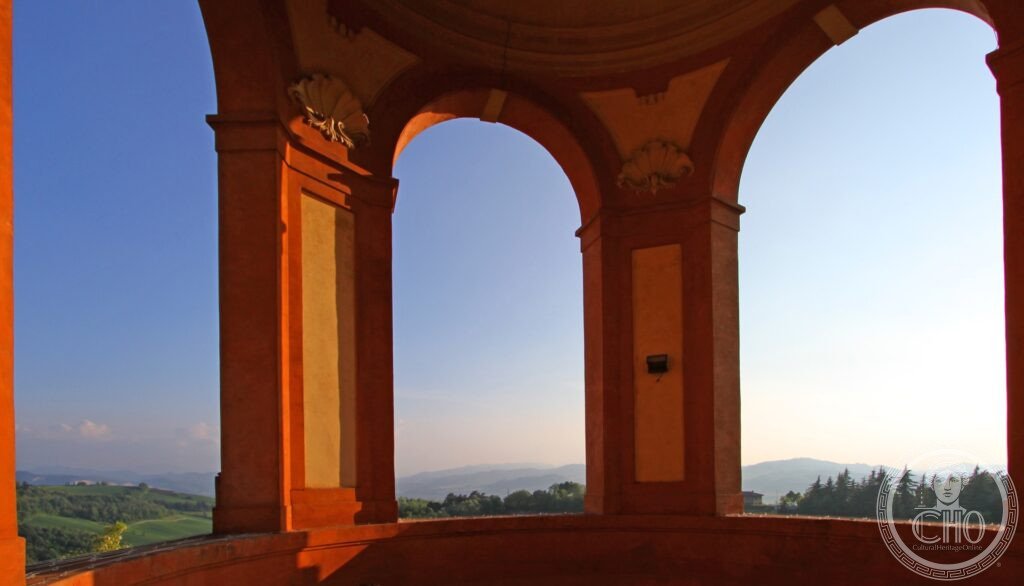
The Portico di San Luca — 3.797 kilometres of covered arcade linking Bologna’s Porta Saragozza to the Sanctuary of the Madonna di San Luca on the hilltop of the Colle della Guardia, built between 1674 and 1793 with 666 arches and a climb of 245 metres — is the longest covered arcade walk in the world, a pilgrimage route that has been walked continuously since the 12th century, and the most extraordinary example of the way the Bologna portico system extends from the urban centre to the surrounding countryside and hills.
At a glance
Portico di San Luca (Bologna; UNESCO 2021, ref. 1650 — inscribed as “The Porticoes of Bologna”) is a covered colonnaded passageway 3,797 metres long, containing 666 arches, rising 245 metres in elevation from the Arco del Meloncello (the triumphal arch entrance at Porta Saragozza, street level) to the Baroque sanctuary of the Beata Vergine di San Luca (300 m above sea level). The portico was constructed over 119 years (1674 first arch; 1793 completion) to provide sheltered passage for the annual procession of the venerated icon of the Madonna di San Luca, which has been carried from the hilltop sanctuary to the city centre every year since 1433 (on the Friday before Ascension Thursday). The total number of arches (666) has generated a popular tradition associating the number with the Apocalypse — but the builders counted 668 (with 2 counted differently) and the 666 figure is a post-hoc folk tradition.
Key facts
- Il primato mondiale: The Portico di San Luca is documented in the Guinness World Records as the longest portico in the world (or longest covered arcade) — longer than the famous covered arcade of Mafra (Portugal, 880 m) and the Long Walk at Windsor Castle (4.6 km but not covered). No other porticoed path in the world approaches its combination of continuous cover + historical continuity + elevation change
- La costruzione (1674-1793): The portico was funded by voluntary contributions from Bologna’s families and guilds — each family or corporation paid for one or more arches and was rewarded with a commemorative inscription on their arch (many survive); the construction required 119 years because funding dried up repeatedly; the most notable interruption was from 1712 to 1730 (due to financial crisis and disagreements between the Commune and the Senate about who should fund the final hill section). The architect who designed the original 1674 arches is unknown; the section from 1674 to 1716 was supervised by Giovanni Giacomo Monti; the hill section was designed by Carlo Francesco Dotti, who also designed the Arco del Meloncello (1732) and the Sanctuary facade (1723-1742)
- Il Santuario della Madonna di San Luca: The Baroque sanctuary at the top of the portico (designed by Carlo Francesco Dotti, 1723-1742) contains the venerated Byzantine icon of the Madonna di San Luca — one of the most important Marian icons in Italy; according to tradition, the icon was painted by Saint Luke the Evangelist (hence the name of the hill and the sanctuary) but art historians date it to the 12th-13th century Byzantine period; it is kept in the sanctuary year-round except for the two annual processions to and from the city centre
- Il record sportivo (Giro al Portico di San Luca): The portico hosts an annual international hill run (the “Giro al Portico di San Luca”) of approximately 4 km from the Arco del Meloncello to the sanctuary; the elite record is under 14 minutes; the event attracts 5,000+ runners annually and is one of the oldest hill runs in Italian sports history
- UNESCO: 2021, rif. 1650
- GPS Arco del Meloncello: 44.4913, 11.3167 — Google Maps; GPS Santuario: 44.4776, 11.3009 — Google Maps
History
The hill of San Luca has been a pilgrimage destination since at least the 12th century, when a small chapel was established at the summit; the Byzantine icon of the Madonna arrived at the hilltop sometime in the 12th or 13th century. The annual procession of the icon from the hilltop to the Cathedral of San Pietro in the city centre (for the Easter-Ascension period) began in 1433 and has continued without interruption to the present day. The first project for a covered portico to shelter the procession route was approved by the Senate of Bologna in 1655, but construction did not begin until 1674. The Arco del Meloncello — the triumphal gateway arch that marks the beginning of the hill section of the portico — was designed by Carlo Francesco Dotti and built in 1732-1739; it is the most architecturally significant single element of the portico system, a full Baroque triumphal arch with Corinthian pilasters, an attic story, and a crowning Madonna.
What you see
The portico walk (one way: 3.8 km, approximately 45-60 min at a leisurely pace; round trip: 1h30-2h) begins at the Arco del Meloncello on the Viale Aldini, just outside Porta Saragozza. The experience: the first 2 km follow the Via di San Luca through the Colle residential neighbourhood, with the arches providing continuous shade and a constant gradient; the architectural character of the arches changes approximately every 200-300 m (reflecting the different construction phases and funding groups); the hill section (from the saddle at approximately 200 m altitude to the sanctuary) is the steepest and most rewarding — the views back toward Bologna and the Po plain become visible between arches; the sanctuary at the summit (open daily; sanctuary itself free; rooftop terrace not accessible) has a wide esplanade with panoramic views in all directions. The icon of the Madonna is kept in the sanctuary chapel; photography inside restricted to non-flash.
Gallery
Practical information
- Portico walk: Open at all hours, free, 365 days. Start: Arco del Meloncello, Viale Aldini (GPS 44.4913, 11.3167), reached by bus from Bologna centre. End: Santuario della Madonna di San Luca, Colle della Guardia (GPS 44.4776, 11.3009). Duration: 45-60 min one-way (fit walker, steady pace). Altitude gain: 245 m. Best time: morning (cooler, better views toward Bologna) or late afternoon (sunset from the sanctuary esplanade). Bring water; no services along the portico.
- Cable car (Funivia della Madonna di San Luca): A gondola cable car connects Viale Aldini (Meloncello area) to the sanctuary — seasonal operation (spring-summer), fee ~€4 each way. The cable car is the alternative to the walk, not the supplement — use it for the return journey if legs are tired.
- Processione (annuale): The procession of the icon from the sanctuary to the Cathedral of San Pietro takes place in late May (exact date varies: the Friday before Ascension). The icon is carried on a litter by the confraternity of the Madonna di San Luca through the entire length of the portico — attending this procession (which has occurred annually since 1433 with almost no interruptions) is a unique experience.
Getting there
Bologna (BO), Emilia-Romagna. GPS Arco del Meloncello (start): 44.4913, 11.3167. By bus: TPER bus 20 from Bologna Stazione Centrale → Porta Saragozza → Arco del Meloncello stop (20 min from the station). By foot from city centre: from Piazza Maggiore (1 km south-west via Via Saragozza) → Porta Saragozza → Arco del Meloncello (another 300 m). By car: parking at the Meloncello area (limited) or at Porta Saragozza (paid). Bologna is served by Trenitalia AV from Milan (1h), Florence (35 min by Frecciarossa), Rome (2h10).
Nearby
- Porta Saragozza — 300 m from the Arco del Meloncello; the most intact of Bologna’s 12 medieval city gates, built in the Bentivoglio period (15th century, rebuilt 1615)
- Parco di Villa Ghigi — 300 m north of the sanctuary; the large English-landscape park (20 ha) on the Colle della Guardia with groves of secular oaks and views over Bologna; free access
- Piazza Maggiore di Bologna — the historic heart of the city with the porticoed Palazzo d’Accursio, the Palazzo dei Notai, and the Basilica di San Petronio; 1 km from the Arco del Meloncello
Sources
- UNESCO: whc.unesco.org/en/list/1650
- Wikipedia EN: Portico of San Luca
- Gurrieri, Orietta: Il Portico di San Luca, Bologna: Bononia University Press, 2008
- Comune di Bologna: comune.bologna.it/portici
Find it on the map
See this place and what’s around it →📷 Become a Cultural Heritage Online photographer
Share your photos of places: they stay published under your name as the author. The more they're seen, the more you get noticed — and soon a contest will reward the most appreciated photos.
Log in or sign up free to add a photo