

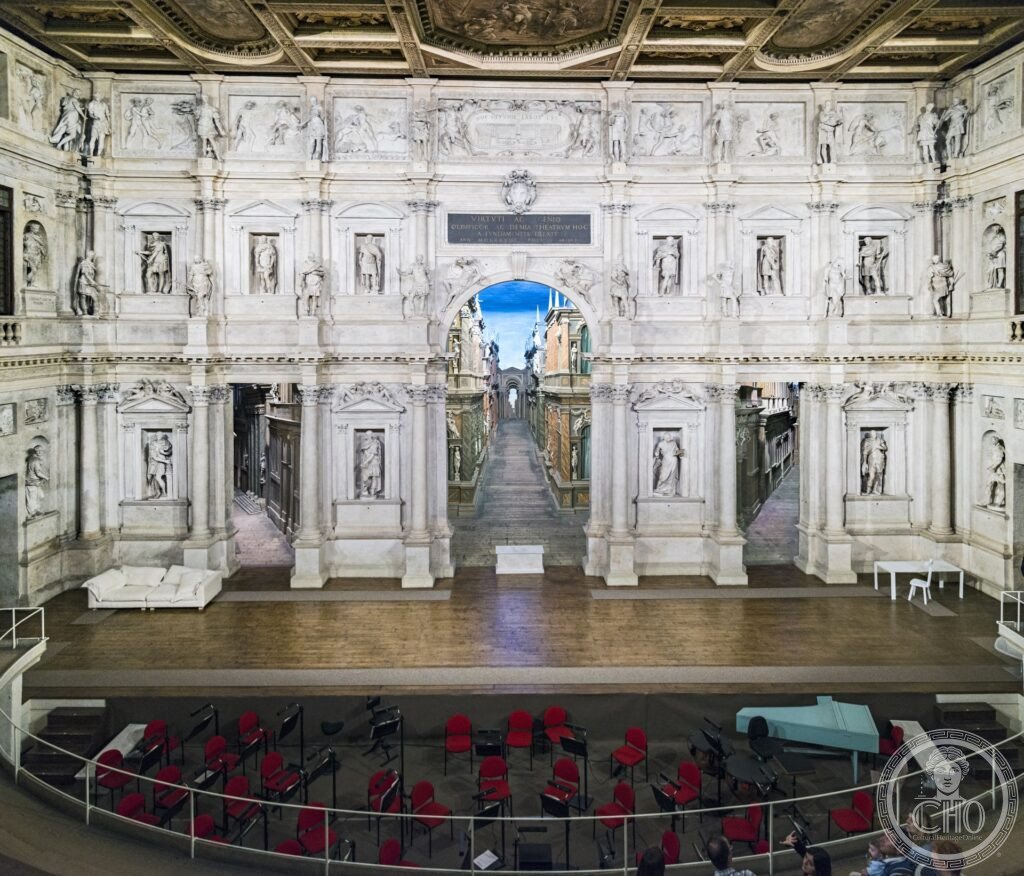
The Teatro Olimpico in Vicenza. Begun by Palladio in 1580, the year of his death, and completed by Vincenzo Scamozzi, who added the extraordinary permanent street-scene backdrop in 1585. Is the oldest surviving indoor theatre in the world and the only one from the Renaissance with its original permanent stage set still in place: five illusionistic streets leading away from the three stage doors, built in wood and plaster, painted in trompe-l’oeil perspective to create the illusion of an ancient city receding to the horizon, still installed exactly as they were for the inaugural performance on 3 March 1585.
At a glance
Teatro Olimpico (Vicenza; UNESCO 1994, ref. 712 — inscribed as part of “The City of Vicenza and the Palladian Villas of the Veneto”) was commissioned by the Accademia Olimpica (Olympic Academy), the cultural academy of Vicenza founded in 1555 by a group of Vicentine noblemen (Palladio was a founding member), to build a permanent theatre for the performance of classical plays. Palladio received the commission in 1579 and began construction of the semicircular cavea and the scaenae frons (stage wall) in 1580. He died on 19 August 1580 before the theatre was completed. The building was finished by Vincenzo Scamozzi, who added the permanent five-street perspective stage set in 1585, just in time for the inaugural performance of Sophocles’s “Oedipus Rex” (Edipo Tiranno) in Italian translation on 3 March 1585. The theatre has been in continuous use since its inauguration and is the oldest surviving permanent indoor theatre in the Western world.
Key facts
- La “Scaenae Frons” (facciata del palcoscenico): The rear wall of the Teatro Olimpico stage is the most elaborate Renaissance theatrical set ever built: a 3-storey architectural facade in white stucco (imitating Istrian stone), with a central arched door (the “porta regia”), two smaller rectangular side doors, and abundant sculptural decoration (statues, reliefs, entablatures). All deliberately imitating the rear wall of a Roman theatre (specifically the Theatre of Marcellus in Rome and the description of the scaena in Vitruvius’s De Architectura). Palladio based his design on the archaeological study of Roman theatres he had published in the “Quattro Libri” (1570). The Teatro Olimpico is the only surviving built realization of a Renaissance archaeological reconstruction of a Roman theatre.
- Le cinque prospettive (Scamozzi, 1585): The five “streets of Thebes” built by Scamozzi for the inaugural Oedipus Rex performance in 1585 and never dismantled since are the most extraordinary theatrical optical illusion surviving from the Renaissance: five urban street scenes (aligned with the five stage doors in the scaenae frons) receding in exaggerated perspective toward vanishing points approximately 12 m behind the stage wall. The visual illusion, however, creates streets that appear to continue for approximately 100-150 m. The streets are built entirely of wood, canvas, and painted plaster, with houses, fountains, arches, and statues that would fill a small Roman city. The “streets” are not walkable by actors (too low and narrow at the far end of the perspective compression) but were originally lit by hundreds of candles placed along their length to complete the illusion of depth. They survive in almost exactly the state they were installed in 1585 (the painted surfaces have been touched up several times).
- Il graticolato ellittico (la cavea): The seating of the Teatro Olimpico is a semicircular arrangement of 13 steps in white stucco (imitating a Roman theatre cavea — specifically the Theatre of Marcellus, which Palladio had measured in person) with a flat orchestra in front. Above the highest step, a continuous colonnade of Corinthian columns supports a classical entablature and, above that, a fictive sky painted in the continuous barrel vault of the ceiling (the sky has clouds and birds, permanently blue — there is no natural light). The cavea is elliptical rather than perfectly semicircular (forced by the irregularity of the available site, a former prison garden), which Palladio concealed by using a slightly different radius for each tier of steps. This is the first documented use of an elliptical cavea in Renaissance architecture.
- UNESCO: 1994, rif. 712.
- GPS: 45.5464, 11.5482. Google Maps (Teatro Olimpico, Vicenza).
History
The Accademia Olimpica received permission from the City Council of Vicenza in 1579 to build a permanent theatre in the garden of the former prison (Prigion Vecchie) adjacent to the Palazzo del Territorio. Palladio won the commission and began immediately (the foundation stone was laid in February 1580). Palladio died on 19 August 1580, having completed only the structural shell of the cavea and the foundations of the scaenae frons. Vincenzo Scamozzi (who had not been Palladio’s assistant but was the leading younger architect of Vicenza at the time) was hired to complete the building and designed the famous perspective streets (1585). The inaugural performance (Oedipus Rex, by Sophocles, in an Italian translation by Orsatto Giustiniani) on 3 March 1585 was attended by all the principal families of Vicenza and the Venetian ambassador. 500 musicians and candles. No changes were made to the stage after the inaugural performance. The building has been managed by the Municipality of Vicenza since 1866 and is now open as a museum and theatre.
What you see
Teatro Olimpico is one of the most astonishing interiors in Italy, and one of the few that always surprises visitors who thought they were prepared for it. The visit (30-45 min, self-guided with audio guide): the entry loggia (the Odeon — a small room at the back of the building with 16th-century frescoes showing famous ancient Greeks, added by Scamozzi as a waiting room for the audience; the only room in the theatre with natural light). The cavea (enter from the Odeon side entrance — the first view of the full theatre from the top tier of seating is the essential shock: the 13 steps of the semicircular cavea descending to the orchestra, the scaenae frons filling the entire width of the stage, the five perspective streets visible through the doors, the barrel-vaulted ceiling painted as a permanently blue outdoor sky). The stage and scaenae frons (approach the stage and look INTO the perspective streets — the visual compression is most extreme when viewed from immediately in front of the stage; the smallest details of the far-end buildings are barely 10 cm across but appear to be full-size buildings at 150 m distance). Close-up examination of the sculptural decoration on the scaenae frons (the 95 stucco statues, the relief panels, the entablature inscription): the level of craftsmanship is extraordinary.
Gallery
Practical information
- Teatro Olimpico: Piazza Matteotti 11, Vicenza. Open daily (except December 25 and January 1): Jun-Aug 09:00-17:00, Sep-May 09:00-17:00 (last entry 16:30). Admission: stand-alone ticket ~€11 (full), ~€8 (students/reduced), children under 6 free. Combined ticket with Palazzo Chiericati (Pinacoteca Civica) and other city museums available for ~€15. Audio guides available in 8 languages (€2). Strongly recommended. Guided tours in English available on specific days at specific times. Check teatrolimpicovicenza.it for current schedule.
- Spettacoli classici: The Teatro Olimpico is still used for theatrical performances, primarily in September (the “Ciclo di Spettacoli Classici al Teatro Olimpico” season). Tickets for performances are available at the theatre box office and sell out quickly in summer. Watching Sophocles in the Teatro Olimpico with the original Scamozzi perspective streets is the most historically resonant theatrical experience available in Italy.
Getting there
Teatro Olimpico, Vicenza (VI), Veneto. GPS 45.5464, 11.5482. Piazza Matteotti. 5 min walk from Vicenza railway station (via Corso Andrea Palladio or via Viale Giuriolo). By train: Trenitalia from Verona (30 min, every 30 min), Padova (15 min, frequent), Venice (45 min, every 30 min), Milan (1h30 by Frecciarossa). The Teatro Olimpico is adjacent to Palazzo Chiericati (Palladio, 1550s, now the Pinacoteca Civica), 200 m from Piazza dei Signori and the Basilica Palladiana. Easily combined in a 4-hour urban Palladio circuit on foot.
Nearby
- Basilica Palladiana (Piazza dei Signori). 300 m south-west. Palladio’s most visible Vicenza work (1549-1617, the enlargement and re-facing of the 15th-century Palazzo della Ragione): the two-storey loggia with semicircular arched openings flanked by narrower rectangular bays creates the “Venetian arch” or “Palladio motif” that became the single most imitated detail in European and American architecture. The building now houses rotating temporary exhibitions.
- Palazzo Chiericati (Pinacoteca Civica). Immediately adjacent. Palladio’s 1550 design for the private palace of Giovanni Chiericati, now the Civic Art Gallery, with the most important collection of 15th-18th-century Venetian painting outside Venice (Bartolomeo Montagna, Tintoretto, Veronese, Tiepolo).
- Villa La Rotonda. 2 km south. Palladio’s most famous villa (1566, the most imitated building in architectural history). Easily combined with the Teatro Olimpico in a half-day Vicenza circuit.
Sources
- UNESCO: whc.unesco.org/en/list/712.
- Wikipedia EN: Teatro Olimpico.
- Mancini, Franco: Il Teatro Olimpico, Vicenza: Neri Pozza, 1984.
- Teatro Olimpico: teatrolimpicovicenza.it.
Find it on the map
See this place and what’s around it →📷 Become a Cultural Heritage Online photographer
Share your photos of places: they stay published under your name as the author. The more they're seen, the more you get noticed — and soon a contest will reward the most appreciated photos.
Log in or sign up free to add a photoIs this page about you?
This page is read by travellers and heritage enthusiasts who find it on Google. Tell us how you are connected to this place and we will take it from there.