
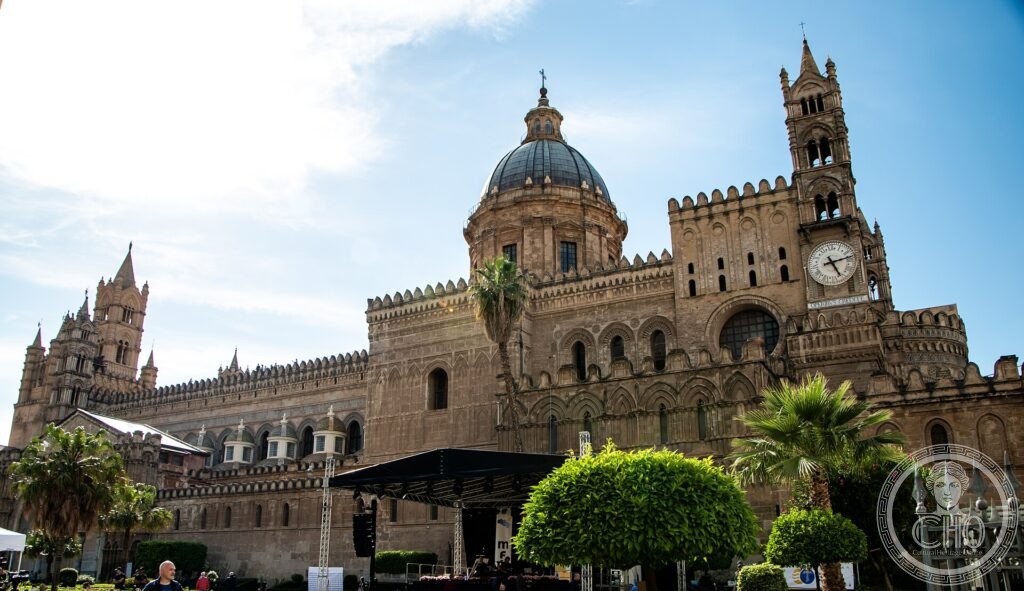
Palermo Cathedral — a building that has been a Christian basilica, an Arab mosque, a Norman cathedral, a Gothic fortified church, and a Neoclassical domed basilica in sequence over 1,400 years — is not a coherent architectural work but a stratified document of the successive civilizations that controlled Sicily, with each period’s builders working on the accumulated structure of all previous periods rather than demolishing and rebuilding, producing a building that is architecturally inconsistent, historically indispensable, and visually unforgettable.
At a glance
Palermo Cathedral (Cattedrale di Palermo; Cattedrale Metropolitana della Santa Vergine Maria Assunta; Palermo, Sicily; UNESCO 2015, ref. 1487) is the metropolitan cathedral of the Archdiocese of Palermo and the burial church of the Norman kings of Sicily. The building was founded by Archbishop Gualtiero da Mill (“Walter of the Mill”) in 1185 on the site of an earlier Norman church, which had in turn been converted from an Arab mosque (in use from 831 to 1072), which had itself been built on the site of the 6th-century Byzantine-era Basilica of Santa Maria. Each successive layer added elements without removing the previous: the Norman (now much altered) apse, the Gothic south portals and arches (14th-15th century, by Master Bartolommeo from Barcelona), the Catalan-Gothic towers (15th century), and the Neoclassical dome (1781-1801, by Ferdinando Fuga, the most controversial architectural intervention in Palermo) are all visible simultaneously on the exterior, making the Cathedral the most architecturally complex building in Sicily.
Key facts
- La cupola di Fuga (1781-1801): The Neoclassical dome added to Palermo Cathedral by the Neapolitan architect Ferdinando Fuga between 1781 and 1801 (commissioned by Archbishop Filangeri) has been described by art historians as “the worst architectural intervention in 18th-century Sicily” (Denis Mack Smith) and as “a Bourbon grafting on a Norman trunk” — the circular drum and shallow dome completely disrupt the exterior silhouette of the building that had accumulated over 600 years, destroying the medieval horizontal composition of towers and nave; the interior is similarly compromised (the Fuga intervention removed the Norman columns, the medieval choir, and the pulpit, and replaced the nave with a single large Baroque-Neoclassical space); the intervention was controversial from the moment of completion and remains the subject of restoration debate
- Le tombe reali: The Cathedral is the burial church of the Norman dynasty of Sicily: the porphyry sarcophagi of Roger II (the founder of the Kingdom of Sicily, died 1154), William II (died 1189), and Frederick II (Holy Roman Emperor, died 1250) are in the left transept, in a space that also contains the tomb of Constance of Aragon (Frederick II’s wife) and a medieval imperial crown; the porphyry sarcophagi are of extraordinary workmanship — red porphyry (the most expensive stone in the medieval world, quarried only in Egypt and used exclusively for imperial burials in the Byzantine tradition) was used deliberately to assert the equivalence of the Norman kings of Sicily to the Byzantine emperors; Roger II’s sarcophagus is the most spectacular, with four supporting lions in white marble
- Il portale gotico-catalano (XV sec.): The south portal of Palermo Cathedral (Porta di San Giovanni, 15th century, attributed to Antonio Gambara) is the finest example of Catalan Gothic carving in Palermo: a pointed arch with a tympanum decorated with carved scenes of the Annunciation and the Nativity, flanked by knotwork columns with stylized acanthus capitals; a covered arch (arco ribassato, 14th century) connects the main south façade to the bell tower of the old Bishop’s Palace and is the most photographed exterior element of the Cathedral
- UNESCO: 2015, rif. 1487
- GPS: 38.1129, 13.3550 — Google Maps (Cattedrale di Palermo)
History
The site of Palermo Cathedral has been continuously occupied by religious buildings since the 6th century CE: a Byzantine Christian basilica (dedicated to the Virgin Mary) stood here from the late Antique period; it was converted to a congregational mosque when the Arabs took Palermo in 831 (the mosque was described by the Arab geographer Idrisi as one of the largest in the western Islamic world); after the Norman conquest (1072), Count Roger I immediately reconverted the mosque to a Christian church; in 1185, Archbishop Walter of the Mill (an Englishman, former tutor of William II) demolished the Norman church and laid the foundation of the present building in the style of the Norman churches of southern England (he was buried in the Cathedral in 1190); the Cathedral was repeatedly modified in the 13th-18th centuries under Hohenstaufen, Angevin, Aragonese, and Bourbon rulers; the most damaging intervention was the Fuga dome (1781-1801), which destroyed much of the medieval interior; the Cathedral was restored in the late 19th and 20th centuries.
What you see
The Palermo Cathedral circuit (1-2 hours): exterior (the south facade is the main approach, with the 14th-century covered arch linking the bell tower to the south portal — from here, the full contradictory character of the building is visible: Gothic towers, Baroque parapet, Neoclassical dome, all in one view); the south portal (15th century, the finest medieval portal in Palermo — examine the Annunciation tympanum and the knotwork columns at close range); the nave interior (largely Neoclassical after Fuga, but the Royal Tombs in the left transept are the essential destination — the porphyry sarcophagi of Roger II, William II, and Frederick II are major works of 12th-century sculpture); the Treasury museum (in the right nave: medieval reliquaries, the 12th-century Crown of Constance of Aragon — a jeweled diadem of extraordinary delicacy — and the medieval ivory altarpiece panels); the crypt (11th-15th century, the oldest surviving part of the building, with carved columns from the Roman-era structure).
Gallery
Practical information
- Cattedrale di Palermo: Corso Vittorio Emanuele, Palermo; the Cathedral itself is free and open daily 07:30-19:30 (Mass times: daily 08:00, 09:30, 11:00, 18:00 — during Mass, tourist access is restricted to the aisles); the Treasury and Royal Tombs require a ticket (~€3); the panoramic terrace (rooftop) over the nave is accessible by a separate ticket (~€5) from the south transept entrance and gives the only unobstructed view of the Fuga dome at close range.
- Il centro UNESCO: Palermo Cathedral is on the “Arab-Norman Palermo” walking route (signed on the streets) that connects all 9 UNESCO-listed monuments; a combined day ticket for all nine is available from the Fondazione Federico II at the Palazzo dei Normanni (€15, valid 3 days).
Getting there
Cattedrale di Palermo, Palermo (PA). GPS 38.1129, 13.3550. From Palermo Centrale railway station: 15 min walk via Via Roma → Piazza Verdi (Teatro Massimo) → Corso Vittorio Emanuele; or bus 101/102 to Piazza della Cattedrale (6 min, 3 stops). From Cappella Palatina (Palazzo dei Normanni): 5 min walk east on Corso Vittorio Emanuele. From the Mercato di Ballarò: 5 min walk north on Via Maqueda → Corso Vittorio Emanuele.
Nearby
- Cappella Palatina — 500 m west; the masterpiece of Arab-Norman-Byzantine art (1130-1143), with the complete gold mosaic cycle by Byzantine craftsmen and the carved muqarnas wooden ceiling; the essential companion visit to the Cathedral
- Palazzo Reale (Palazzo dei Normanni) — immediately adjacent to the Cappella Palatina; the oldest royal palace in the world in continuous use (12th century to present — it is now the seat of the Sicilian Regional Assembly); the Sala di Ruggero (Roger’s Hall) with its cycle of hunting mosaic panels in the Norman-Islamic style is the interior companion to the Zisa
- Mercato di Ballarò — 500 m south; the medieval market of Palermo, continuously in use since the Arab period, now the most authentic street market in Sicily: olives, caponata, street food, arancini, offal panini (stigghiola, pani ca meusa), and the most energetic vendors in southern Italy
Sources
- UNESCO: whc.unesco.org/en/list/1487
- Wikipedia EN: Palermo Cathedral
- Mack Smith, Denis: Medieval Sicily 800-1713, New York: Dorset Press, 1986
- Arcidiocesi di Palermo: cattedrale.palermo.it
Find it on the map
See this place and what’s around it →📷 Become a Cultural Heritage Online photographer
Share your photos of places: they stay published under your name as the author. The more they're seen, the more you get noticed — and soon a contest will reward the most appreciated photos.
Log in or sign up free to add a photoIs this page about you?
This page is read by travellers and heritage enthusiasts who find it on Google. Tell us how you are connected to this place and we will take it from there.