
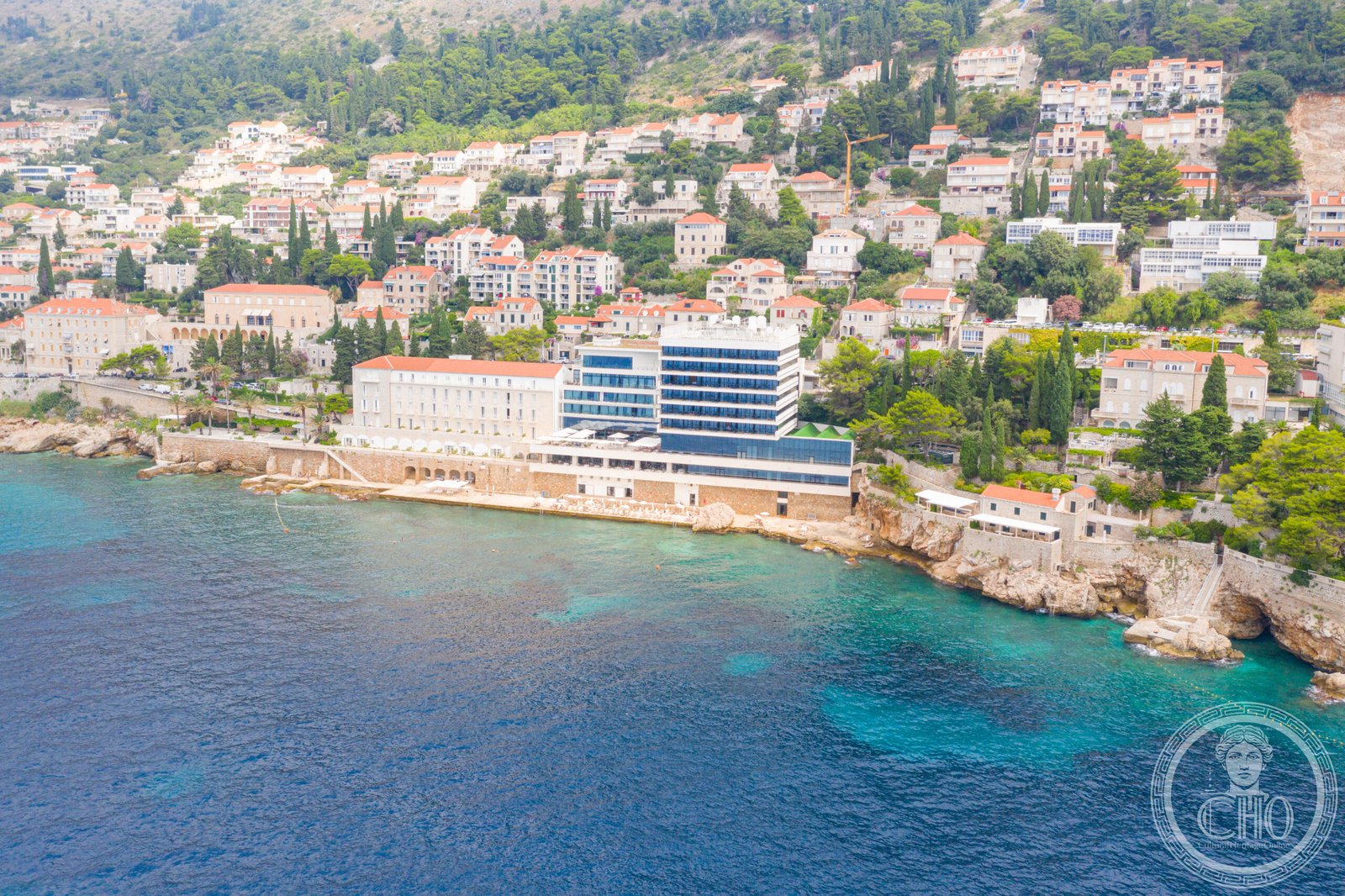
Built in 1913 on the limestone cliffs directly south of the Old City walls, the Excelsior offers the most complete view of Dubrovnik’s UNESCO-listed fortifications from any hotel on the Adriatic.
At a glance
The Hotel Excelsior was constructed in 1913 on the promontory immediately south of the Ploče Gate — the eastern entrance to the Old City of Dubrovnik. The site, on the limestone cliffs above the Adriatic, was selected for its unobstructed view of the Old City walls: a view that encompasses the Revelin Fortress, the Cathedral, the baroque roofline of the inner city, and the island of Lokrum directly opposite. The hotel opened as the prestige address for visitors arriving by the new sea and rail routes established after Dubrovnik’s annexation by Austria-Hungary in 1806.
Key facts
- Built: 1913; several subsequent extensions
- Style: Belle Époque historicist; terrace architecture integrated with the cliff site
- Address: Frana Supila 12, 20000 Dubrovnik, Croatia
- GPS: 42.6501, 18.1101
- Status: Five-star hotel; Adriatic Luxury Hotels group
- Notable guests: Elizabeth Taylor, Richard Burton, Alfred Hitchcock, John F. Kennedy
History
Dubrovnik’s position at the southern end of the Dalmatian coast and its extraordinary walled city — one of the best-preserved medieval urban enclosures in Europe — attracted a growing international tourist trade from the late 19th century. The Excelsior was built to serve this trade, replacing earlier pension-style accommodation with a purpose-designed luxury hotel whose terrace restaurant and sea-facing rooms offered the panorama of the Old City walls that has become the defining image of Dubrovnik.
The hotel became a favourite of the European and American cultural elite in the mid-20th century: Elizabeth Taylor and Richard Burton were regular guests during their Mediterranean travels; Alfred Hitchcock stayed during the 1960s; John F. Kennedy visited during a Adriatic cruise. The Yugoslav government used the hotel for diplomatic accommodation during the Tito era. After Croatian independence in 1991, the Excelsior sustained some damage during the siege of Dubrovnik but was restored and reopened.
What you see
The hotel is built in stages on the cliff face, with the principal entrance at street level and successive terraces descending to the sea. The Belle Époque main block faces the Adriatic with a facade of stone arches and iron balconies consistent with the late Austro-Hungarian resort architecture of the Dalmatian coast. The outdoor swimming pool is cut directly into the limestone cliff; the breakfast terrace, at the hotel’s upper level, frames the view of the Old City walls across the Banje beach cove.
Practical information
The hotel is a 10-minute walk from the Ploče Gate along the coastal path above the sea. The cable car to Mount Srđ departs from a station 5 minutes above the hotel. Lokrum island (ferry from the Old Harbour) is directly visible from the terrace. Kayaking through the sea caves below the Old City walls departs from the Banje beach adjacent to the hotel.
Find it on the map
See this place and what’s around it →📷 Become a Cultural Heritage Online photographer
Share your photos of places: they stay published under your name as the author. The more they're seen, the more you get noticed — and soon a contest will reward the most appreciated photos.
Log in or sign up free to add a photoIs this page about you?
This page is read by travellers and heritage enthusiasts who find it on Google. Tell us how you are connected to this place and we will take it from there.