
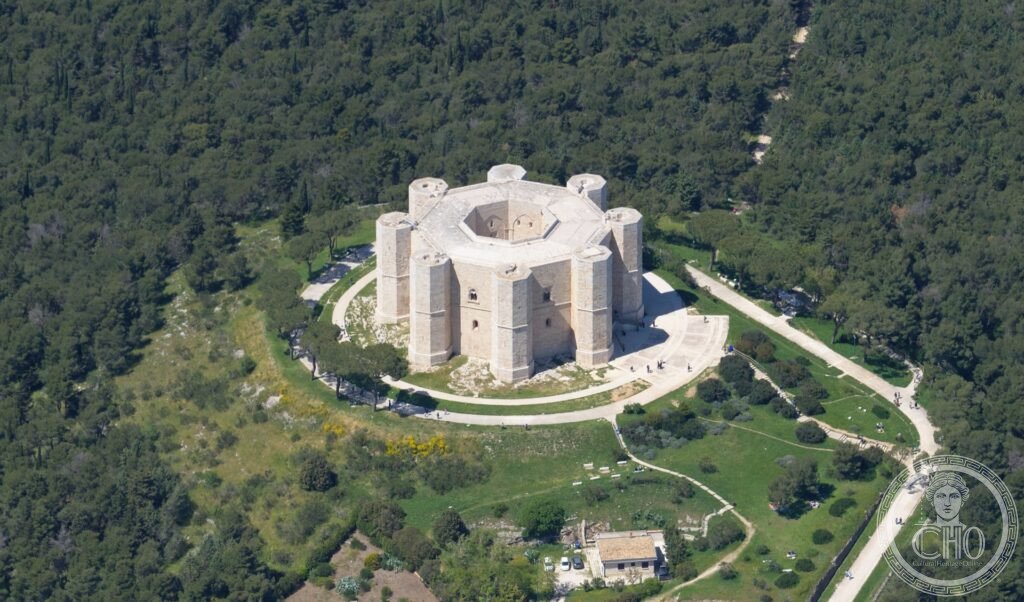
Castel del Monte — the perfectly octagonal tower fortress built between 1240 and 1250 by Frederick II of Swabia on a limestone hilltop in the Murge plateau of Apulia — is one of the great architectural enigmas of the Western Middle Ages: its mathematical precision (every dimension is a multiple of the octagon), its absence of all military and domestic facilities (no stables, no kitchens, no chapel, no water supply), and its unresolved function (hunting lodge? astronomical observatory? symbol of imperial power?) make it a structure that architectural historians have studied for 200 years without reaching consensus on why it was built.
At a glance
Castel del Monte (province of Barletta-Andria-Trani, Apulia; UNESCO 1996, ref. 398) was built by Frederick II (Frederick of Hohenstaufen, Holy Roman Emperor 1220-1250, King of Sicily 1198-1250) between approximately 1240 and 1250 on a limestone plateau (540 m a.s.l.) in the Murge, 18 km from Andria. The WHC Outstanding Universal Value recognizes: (1) the mathematical and symbolic coherence of the design — the octagonal plan, the 8 octagonal towers, the 8-room-per-floor layout, the proportional system based on mathematical ratios that Frederick may have encountered through his Arab court scholars in Palermo; (2) the blend of cultural influences — the design synthesizes Islamic (the octagonal courtyard), Byzantine (the mosaic floor fragments), northern European Gothic (the pointed arched windows and portals), and Roman (the barrel-vaulted rooms) architectural traditions into a unique hybrid impossible to classify in a single tradition; and (3) the extraordinary level of decorative quality for a “castle”: the Corinthian column capitals are among the finest 13th-century stone carving in southern Italy.
Key facts
- The enigma of its function: Castel del Monte is unique among medieval castles in having no defensive moat, since the building sits on flat ground, easily approachable from all sides; no drawbridge or portcullis, as the main entrance is a single Gothic arch door with no defensive gate; no stables, with no provision for horses or livestock; no kitchen, with no fireplace of cooking scale, only ceremonial fireplaces in the main halls; no chapel, with no dedicated sacred space, though some rooms have been hypothetically identified as chapels; and no water supply, with no well and no cistern for internal use, so water must be brought from outside. This means Castel del Monte was NOT designed as a military fortress, an agricultural residence, or a self-sufficient dwelling. The leading contemporary hypotheses are: (1) a place of ceremonial reception and imperial representation; (2) a hunting lodge for the Murge plateau game hunts organized by Frederick II; (3) an astronomical observation structure, since the towers create specific shadow patterns on the solstices and equinoxes; (4) a symbolic monument to imperial power expressed in mathematical form.
- Frederick II and the Sicilian court: Frederick II (1194-1250) was one of the most extraordinary figures in medieval Europe. Born in Jesi (Marche), he was crowned king of Sicily at 4 years old and Holy Roman Emperor at 26. His court at Palermo employed Arab philosophers, Jewish physicians, Christian theologians, and Sicilian poets; the “Sicilian School” of poetry, the first Italian literary tradition, was invented at his court. He conducted the Sixth Crusade diplomatically without a battle, through a treaty with Sultan al-Kamil of Egypt in 1229, securing Christian access to Jerusalem without fighting. He wrote a foundational treatise on falconry (“De Arte Venandi cum Avibus”) that remained the standard reference for 300 years. Dante placed him in the Sixth Circle of Hell, among the heretics, not for his military deeds but for his reputation for religious skepticism.
- The octagonal plan: The octagon plan of Castel del Monte is not arbitrary. In Islamic architectural tradition, the octagon is the geometric form that mediates between the square (earth) and the circle (heaven), and Frederick II’s court scholars in Palermo included Arab geometers and Muslim philosophers who may have transmitted this symbolic geometry. The specific 8×8 programme, an octagonal plan, 8 towers, 8 rooms per floor, 8 windows per tower, may be a mathematical pun on the number of the year 1248 CE (1248 = 8 × 156), a detail that has been noted but is generally considered coincidental by scholars.
- UNESCO: 1996, ref. 398.
- GPS: 41.0840, 16.2720 — Google Maps (Castel del Monte, Andria).
History
Castel del Monte was begun after 1240 (a letter of Frederick II to the court bailiff of Andria dated 1240 orders building materials to be brought to the site, the earliest documentary evidence) and substantially complete by 1246 (Frederick’s son Manfredi used it as a residence in that year). After Frederick II’s death (1250), the castle passed to his son Manfredi (King of Sicily 1258-1266) and then to Charles of Anjou (after the Battle of Benevento, 1266). Charles of Anjou used it as a prison for various noble captives, including Frederick’s grandsons; after the Angevin period (1282), the castle fell into disuse and was progressively stripped of its marble floor slabs, decorative elements, and building materials. It was under the direct administration of the Italian state since 1876; a major restoration was completed in the 1990s-2000s (Superintendence for Architectural Heritage, Puglia).
What you see
Castel del Monte is 18 km from Andria (accessible by shuttle bus from Andria, or by car via the SP170; parking at the base of the hill, 10 min walk up). The visit circuit (45-90 min, all self-guided; audioguide available in 6 languages): the exterior (the only place to appreciate the full octagonal geometry — walk completely around the perimeter to see all 8 towers and their relationship to the central octagon); the ground floor (8 rooms arranged around the central courtyard; the surviving Corinthian column capitals in the main hall; the original floor slab ghost-marks; the carved Gothic arch portals); the upper floor (8 rooms, some with the original rose-pink Apulian marble floor slabs in place; the restored windows with Gothic ribbed arches overlooking the courtyard; the view from the corner towers across the Murge plateau). The interior is uniformly austere — the decorative stripping over 700 years has reduced it to its structural skeleton, which paradoxically makes the mathematical programme of the building MORE visible than it was in the furnished original.
Gallery
Practical information
- Castel del Monte: Locality Castel del Monte, Andria (BT), Apulia; open daily (except January 1 and December 25) 10:00-19:30 (summer), 09:00-18:30 (winter); admission ~€7 (full), ~€3.50 (reduced 18-25 EU, teachers, etc.), free under 18 EU and over 65 EU on Sundays; no pre-booking required (capacity is rarely an issue). Shuttle bus from Andria (Piazza Catuma, in front of the Andria station), several daily round trips in summer (check parcocasteldelmonte.it for current schedule); the shuttle is required if you arrive by train (no taxi rank at the station in Andria, but taxi available by phone).
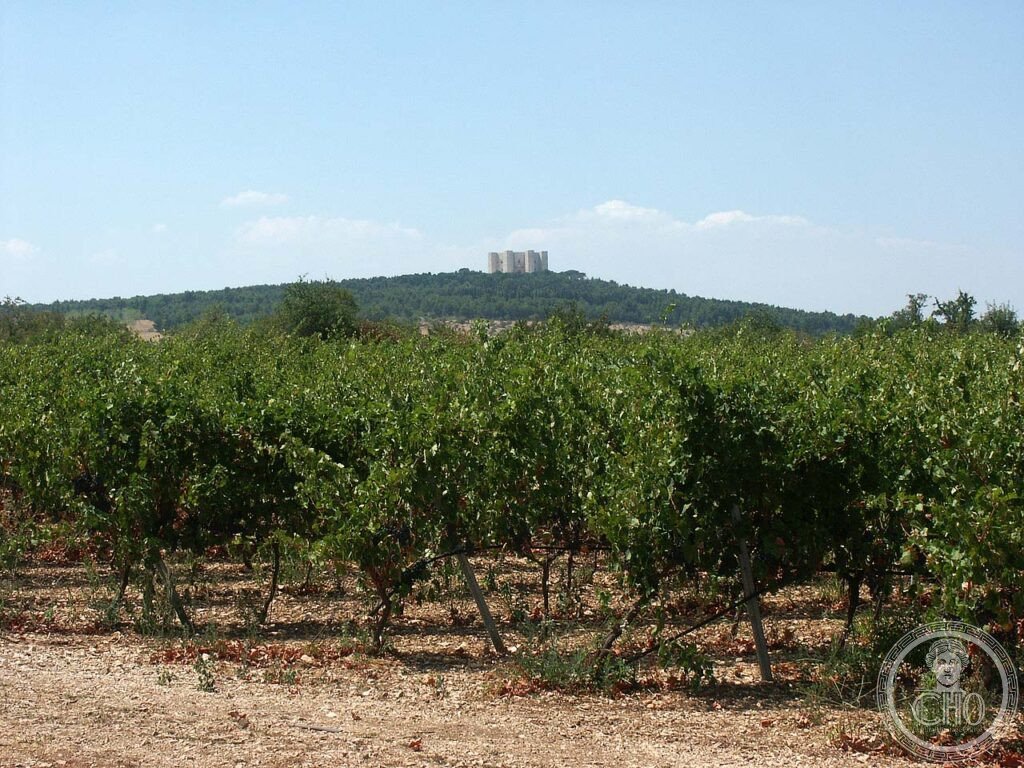
- Best time to visit: March-June and September-November (mild temperatures, fewer visitors); July-August is very hot on the exposed plateau (35-40°C) and the most crowded. Sunrise and sunset from the castle exterior are spectacular — the silhouette of the octagon against the Murge plateau is one of the most photographed images in southern Italy.
Getting there
Castel del Monte, Andria (BT), Apulia. GPS 41.0840, 16.2720. By train: Trenitalia from Bari to Andria (30-40 min, every 30-60 min; Bari is the regional transport hub — arrive by Frecciarossa from Rome 3h50, Naples 2h45, or regional from Brindisi 1h40); from Andria station, shuttle bus to the castle (18 km, 25 min). By car: from Bari, SS98 west or A14 exit Andria-Barletta → SP170 to Castel del Monte (60 km, 1h); from Naples, A1 → A16 → Andria exit → SP170 (250 km, 3h). Parking at the base of the hill (free, 300 m from entrance).
Nearby
- Trani — 25 km north-east; the medieval port city with the Cattedrale di San Nicola Pellegrino (Romanesque, 1099 to the thirteenth century) built directly on the sea — the most spectacularly positioned Romanesque cathedral in southern Italy; the medieval Jewish quarter (Giudecca) with the 13th-century synagogue (now converted to a church).
- Alberobello e i Trulli — 50 km south; (UNESCO 1996, ref.787); the only inhabited UNESCO trulli village (the conical dry-stone dwellings of Alberobello, built in an unique technique not found anywhere else in the world).
- Matera, Sassi — 80 km south-west; (UNESCO 1993, ref.670); the prehistoric cave-city of southern Italy, inhabited continuously from the Paleolithic (10.000 BCE) to 1952 (forced evacuation) and now the most architecturally dramatic urban rehabilitation in Italy.
Sources
- UNESCO: whc.unesco.org/en/list/398..
- Wikipedia EN: Castel del Monte..
- Belli D’Elia, Pina: Castel del Monte, Milano: Electa, 2000.
- Parco Culturale Castel del Monte: parcocasteldelmonte.it..
Find it on the map
See this place and what’s around it →📷 Become a Cultural Heritage Online photographer
Share your photos of places: they stay published under your name as the author. The more they're seen, the more you get noticed — and soon a contest will reward the most appreciated photos.
Log in or sign up free to add a photoIs this page about you?
This page is read by travellers and heritage enthusiasts who find it on Google. Tell us how you are connected to this place and we will take it from there.