
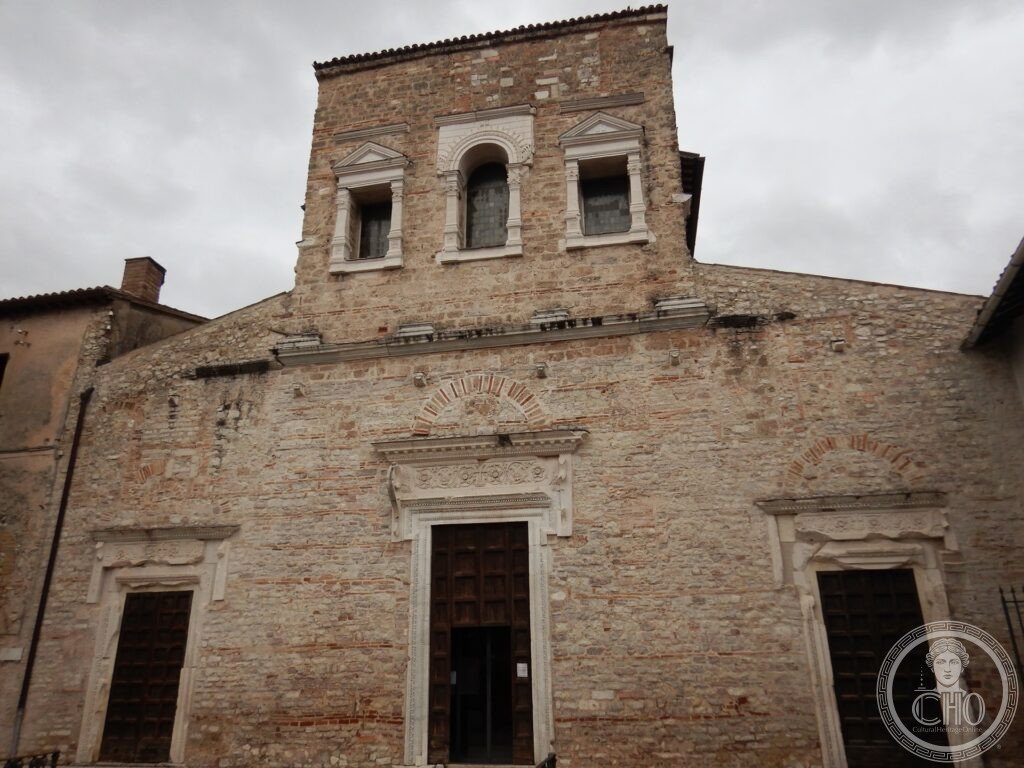
The Basilica of San Salvatore in Spoleto — built in the 4th or 5th century CE from the spoliated materials of demolished Roman temples, significantly modified by Lombard builders in the 7th or 8th century, and continuously used as a church ever since — is the oldest and most complete early Christian basilica in Umbria, containing the finest surviving examples of early Christian pierced-stone windows (finestre in pietra forata) in Italy: geometric lattice-work screens cut from single sheets of stone that filter light in the same way that alabaster or glass would do, and that represent a transitional technique between the solid Roman wall and the glass-filled Gothic window.
At a glance
Spoleto (province of Perugia, Umbria; UNESCO 2011, ref. 1318) was inscribed as part of the serial property “Longobards in Italy: Places of Power (568-774 AD).” Spoleto was the capital of the Duchy of Spoleto, one of the largest and most powerful of the southern Lombard duchies (established 571 CE; it survived the Carolingian conquest of the northern Lombard kingdom in 774 and continued as a Carolingian/then independent duchy until 1213). The San Salvatore basilica was the ducal church of Spoleto in the Lombard period; the modifications made by Lombard builders in the 7th-8th century (the interior decoration, possibly some structural changes) added Lombard layer to an already-complex building that had Roman, early Christian, and late antique phases.
Key facts
- Le finestre in pietra forata (IV-V sec.): The nave clerestory of San Salvatore has a series of windows made from single stone slabs with geometric patterns cut through them (circles, hexagons, and interlace patterns) that filter and diffuse light without using glass; this technique (known in French as “claustra” or in Italian as “transenna” or “finestra in pietra forata”) was the standard window treatment of early Christian basilicas in the 4th-6th century (before coloured glass windows became widespread); the San Salvatore examples are the most complete surviving set of pierced-stone windows in any Italian church: the windows are in the original positions, in the original stone, unrestored. The geometric patterns include: a simple repeating circle (the earliest type), a hexagonal tessellation, and a complex interlace pattern. In strong sunlight, the light filtered through these windows creates circular or hexagonal pools of light on the interior floor — a spatial effect that was deliberately designed
- The Roman spolia reuse: San Salvatore is built almost entirely from reused Roman building materials taken from the Roman temples and buildings of the Spoletium colony (Spoleto was a Latin colony of 241 BCE): the exterior column shafts (two of the original columns that framed the facade portals are still partially visible embedded in the facade), the capital types (which mix Corinthian, Composite, and late antique variants), and the entablature blocks (with pagan Roman decorative elements such as acanthus and egg-and-dart mouldings) all derive from demolished Roman-period buildings. The mixture of Roman marble spolia with early Christian spatial planning (the basilica plan: nave + two aisles + apse) in a single building is a perfect case study of the 4th-5th century Christian practice of architectural christianization through reuse
- The Lombard modifications (VII-VIII sec.): The most visible Lombard-period element is the interior decoration of the nave (the painted decoration, now largely lost, and some of the carved ornamental elements) and possibly the current roof structure. The interior was reorganized and redecorated in the Lombard period, probably under the patronage of the Duke of Spoleto (the Duchy was established in 571 CE by the Lombard duke Faroald I)
- Position in the cemetery: San Salvatore is located in the Cimitero Monumentale of Spoleto (the monumental cemetery on the hill north of the historic centre) — an unusual setting that gives the basilica an atmosphere of particular solemnity and protects it from tourist crowds
- UNESCO: 2011, ref. 1318
- GPS: 42.7367, 12.7425 — Google Maps
History
Spoletium was a Latin colony established in 241 BCE to control the Umbrian uplands; it became a significant Roman city (the road station on the Via Flaminia where the road forks north-east toward the Adriatic). The basilica of San Salvatore was built in the 4th or 5th century CE (the exact date is disputed; the architectural evidence suggests 4th century for the earliest phase) by early Christians reusing the material of the pagan Roman buildings; the dedication to “the Saviour” (San Salvatore = Il Salvatore) is one of the oldest dedications in Italian Christianity (predating the widespread adoption of saint's-name dedications). The Lombard duchy of Spoleto (established 571 CE) made the basilica its dynastic church and left the 7th-8th century layer visible in the interior. The duchy continued as an entity after the 774 CE Carolingian conquest and was not fully absorbed into the Papal State until 1213 (making it the longest-lasting quasi-independent Lombard political entity in central Italy).
What you see
San Salvatore is at the north end of the Cimitero Monumentale of Spoleto (the cemetery entrance on Viale Trento e Trieste, approximately 15 min on foot from the historic centre via Via San Carlo): you enter the cemetery and follow the main path to the back of the enclosure, where the basilica facade is visible at the far end. The facade (west-facing, with three portals and three window openings above) shows the three types of pierced-stone windows in the upper register (best visible from outside before entering, with morning or afternoon light from the west). Inside (admission; open during cemetery hours): the nave with the clerestory windows (walk slowly down the nave on a sunny day and look up at the light patterns on the floor from the pierced-stone windows), the apse (with fragments of ancient decorative schemes), and the columns (with the mix of capital types — Corinthian, Composite, and late antique variants — that document the Roman spolia origin).
Gallery
Practical information
- Basilica di San Salvatore: Via San Carlo (access via Viale Trento e Trieste, Cimitero Monumentale), Spoleto (PG); open daily 7:00-19:00 (summer) and 7:00-17:00 (winter; access through the Cimitero Monumentale); free (it is a working church within a public cemetery).
- Combined Spoleto visit: The Spoleto historic centre (Duomo, Rocca Albornoziana, Ponte delle Torri, Arco di Druso) is 15 min on foot from San Salvatore. The Duomo di Spoleto (12th century, with a stunning Romanesque rose window and Filippo Lippi frescoes in the apse, 1467-1469 — Lippi died in Spoleto while painting the Assumption and is buried in the Duomo) is the other principal monument of the city.
- Festival dei Due Mondi (Spoleto Festival): The Spoleto Festival (July, founded 1958) is one of Italy's major performing arts festivals (opera, dance, theatre, exhibitions); if visiting in July, accommodation must be booked months in advance.
Getting there
Cimitero Monumentale, Spoleto (PG), Umbria. GPS 42.7367, 12.7425. By train: Trenitalia from Perugia (50 min regional; frequent); from Rome (1h20-1h40 via Foligno; Frecciarossa from Roma Tiburtina to Spoleto Ferrovia); from Florence (2h with change at Foligno). Spoleto station is 1.5 km from the historic centre (local bus or 20 min on foot). By car: from Perugia, E45 south (60 km, 45 min); from Rome, A1 to Orte then SS3 Flaminia north (180 km, 2h).
Nearby
- Tempietto sul Clitunno — 10 km north; (CHO card: Tempietto Clitunno UNESCO 2011); the other Longobards-in-Italy site in Umbria, the false-Roman-temple church
- Ponte delle Torri — 500m from the Duomo di Spoleto; the 14th-century aqueduct-bridge (82 m high, 230 m long, across the gorge between the Rocca Albornoziana and the Monteluco forest) is the most dramatic medieval engineering structure in Umbria; the walk from the Rocca to the Monteluco monastery across the bridge gives the best view of the bridge and of the Spoleto valley
- Assisi — 60 km north; (CHO card TBD); the Basilica di San Francesco (UNESCO 2000, with Giotto frescoes cycle) and Rocca Maggiore
Sources
- UNESCO: whc.unesco.org/en/list/1318
- Wikipedia EN: Basilica of San Salvatore, Spoleto
- Krautheimer, Richard: Early Christian and Byzantine Architecture, Yale University Press, 4th ed. 1986
- Comune di Spoleto — Basilica di San Salvatore: comune.spoleto.pg.it
Find it on the map
See this place and what’s around it →📷 Become a Cultural Heritage Online photographer
Share your photos of places: they stay published under your name as the author. The more they're seen, the more you get noticed — and soon a contest will reward the most appreciated photos.
Log in or sign up free to add a photoIs this page about you?
This page is read by travellers and heritage enthusiasts who find it on Google. Tell us how you are connected to this place and we will take it from there.