
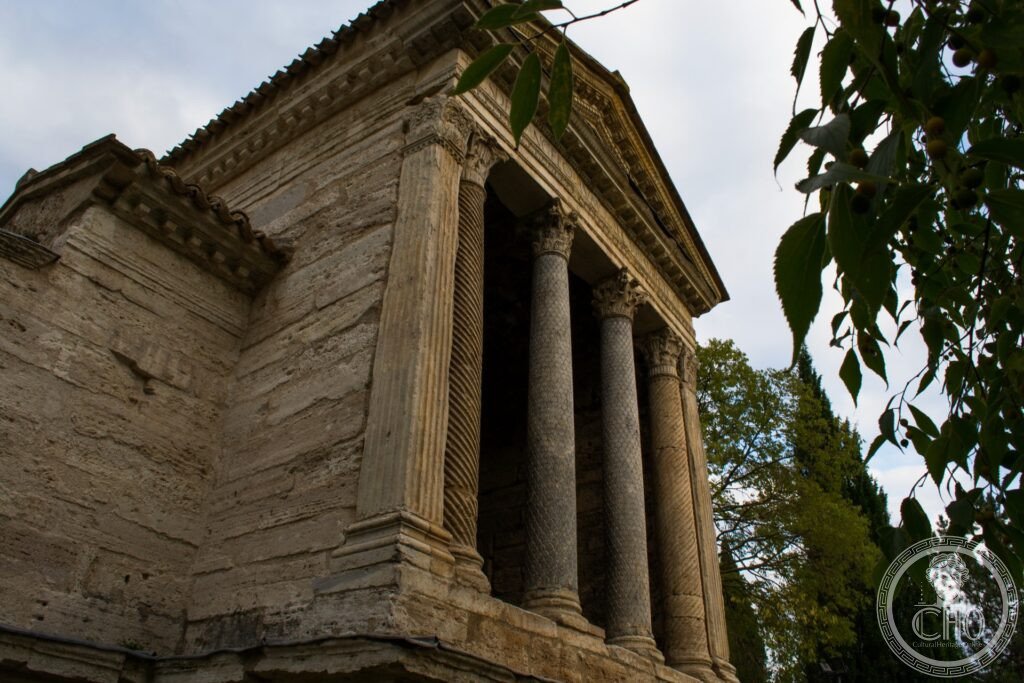
The Tempietto sul Clitunno at Campello — a small church building in the Clitunno river valley, constructed in the 7th century CE with columns, capitals, and entablature blocks taken from demolished Roman temples — so perfectly mimics the appearance of a small Roman temple that it was identified as such by every traveller and scholar from antiquity to the early 20th century, including Goethe (1786), Byron (“Sweet Clitumnus!”), and Carducci (who won the Nobel Prize partly for his poem about it); only the Christian dedication inscription carved into the architrave and the east orientation of the building (temples face west; churches face east) reveal that it is a church, not a temple.
At a glance
Campello sul Clitunno (province of Perugia, Umbria; UNESCO 2011, ref. 1318) was inscribed as part of the serial property “Longobards in Italy: Places of Power (568-774 AD).” The Tempietto sul Clitunno is the most enigmatic of the seven Lombard sites in the inscription: it is a small single-nave church (approximately 14 m × 5.5 m) with a pseudo-prostyle facade (four Corinthian columns supporting an architrave with a classical inscription and a triangular pediment above) constructed entirely from spoliated Roman building materials (column shafts, capitals, entablature blocks, cella wall blocks — all taken from the Roman sanctuary of the river deity Clitunnus that had occupied the same riverside site in antiquity). The date of construction (probably 7th century, possibly early 8th century) places it in the Lombard period, but the debate about whether it was actually built by Lombards or by early Christian converts using Roman spolia is unresolved.
Key facts
- The “false temple” problem: The Tempietto was identified as a genuine Roman temple by Pliny the Younger (he described a temple at the Clitunno springs in his Epistles, VII.8, written c.107 CE); from the Renaissance onward, the Tempietto was assumed to be this Plinian temple, preserved intact. Only in 1879 did the philologist Giosue Carducci (Nobel Prize 1906) propose — in his poem “Alle fonti del Clitunno” — that the building was not Roman but Christian; and only in the 20th century did systematic art-historical analysis establish that the building was built in the 7th-8th century CE from Roman spolia, not in the Roman period. The Christian dedication inscription on the architrave (… IN HONOREM ET IN MEMORIAM APOSTOLORUM ET MARTYRUM XLII… = “in honour and memory of [the] apostles and forty-two martyrs”) is in late antique letter forms (5th-7th century) and definitively identifies the building as Christian
- The frescoes inside: The interior of the Tempietto has original frescoes on the apse and the triumphal arch (late 7th-early 8th century), showing Christ enthroned between the apostles Peter and Paul (apse), and figures of saints (triumphal arch); the fresco style is related to the Castelseprio frescoes (another Lombard site, UNESCO 2011) in its Byzantine-influenced expressive quality
- Goethe, Byron, Carducci: The Tempietto was a stop on the 18th-19th century Grand Tour: Goethe visited in 1786 and described it in the Italienische Reise (“a very singular little building, which I described from different viewpoints”); Byron included the “Sweet Clitumnus” line in Childe Harold's Pilgrimage (Canto IV, 66, 1818); Carducci's poem of 1876 was a major factor in the Risorgimento-era re-evaluation of the site as a symbol of the ancient Italian genius
- UNESCO: 2011, ref. 1318
- GPS: 42.7618, 12.6730 — Google Maps
History
The Clitunno valley was a significant Roman sacred site in antiquity: the river Clitunnus (the Clitunno, a tributary of the Topino) was believed to be sacred to an oracular river deity, and the springs at Campello (where the river emerges from the hillside in a series of cold, clear pools) were the site of a Roman sanctuary described by Pliny the Younger (c.107 CE) as a pleasant resort with colonnaded temples, guest houses, and a constant stream of visitors seeking omens from the river. After the Roman collapse and the Lombard conquest (6th-7th century), the Roman sanctuary was demolished and its materials were reused to build the current Tempietto as a Christian church, probably dedicated to the Apostles and Martyrs (the inscription survives) and possibly to San Sebastiano (a later medieval dedication). The site was continuously used as a church through the medieval period; the current interior frescoes (7th-8th century) are the earliest visual evidence of the site's Christian phase.
What you see
The Tempietto is a standalone building on the west bank of the Clitunno river, accessible from the SS3 (Via Flaminia) on a minor road (signed “Tempietto Longobardo”). The approach from the road is through a small riverside park (the Parco delle Fonti del Clitunno, with the natural springs and pool of the river, a favourite Romantic-era picnic spot). The Tempietto itself is a 15-minute walk from the parking area along the river bank. From the exterior: the four-column facade (the false-temple front) from the west side (do not mistake it for a Roman temple — look for the Christian inscription in the architrave). The interior (admission required): the fresco cycle in the apse and on the triumphal arch. The interior is small (approximately 20 people maximum) and the frescoes are in relatively good condition but require close inspection. There is a printed guide available at the entrance.
Gallery
Practical information
- Tempietto sul Clitunno: Via Flaminia SS3, Campello sul Clitunno (PG); open daily 10:30-13:00 and 14:30-17:00 (winter), 10:30-13:00 and 14:30-18:30 (summer); admission ~€2. Closed Mondays in winter. The site is managed by the Comune di Campello sul Clitunno; confirm opening hours before visiting.
- Fonti del Clitunno: The Clitunno springs (5 min drive south from the Tempietto along the SS3) are a separate public garden/natural site (the large pool fed by the springs, with boating and picnicking) that is free to visit and makes a pleasant combination with the Tempietto.
- Combined visit with Spoleto: Spoleto (the Basilica di San Salvatore, the other UNESCO Longobards site in Umbria) is 10 km south of the Tempietto on the SS3. The two sites can be combined in a half-day from Spoleto or from Foligno.
Getting there
Via Flaminia, Campello sul Clitunno (PG), Umbria. GPS 42.7618, 12.6730. By train: Trenitalia from Spoleto (10 min regional; Campello-Limiti station, 1 km from the Tempietto); from Foligno (20 min regional). The Campello-Limiti station has irregular service (check timetables); most visitors come by car. By car: from Spoleto, SS3 north (10 km, 10 min); from Foligno, SS3 south (18 km, 20 min); from Perugia, E45 south to Foligno then SS3 south (60 km, 50 min).
Nearby
- Spoleto — 10 km south; (CHO card: Spoleto San Salvatore UNESCO 2011); the Basilica di San Salvatore (4th-5th century, with 7th-century Lombard modifications, UNESCO 2011) + the Arco di Druso (1st century BCE), the Duomo (12th century, with Filippo Lippi frescoes in the apse), and the Ponte delle Torri (14th-century aqueduct-bridge, 82 m high, 200 m long)
- Assisi — 50 km north; (CHO card TBD); the Basilica di San Francesco (1228-1253, UNESCO 2000, with Giotto frescoes) and the Rocca Maggiore (13th-century castle with panoramic views)
- Fonti del Clitunno — 5 min south on SS3; the Roman-era natural springs (described by Pliny the Younger, visited by Goethe and Byron); free public garden; the pool is one of the most photographed natural sites in Umbria
Sources
- UNESCO: whc.unesco.org/en/list/1318
- Wikipedia EN: Tempietto sul Clitunno
- Pliny the Younger: Epistolae VII.8, c.107 CE (description of the Clitunno sanctuary)
- Goethe, J.W.: Italienische Reise, 1816-1817 (visit 1786)
- Carducci, Giosue: Alle fonti del Clitunno, in Odi barbare, 1876
Find it on the map
See this place and what’s around it →📷 Become a Cultural Heritage Online photographer
Share your photos of places: they stay published under your name as the author. The more they're seen, the more you get noticed — and soon a contest will reward the most appreciated photos.
Log in or sign up free to add a photoIs this page about you?
This page is read by travellers and heritage enthusiasts who find it on Google. Tell us how you are connected to this place and we will take it from there.