
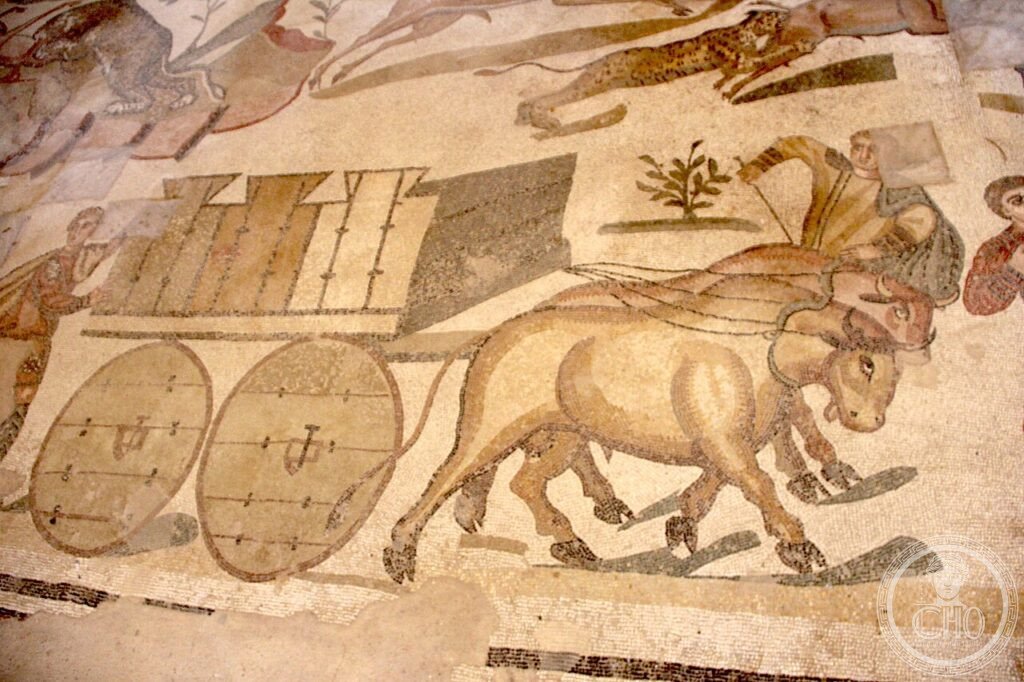
The Villa Romana del Casale, built in the Sicilian interior between approximately 310 and 360 CE, preserves 3,500 square metres of Roman floor mosaic across 40 rooms — the largest in-situ Roman mosaic complex in the world — including the most vivid surviving depictions of Roman Africa, Roman hunting practice, Roman athletic games, and Roman private life at the highest imperial social level.
At a glance
The Villa Romana del Casale (near Piazza Armerina, province of Enna, Sicilia; UNESCO 1997, ref. 516) is a late Roman country villa of exceptional size (approximately 3,500 m² of floor mosaic in 40 surviving decorated rooms, plus extensive bath complexes, courtyards, and service buildings) built in the early 4th century CE. The villa's mosaics are the single most important surviving record of late Roman pictorial culture: the North African mosaic workshops that created them (the style, the techniques, and the iconographic repertory are closely related to the mosaics of Carthage, Sousse, and El-Jem in modern Tunisia) produced compositions of exceptional quality and complexity, including the longest mosaic carpet in Roman art (the 64-metre Great Hunt corridor showing the capture of exotic animals in Africa for transport to Roman arenas), the most famous erotic-adjacent image in Roman archaeology (the “Bikini Girls” of the Large Gymnasium, showing young women athletes in two-piece garments playing games), and the finest mythological composition surviving from Roman domestic decoration (the Ulysses and Polyphemus scene in the Small Hunt corridor).
Key facts
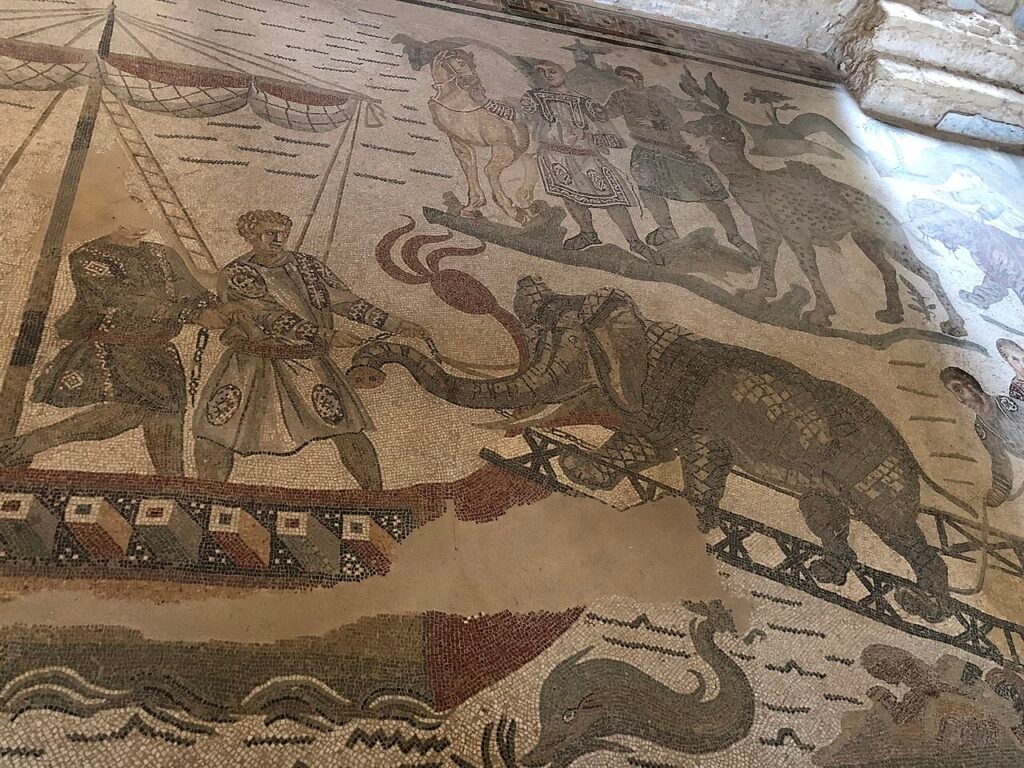
- The Great Hunt (Ambulacro della Grande Caccia): The most impressive room of the villa: a corridor 64 metres long and 5 metres wide, entirely covered in a mosaic showing the capture of exotic African animals (elephants, rhinoceroses, lions, tigers, ostriches, antelopes, wild boars, bears) and their transport by ship to Rome for use in the ludi (public games in the arena). The composition is organized symmetrically around two central figures (imperial personages, possibly Maximian and his son Maxentius, identified by their purple cloaks and attended by soldiers) directing the hunt from Africa. The animals are shown with anatomical accuracy suggesting observation of live animals, not copying of models; the African landscapes (acacia trees, Nile-edge vegetation, Nilotic scenes) are the most extensive surviving Roman depiction of non-European landscape
- The “Bikini Girls” (Sala delle Ragazze in Bikini / Large Gymnasium): The mosaic of the vestibule of the Large Gymnasium shows 10 young women athletes engaged in various sports (discus throwing, ball games, running, receiving a victory crown) wearing garments consisting of two pieces covering only breasts and hips — structurally identical to a modern bikini and the earliest surviving visual record of this type of garment in Western art. The interpretation (are they athletes? gladiators? dancers? a specific class of female athletes known from late Roman sources?) is debated, but the visual accuracy and quality of the execution is not
- Ownership (hypothesis): The identity of the villa's owner is not documented in any source. The prevailing hypothesis (based on the imperial iconography of the mosaics, the exceptional scale, and the administrative evidence for Maximian's presence in Sicily in the early 4th century) is that the villa belonged to Maximian (Marcus Aurelius Valerius Maximianus, co-emperor with Diocletian 285-305 CE, d.310 CE) or a member of his immediate family. The hypothesis is not confirmed by epigraphy or documentation
- Discovery and conservation: The villa was buried under a landslide in the 12th century (which paradoxically preserved the mosaics by covering them with protective earth) and rediscovered in the 1940s-1950s; systematic excavation and conservation began in 1950 and major restoration was completed in 2010-2012; the current protective covering (a steel-and-glass structure over the entire site, built in the 1990s-2000s) protects the mosaics from weather while allowing visitor circulation above the mosaic level on elevated walkways
- UNESCO: 1997, ref. 516
- GPS: 37.3655, 14.3330 — Google Maps
History
The Villa del Casale was built in several phases between approximately 310 and 360 CE, with the main construction campaign in 320-340 CE; it was continuously occupied through the 5th and 6th centuries, used as an Arab farmstead in the 9th-10th centuries, and buried under a landslide (from the surrounding hills) at some point in the 12th century. The burial preserved the mosaics by covering them with neutral earth that did not damage the tesserae; local inhabitants were aware of the ruins (medieval chronicles mention “palatium comitis Rogerii” in the area, suggesting a tradition that associated the site with the Norman Count Roger) but systematic excavation was only undertaken after World War II. The excavation campaigns of 1950-1964 (directed by Gino Vinicio Gentili of the Soprintendenza of Agrigento) revealed the full extent of the mosaic decoration; the protective covering was built in stages from the 1960s to the 2000s; the major consolidation and re-covering project (building the current steel-and-glass shelter) was completed in 2012.
What you see
The visitor circuit of the Villa del Casale (elevated walkways above the mosaic level, with the mosaics visible below and the surrounding ruins visible through the glass walls) covers approximately 2 hours for a thorough visit. The main sequence (following the walkway circuit in the standard direction) is: the entrance atrium (with the mosaic of the Hunting Seasons on the threshold); the bath complex (the richest surviving late Roman bath decoration outside North Africa, with marine creature mosaics in the cold pool and the heating system visible); the Great Hunt corridor (the 64-metre narrative carpet, the centrepiece of the visit); the triclinium (formal dining room, with the Labours of Hercules mosaic, one of the largest single mythological compositions in Roman art); the private apartments (with the Small Hunting and Fishing corridor, the Children's Circus, the Erotic Room); and the Large Gymnasium with the “Bikini Girls” mosaic.
The protective glass covering over the entire site creates an unusual visiting experience: the mosaics are approximately 0.5-1.5 metres below the walkway level, and the elevated position allows the visitor to see the full composition of each room from above (the intended viewpoint for large floor mosaics) rather than from ground level (which was the standard perspective for archaeologists during excavation and early publication, and which distorts the proportional relationships). The photographic challenge of glass reflections is real — early morning or overcast days give the best light.
Gallery
Practical information
- Villa Romana del Casale: Contrada Casale, 3 km from Piazza Armerina town centre; open daily 9:00 to one hour before sunset; admission ~€10 (full), ~€5 (reduced, EU citizens 18-25). Combined tickets with the Museo Regionale di Enna available.
- Crowding: The Villa is one of the most visited sites in Sicily; July-August can be very crowded on the walkways (which are narrow). April-June and September-October give better conditions. Guided tours in Italian and English are available at the site entrance (advance booking recommended in peak season).
- Photography: Permitted without flash; the glass canopy creates reflections that require polarizing filters. Early morning (9:00-10:00) or late afternoon (17:00-18:00) are the best light conditions.
- Duration: 2-3 hours for the full circuit.
Getting there
Contrada Casale, Piazza Armerina (EN), Sicilia. GPS 37.3655, 14.3330. By car: from Enna, SS192 south-west then SP15 (30 km, 30 min); from Catania, A19 then SS192 (95 km, 1h30); from Palermo, A19 east to Enna then SS192 (165 km, 2h). By shuttle: local buses from Piazza Armerina to the villa (limited service; check locally). No direct train to Piazza Armerina; nearest station: Enna (30 km).
Nearby
- Caltagirone — 50 km east; (CHO card: Caltagirone UNESCO 2002); the Scala di Santa Maria del Monte (142 ceramic-decorated steps) and the Museo Regionale della Ceramica
- Agrigento / Valle dei Templi — 70 km south-west; (CHO card: Agrigento Valle dei Templi batch9 2026-05-29); the Valley of the Temples (UNESCO 1997, ref.831); the Tempio della Concordia (440 BCE, the best-preserved Greek Doric temple in the world)
- Morgantina — 15 km east; the excavated ancient Greek and Roman city (5th century BCE – 2nd century CE) with a well-preserved agora; the “Venus di Morgantina” (a cult statue in the Metropolitan Museum New York, repatriated to Sicily 2011 after a long legal battle) was excavated here
More photographs
Sources
- UNESCO: whc.unesco.org/en/list/516
- Wikipedia EN: Villa Romana del Casale
- Gentili, Gino Vinicio: La Villa Erculia di Piazza Armerina, Roma 1959
- Ministero della Cultura: villaromanadelcasale.it
Find it on the map
See this place and what’s around it →📷 Become a Cultural Heritage Online photographer
Share your photos of places: they stay published under your name as the author. The more they're seen, the more you get noticed — and soon a contest will reward the most appreciated photos.
Log in or sign up free to add a photo