
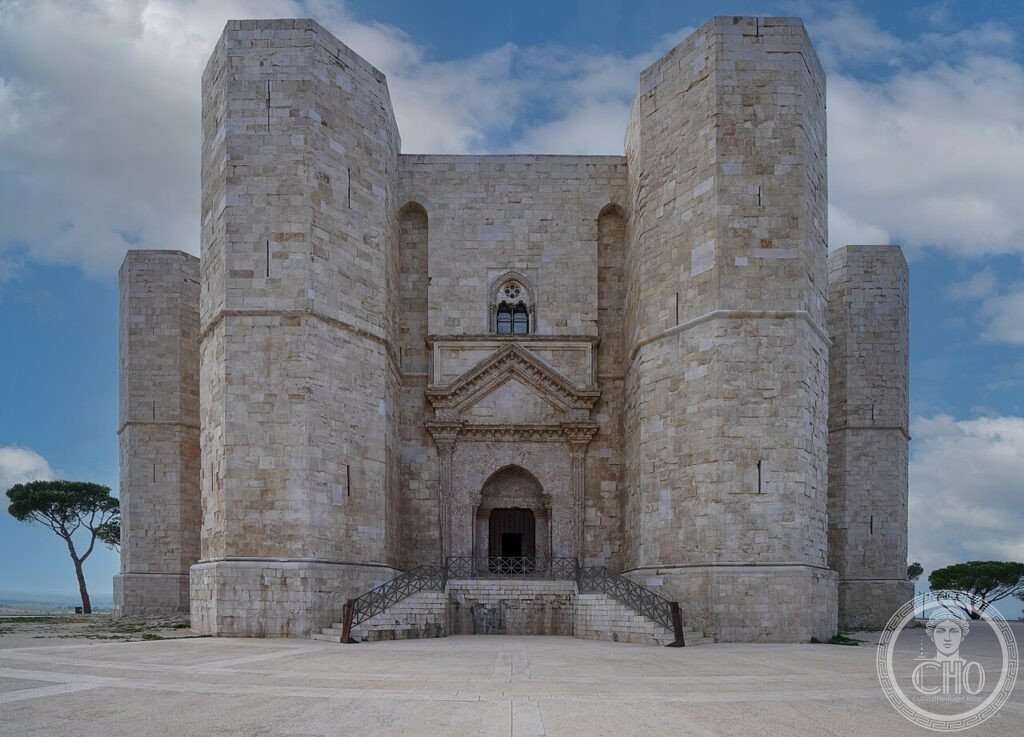
Castel del Monte — built by Emperor Frederick II of Hohenstaufen (1194-1250) on a hilltop in Puglia, probably between 1229 and 1240, with a perfect octagonal plan and eight octagonal towers — has no moat, no drawbridge, no grain store, no stables, and no well: it was never a military castle, and what it was actually for has been debated by historians for nearly eight centuries.
At a glance
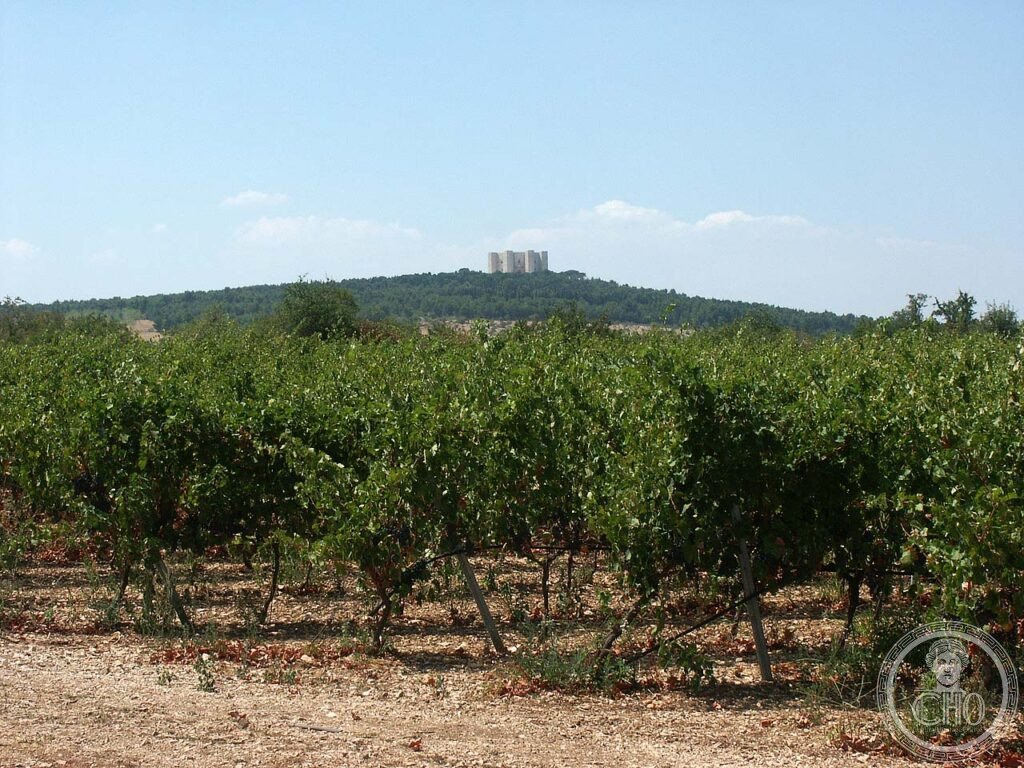
Castel del Monte (province of Barletta-Andria-Trani, Puglia) is the most architecturally enigmatic monument of medieval Italy. Built by Emperor Frederick II of Hohenstaufen at some point between 1229 and 1240 CE (the documentary record is incomplete — no contract of commission, no building account, no contemporary description survives), the castle is a perfect regular octagon in plan, with eight identical octagonal towers at the corners, rising two storeys above a hilltop (540 m) in the Murgia Pugliese, visible for 30-40 km in all directions. Unlike every other castle of the period, it has no moat, no drawbridge, no grain store, no barracks, no stables, no productive facilities, no defensive earthworks: the architectural elements of military architecture (towers, battlements, arrow slits) are present as forms but emptied of their military function, combined with marble portals in the Gothic style (unusual in Puglia in the 13th century), ribbed vault systems derived from French Gothic cathedrals, private apartments with latrines, and a geometrical precision in plan and in all dimensional relationships that is unparalleled in 13th-century Italy.
Key facts
- The octagonal plan: The main body of the castle is a perfect regular octagon (each of the eight sides is 16.5 m); the eight towers at the corners are also perfect regular octagons (each tower is 3.1 m on each face); the eight interior rooms on each floor (16 rooms total, in two storeys) are also trapezoidal shapes with octagonal towers at the inner corners; the courtyard at the centre is also octagonal. The octagon (8 sides = the number between the square/4 and the circle/∞ = the number of the Resurrection in Christian iconography; the shape of baptisteries and coronation thrones in the Hohenstaufen tradition) is the structuring element of the entire building, from the plan to the individual rooms to the towers to the courtyard
- Frederick II (1194-1250): Frederick II of Hohenstaufen, “Stupor Mundi” (the wonder of the world — the contemporary epithet for a monarch who was simultaneously Holy Roman Emperor, King of Sicily, and King of Jerusalem, spoke 6 languages, maintained a court of Arab, Jewish, and Christian scholars, wrote a treatise on falconry that is still the standard reference, and was excommunicated four times by the Pope while on crusade), was the most extraordinary ruler of medieval Europe and the principal patron of all the major architectural projects in southern Italy and Sicily in the 1220s-1240s. Castel del Monte is the most celebrated of the approximately 200 castles and towers attributed to his patronage in Puglia and Sicily
- What it was for (hypotheses): Military strongpoint (rejected — no defensive features function militarily); hunting lodge (possible — Frederick II was an obsessive falconer and the Murgia was prime hunting territory); astronomical observatory (proposed — the shadow of the entrance portal falls across the courtyard in geometrically significant positions at the equinoxes and solstices); symbolic monument to Hohenstaufen power (most plausible — the octagonal form, the orientation, and the dimensions encode numerical relationships that reference the imperial ideology of the Hohenstaufen court); ceremonial residence for a single visit (the historic records show Frederick II at Castel del Monte in 1240; no other royal visit is documented)
- UNESCO: 1996, ref. 398
- GPS: 41.0840, 16.2709 — Google Maps
History
Castel del Monte was built under Frederick II at some point between 1229 (the first documentary mention, in a letter ordering local authorities to supply materials) and 1240 (the year of the first and only documented royal visit). After Frederick II's death (1250) and the fall of the Hohenstaufen dynasty in southern Italy (1266, when Charles of Anjou defeated Manfredi at Benevento), the castle was used briefly as a prison (several Hohenstaufen princes were held there under Angevin captivity in the 1270s) and then abandoned. It was used as a quarry for building material in the late medieval period (the marble portals and floors were stripped, the sculptures removed) and remained in poor condition through the 19th century; restoration and consolidation began in the 1880s and the major structural restoration was completed in the 1930s. The question of the castle's original interior decoration (the columns, the floor mosaics, the marble revetments, of which only traces remain) has been partially answered by the restoration campaigns of the 1990s-2000s.
What you see
The visit to Castel del Monte (access via a shuttle bus from the visitor centre 1.2 km away) begins with the external circuit: walking around the castle, which sits alone on the hilltop without any surrounding structures, the visitor can appreciate the full octagonal form and the scale (each side is 16.5 m; the towers project approximately 7 m from the face). The main entrance portal (on the east side, facing the approach road) is the most elaborately carved surviving element: the pointed arch in limestone, with two columns (the capitals are in the classical mode, unusual for the 1230s) flanking the door. The interior (16 rooms in two storeys around the octagonal courtyard) is largely stripped of decoration — the marble portals, floors, and column shafts were removed in later centuries — but the ribbed vaulting (in the Gothic system derived from French architecture, brought to Puglia by Frederick's court builders) survives in most of the rooms and is the most refined architectural element visible. The courtyard (a regular octagon, approximately 17 m across) has the central space where the geometric relationships of the castle — the shadows at equinox, the proportional system — can be appreciated. The upper storey is accessible via a spiral staircase in one of the towers.
Gallery
Practical information
- Castel del Monte: Contrada Castel del Monte, Andria (BAT); visitor centre at the car park 1.2 km below the castle (the road to the castle is closed to private traffic); shuttle bus from visitor centre to castle entrance (~€1, runs continuously during opening hours). Open daily 9:00-19:30 (summer), 9:00-17:30 (winter); closed December 25 and January 1. Admission ~€5 (full), ~€2.50 (reduced).
- Tip: The castle is most impressive in the late afternoon or at sunset (the golden limestone turns amber-orange in the low light). The castle is 40 km inland from Bari; visit before or after Bari to optimize travel time.
- Duration: 1-1.5 hours for the castle visit.
Getting there
Contrada Castel del Monte, Andria (BAT), Puglia. GPS 41.0840, 16.2709. By car: from Bari, SS98 west to Andria then SP234 south to the castle (65 km, 1h); from Barletta, SS98 east to Andria then SP234 (35 km, 40 min). No direct public transport to the castle. By organized tour: several operators from Bari (day trip, 2-3h including travel).
Nearby
- Alberobello — 60 km south-east; (CHO card: Alberobello batch9 2026-05-29); the trulli — dry-stone conical-roofed white-painted houses unique to the Valle d'Itria; UNESCO 1996 (ref.787)
- Bari Vecchia (old city of Bari) — 65 km east; the Basilica di San Nicola (1087-1197, the first church built in the Romanesque Pugliese style, housing the relics of St Nicholas of Myra — patron saint of children, sailors, Russia, and Greece; the destination of Orthodox Christian pilgrimage from Russia and Greece since the 12th century)
- Trani — 30 km north; the Duomo di Trani (1099-1200, Romanesque Pugliese, built on a rock jutting into the Adriatic immediately at the sea level — the most visually dramatic siting of any Romanesque cathedral in Italy); the Jewish quarter (the most complete medieval Jewish quarter surviving in Puglia)
Sources
- UNESCO: whc.unesco.org/en/list/398
- Wikipedia EN: Castel del Monte, Apulia
- Borsook, Eve: “Frederick II” in Art and Politics in the Middle Ages, 1990
- Ministero della Cultura, Castel del Monte: casteldelmonte.beniculturali.it
Find it on the map
See this place and what’s around it →📷 Become a Cultural Heritage Online photographer
Share your photos of places: they stay published under your name as the author. The more they're seen, the more you get noticed — and soon a contest will reward the most appreciated photos.
Log in or sign up free to add a photoDo you manage this place?
This page is read by travellers and heritage enthusiasts who find it on Google. Keep it accurate — and make it work for you. Free for non-profit heritage institutions.