
The Sanctuary of Monte Sant’Angelo — a natural cave in the Gargano promontory where the Archangel Michael is believed to have appeared to the Bishop of Siponto four times between 490 and 493 CE — is the oldest continuously active pilgrimage site in Western Christianity: it predates Santiago de Compostela (711 CE) by 221 years, Lourdes (1858 CE) by 1,368 years, and has received an uninterrupted stream of pilgrims for over 1,530 years, including Crusader armies (who stopped here before and after campaigns), medieval popes, Norman knights, and twelve canonized saints.
At a glance
The Sanctuary of Monte Sant’Angelo (province of Foggia, Puglia) is one of seven components of the UNESCO serial property “Longobards in Italy. Places of the Power (568-774 A.D.)” (ref. 1318), inscribed in 2011. The inscription covers seven sites across Italy that bear outstanding testimony to the Longobard people’s political, cultural, and religious history after their conquest of most of the Italian peninsula in 568 CE: Cividale del Friuli (FVG), Castelseprio-Torba (VA), Brescia/San Salvatore-Santa Giulia (BS), Campello sul Clitunno (PG), Spoleto/San Salvatore (PG), Benevento/Santa Sofia (BN), and Monte Sant’Angelo (FG). The Monte Sant’Angelo component is valued both for its role in the Longobard world (the Lombard Dukes of Benevento, who controlled the Gargano, built the first permanent sanctuary structures in the 7th-8th centuries and had the archangel Michael as their patron; the sanctuary provided them with religious legitimacy and a pilgrimage economy) and for its pre-Longobard significance as the earliest important Christian sanctuary in the West dedicated to a specific archangel.
Key facts
- The apparitions (490-493 CE): According to the tradition first recorded in the Liber de Apparitione Sancti Michaelis in Monte Gargano (c.6th century), Lorenzo Maiorano, bishop of Siponto (the ancient city on the coast near modern Manfredonia), had four visions of the Archangel Michael between 490 and 493 CE, in which the archangel appeared in a natural cave on the summit of Monte Gargano and instructed that the cave be consecrated as a place of Christian worship without further construction (unlike other Christian shrines, which are built over or around the sacred site; at Monte Sant’Angelo, the natural cave itself is the sanctuary). The fourth apparition (493 CE) is considered the definitive founding moment; the cave was consecrated by Bishop Lorenzo without further alteration (the archangel had declared it already consecrated). This tradition — of a cave sanctuary on a mountaintop, consecrated by divine apparition rather than episcopal decree — became the model for Michaeline sanctuaries throughout Europe (including Mont-Saint-Michel in France, 708 CE, which directly cites the Monte Gargano precedent as its founding inspiration)
- Longobard period (568-774 CE): The Lombard Duchy of Benevento (one of the two major Lombard principalities that survived the Frankish conquest of the Lombard Kingdom in 774 and continued as independent entities until the Norman conquest in the 11th century) had Monte Sant’Angelo within its territory; the dukes of Benevento adopted St. Michael as their patron saint and made regular donations to the sanctuary; the sanctuary received so many pilgrims from Lombard territory that it developed substantial political and economic importance for the duchy. The Lombards also built the Castello (the Norman fortification that replaced the Lombard tower has Byzantine and Norman additions from the 9th-12th centuries)
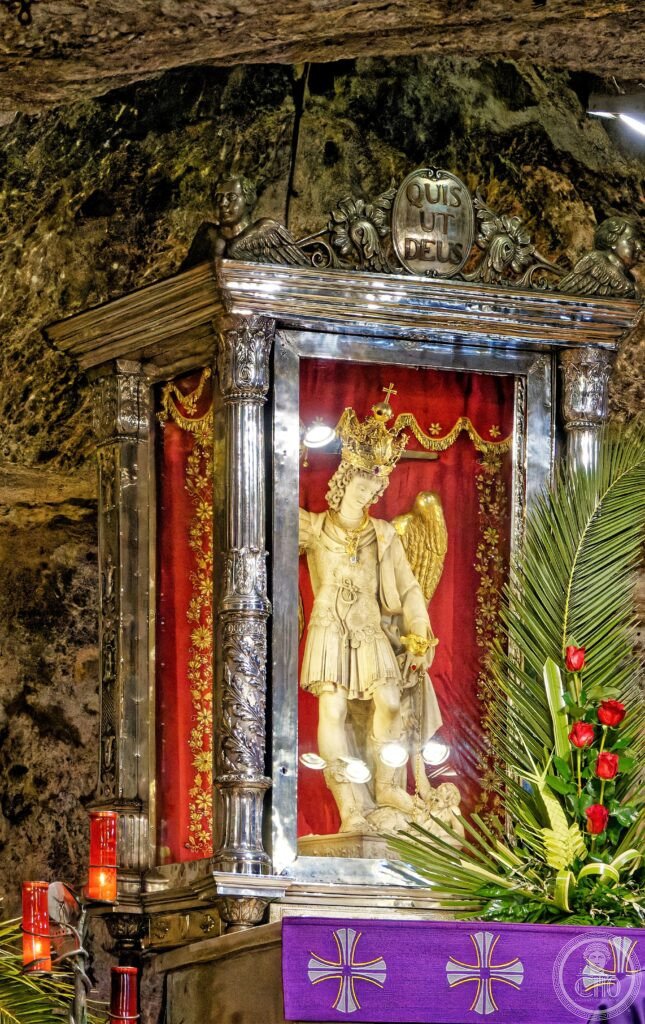
- The cave interior: The bronze doors (commissioned 1076 by Pantaleone of Amalfi from a bronze-caster in Constantinople; 24 panels with scenes from the life of the Archangel Michael and dedications in Greek and Latin); the 8th-century Bishop’s Throne; the 11th-century statue of Saint Michael by Andrea di Salerno; the large altar niche where the apparition occurred; the carved inscriptions by pilgrims (including one in Old Norse, probably from a Viking-age pilgrim passing through southern Italy)
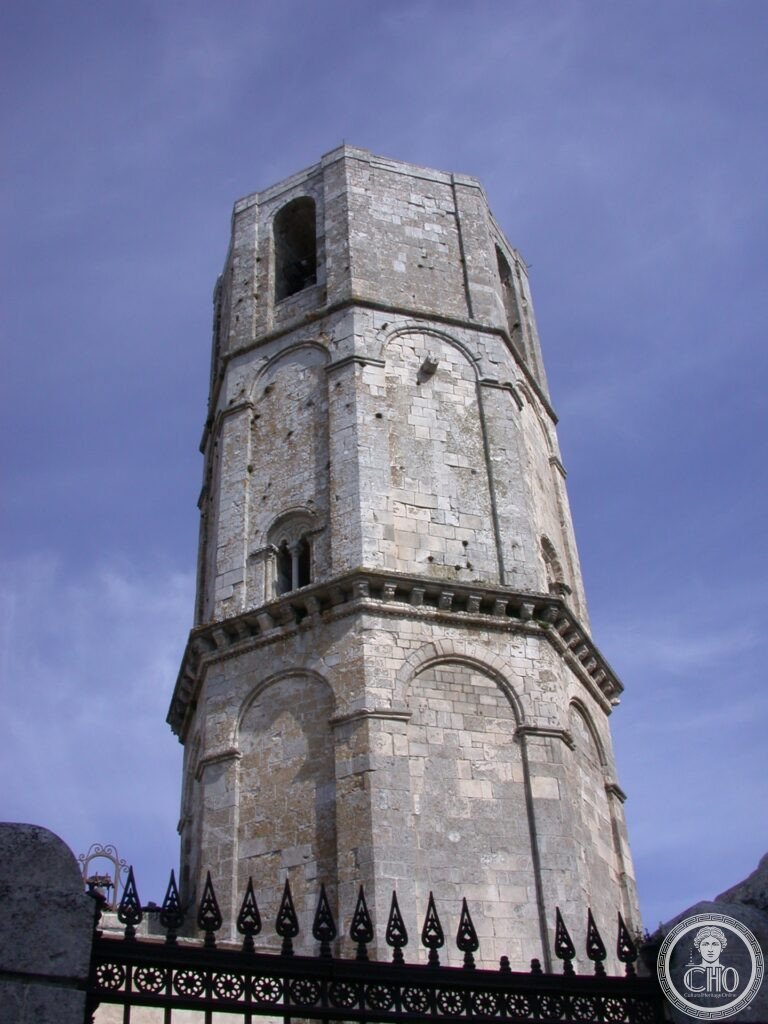
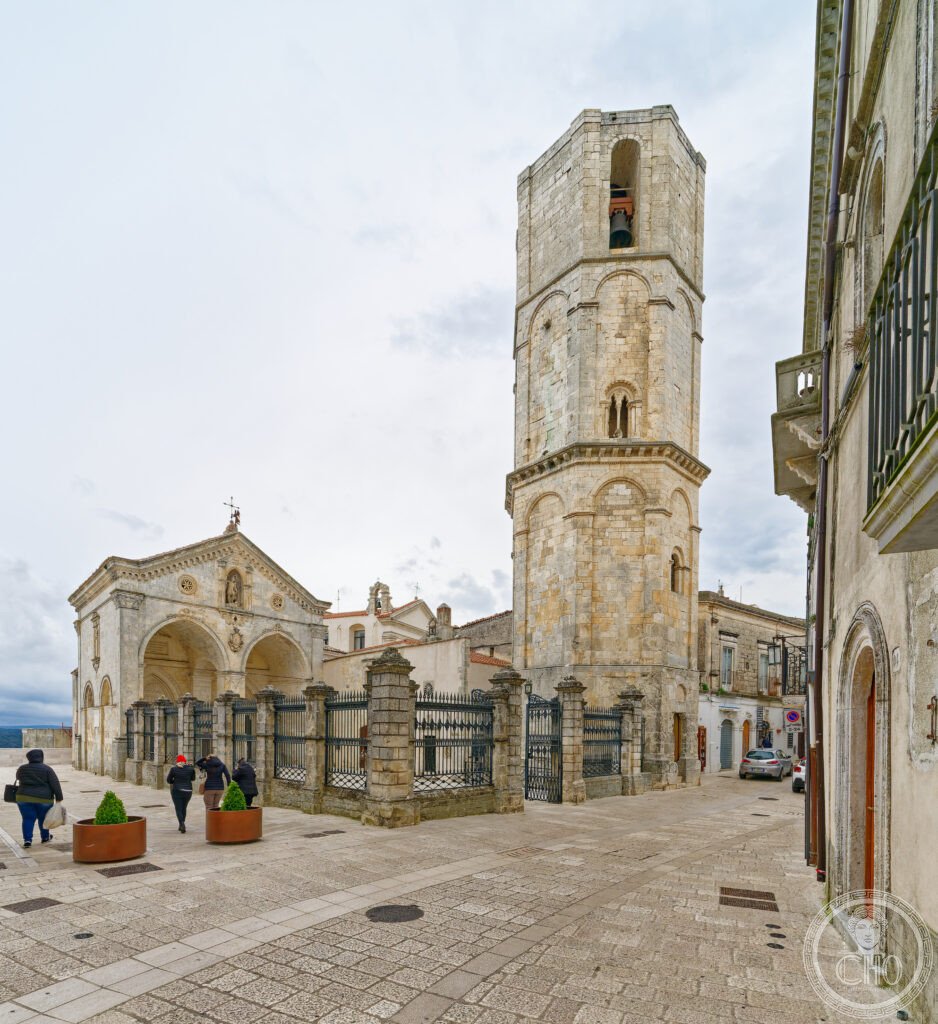
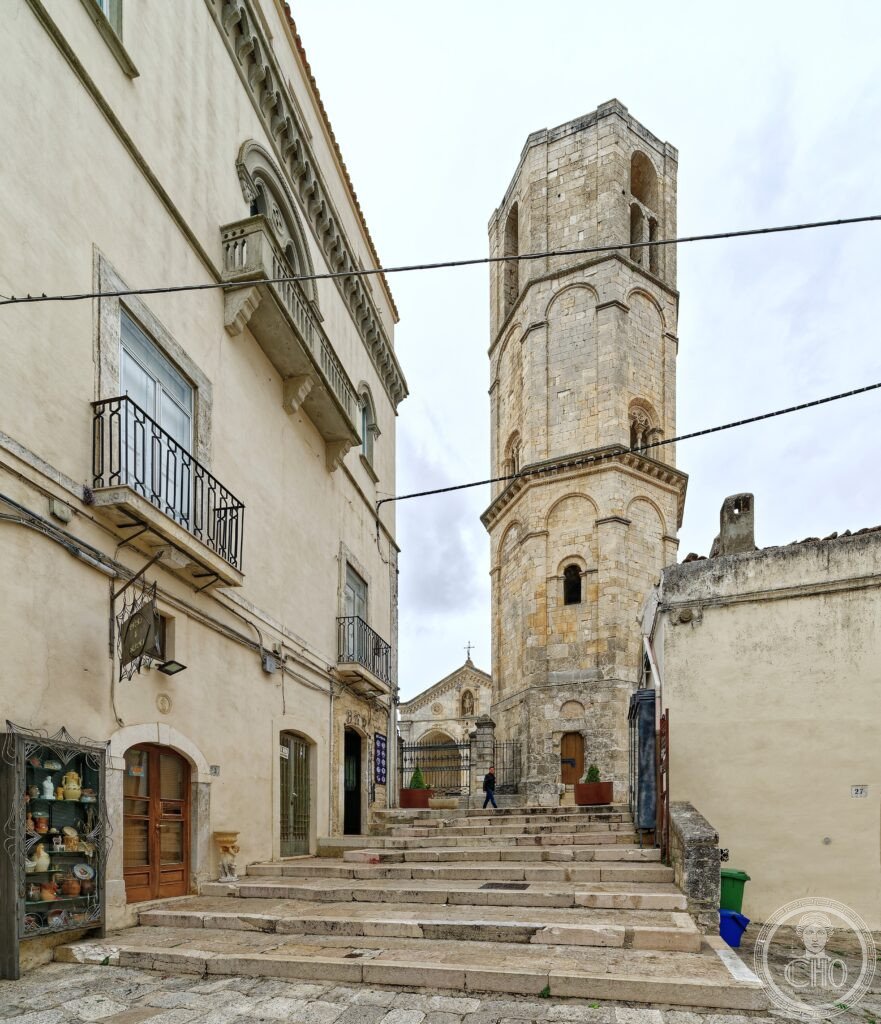
- The tower campanile (1282): Built by Charles I of Anjou (who had just defeated the Hohenstaufen at the Battle of Benevento in 1266); the octagonal tower (32m) is the only significant aboveground structure of the sanctuary (the rest is underground in the cave) and is visible from the coast 20 km away
- UNESCO: 2011, ref. 1318 (as part of “Longobards in Italy: Places of the Power”)
- GPS: 41.7088, 15.9615 — Google Maps
History
The pilgrimage to Monte Sant’Angelo established itself in the 5th-6th centuries as the most important Michaeline sanctuary in Western Christianity — Michael being the principal warrior-angel in the Christian tradition (patron of soldiers, knights, and high places) and the Gargano sanctuary being the only place where Michael was believed to have physically appeared and consecrated the earth with his feet. In the 8th and 9th centuries, Monte Sant’Angelo received visits from Frankish kings (Charlemagne sent a gold chalice before his Lombard campaign in 773; he or his representatives visited after the conquest to give thanks at the shrine of the Lombard royal saints); from Norman adventurers in the early 11th century (the tradition that the first Norman group to enter southern Italy was inspired to stay by a vision at Monte Gargano in 1016 CE, though this is a later legendary elaboration); from Crusader armies on their way to and from the Holy Land (the port of Manfredonia on the coast 17 km from Monte Sant’Angelo was an embarkation point). The sanctuary hosted at various times: Pope Gelasius I (492-496), Pope Urban II (who launched the First Crusade at Clermont in 1095 and stopped at Monte Gargano on his return), Emperor Frederick II (who visited repeatedly from his Apulian bases), Charles I of Anjou, and hundreds of thousands of unnamed pilgrims.
What you see
The approach to the sanctuary (from the Piazza Roma or the Via Reale dei Lombardi, 15 steps down from the main piazza of Monte Sant’Angelo old town) leads through the atrium — an open courtyard with two logge, inscriptions from various papal visits, and the octagonal campanile (1282) — and then down the 86-step scala (the main staircase descending into the mountain, built in the 17th century over earlier medieval stairs). At the bottom is the vestibule with the bronze doors (1076, 24 panels) and the entrance to the cave-sanctuary.
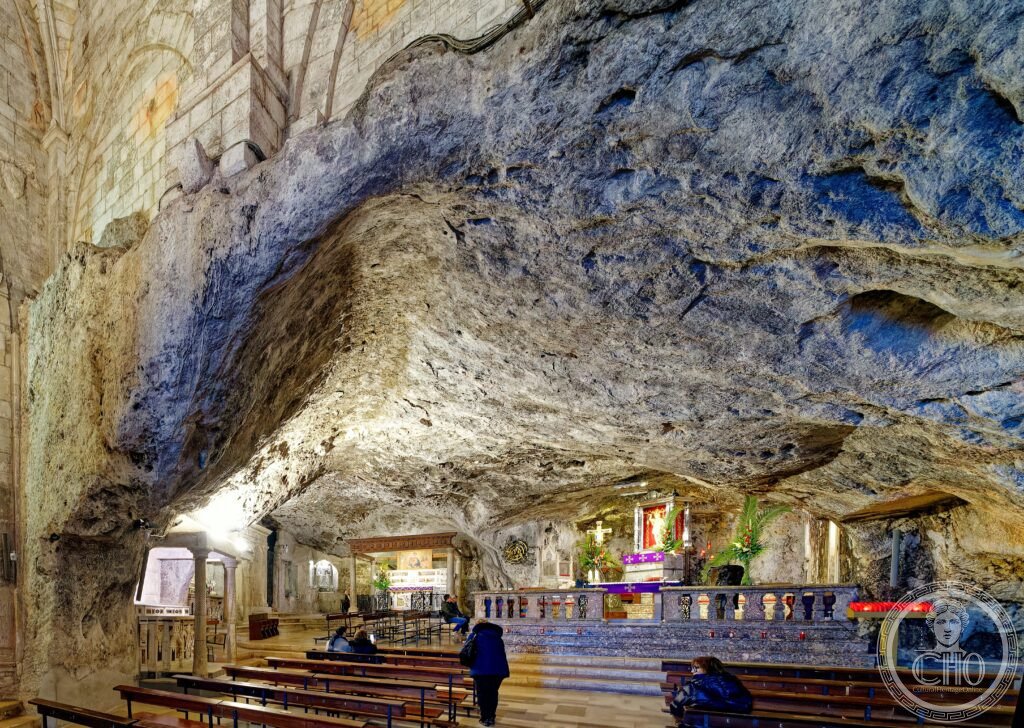
The cave itself (the Grotta) is approximately 30m × 15m × 9m: the natural limestone cave is entirely visible (no significant architectural modification beyond the nave division), with natural stalactite formations on the walls and ceiling. The altar niche (the exact spot of the apparition, according to tradition) is in the deepest part of the cave, marked by a white marble ciborium (13th century) with a bronze statue of the Archangel (Andrea di Salerno, 11th century; the standing figure in armour and helmet, sword in hand, is the canonical medieval Western iconographic type of Michael as warrior-archangel). The carved pilgrim graffiti on the cave walls — ranging from medieval Latin inscriptions to a runic text from a Norse-language pilgrim — cover every accessible surface.
Gallery
Practical information
- Santuario di San Michele Arcangelo: Via Reale dei Lombardi, Monte Sant’Angelo (FG); open daily 7:30-12:30 and 14:30-19:00 (summer extended to 20:00). Free entry (donations accepted). Dress code: shoulders and knees covered. The sanctuary can be crowded on religious feast days (8 May, feast of the apparition; 29 September, feast of the archangels; Easter weekend).
- The grotto: The cave temperature is approximately 14°C year-round — bring a layer regardless of outdoor temperature.
- Monte Sant’Angelo old town: The medieval town above the sanctuary is well preserved and offers several hours of exploration: the Castello (Norman/Angevin fortification, 9th-14th century, on the summit; open Tuesday-Sunday 9:00-19:00; admission ~€4), the archaeological museum, and the old Jewish quarter (Via del Macello area).
- Duration: Sanctuary visit: 30-60 min. Old town exploration: 1-2 hours. Total with castle: 3-4 hours.
Getting there
Via Reale dei Lombardi, Monte Sant’Angelo (FG), Puglia. GPS 41.7088, 15.9615. Monte Sant’Angelo has no railway station. By bus: SITA bus from Foggia railway station (45 km, 1h; 3-4 services/day); from Manfredonia (17 km, 40 min; more frequent services). By car: from Foggia, SS89 then SP23 north-east (45 km, 50 min); from Bari, A14 north to Foggia exit then SS89 (175 km, 2h). Parking in Piazza Duca d’Aosta (paid, 3-min walk from sanctuary entrance).
Nearby
- Manfredonia — 17 km south-west; the Museo Nazionale del Gargano (in the Castello Angioino; important pre-Christian and early-Christian finds from the Gargano and Siponto area); the Basilica di Santa Maria di Siponto (11th-12th century, on the site of the ancient city)
- Foresta Umbra — 30 km north; the dense beech and oak forest at the centre of the Gargano promontory; one of the least-altered primary forests in southern Italy; deer, rare orchids, and walking trails
- Mattinata e Baia delle Zagare — 25 km south-east; the southern Gargano coast with sea stacks, sea caves, and clear water
Sources
- UNESCO: whc.unesco.org/en/list/1318
- Wikipedia EN: Sanctuary of Monte Sant’Angelo
- Otranto, Pierre: Origines et histoire du sanctuaire de Mont-Gargan, Presses universitaires de Bordeaux, 2000
- Santuario di San Michele Arcangelo: santuariosanmichele.it
Find it on the map
See this place and what’s around it →📷 Become a Cultural Heritage Online photographer
Share your photos of places: they stay published under your name as the author. The more they're seen, the more you get noticed — and soon a contest will reward the most appreciated photos.
Log in or sign up free to add a photoIs this page about you?
This page is read by travellers and heritage enthusiasts who find it on Google. Tell us how you are connected to this place and we will take it from there.