
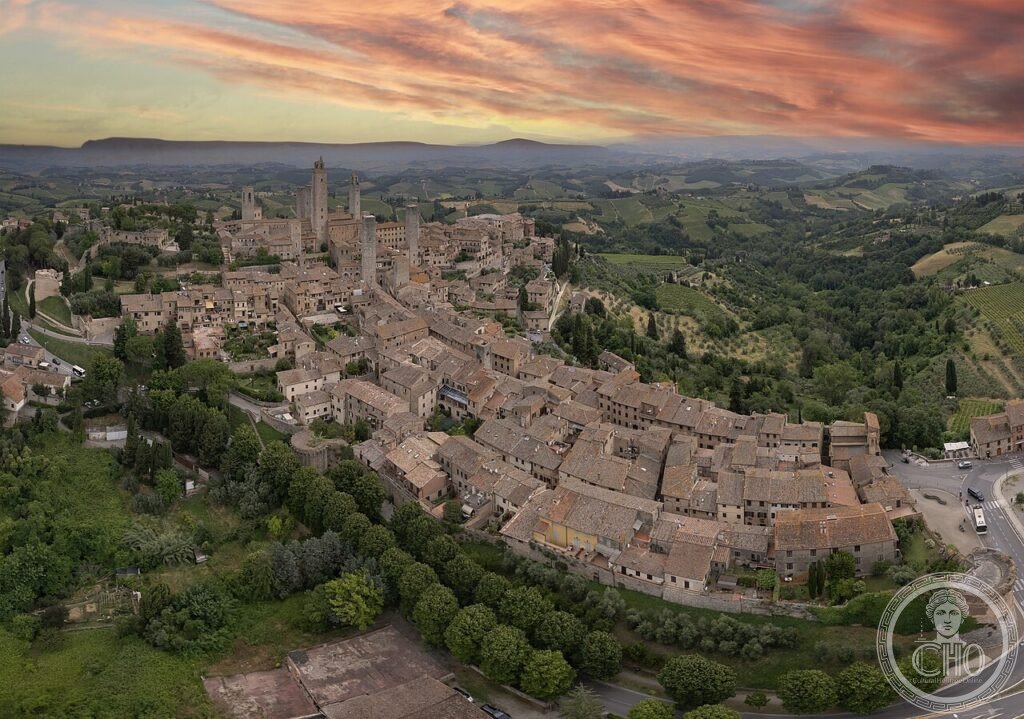
San Gimignano’s fourteen surviving medieval towers — out of the original seventy-two that once rose from this small hilltop town of 7,000 inhabitants — make it the only place in Italy where the medieval Tuscan tower landscape can be understood at something approaching its original scale: a skyline of private fortresses where noble families built upward in stone as an expression of competitive pride, political allegiance, and commercial success.
At a glance
San Gimignano (province of Siena, Toscana) is a UNESCO World Heritage Site inscribed in 1990 (ref. 550) as “Historic Centre of San Gimignano.” The inscription covers the entire historic centre of the medieval town within its 13th-14th century walls — approximately 53 hectares with a resident population of approximately 2,000 people (the historic centre; the municipality has about 8,000 total). The town was an important stop on the Via Francigena (the main pilgrimage route from Canterbury to Rome, via France and the Alps) and grew wealthy in the 12th-13th centuries from the toll income, hospitality services, and above all from its famous saffron (Zafferano di San Gimignano, still grown in the surrounding countryside and sold at the premium price its medieval reputation commands) and from banking (several Gimignanese banking families operated in England, France, and the Levant in the 13th century).
Key facts
- The towers: 72 towers were built by the noble families of San Gimignano between the 11th and 14th centuries; 14 survive; the tallest is the Torre del Grasso (also called the Torre di Palazzo Comunale or Torre Rognosa depending on the source; 54 m). The tower-building tradition in Tuscany was common in the 12th-13th centuries (Siena, Lucca, Florence all had hundreds of towers that were almost entirely demolished in the 14th-15th centuries by rival families or by communal authority asserting control over private fortification); San Gimignano’s peculiarity is that the towers survived because the town’s economic and political decline after the 14th century (plague, loss of independence, reduced population) meant there was no incentive or resource for demolition or rebuilding. The 1255 municipal statute of San Gimignano regulated tower construction (setting a maximum height equal to the town hall tower and prohibiting towers taller than the Torre della Rognosa, which was the symbol of communal authority)
- Collegiata di Santa Maria Assunta: The main church (not a cathedral, since San Gimignano was never a bishop’s see) contains one of the most complete fresco programmes in Italy: the New Testament cycle by Barna da Siena (nave right wall, 1333-1338); the Old Testament cycle attributed to Bartolo di Fredi (nave left wall, 1356-1367); the Chapel of Santa Fina (Domenico Ghirlandaio, 1475, two frescoes depicting the life of the local saint, among the finest early Renaissance frescoes in Tuscany outside Florence); the Last Judgment by Taddeo di Bartolo (west wall, 1393)
- Sant’Agostino (church): The other important frescoed church, outside the town walls; the Cycle of the Life of Saint Augustine by Benozzo Gozzoli (1465, 17 scenes, choir apse) is a masterpiece of early Renaissance narrative painting and Gozzoli’s second most important surviving fresco cycle after the Magi Chapel in the Medici Palace in Florence
- UNESCO: 1990, ref. 550
- GPS: 43.4677, 11.0438 — Google Maps
History
San Gimignano was an Etruscan settlement before becoming a Roman municipium (Forum Bamboli or Silvis Giminanae, named after a 4th-century bishop, Saint Geminian of Modena, whose relics were said to have saved the city from Attila’s Huns in 450 CE and who became the town’s patron saint). The medieval commune emerged in the 10th-11th centuries, growing rapidly as a toll and service node on the Via Francigena — Dante Alighieri stopped in San Gimignano in 1300 on his way to Siena (as prior of the Florentine republic, seeking to recruit support against Pope Boniface VIII’s territorial ambitions in Tuscany). The town’s independence was ended in 1353 when, weakened by the Black Death (1348) and internal factional conflict (Ardinghelli vs. Salvucci), San Gimignano submitted voluntarily to Florentine rule. The Florentines quickly demolished many of the tower-fortifications as a measure of control over private military power — but San Gimignano’s relative insignificance within the Florentine sphere meant that demolition was never complete, and the 14 surviving towers are the result.
What you see
The essential circuit covers the Piazza della Cisterna (the triangular market square with the 13th-century cistern at its centre), the Piazza del Duomo (the civic-religious centre with the Collegiata, the Palazzo del Popolo with its tower, and the twin Salvucci towers), and the main corso (Via San Giovanni and Via San Matteo). The Collegiata fresco programme (Barna da Siena, Bartolo di Fredi, Ghirlandaio) is the principal indoor monument. The Palazzo del Popolo museum contains the Civic Museum (Sienese Gothic paintings) and access to the Torre Grossa (the tallest tower accessible to the public, 54 m; 218 steps; panoramic view of the Val d’Elsa). The church of Sant’Agostino (10-min walk north from the Piazza del Duomo) has the Gozzoli fresco cycle in a well-lit apse, usually less crowded than the Collegiata.
Gallery
Practical information
- Collegiata di Santa Maria Assunta: Piazza del Duomo 2; open Monday-Friday 10:00-19:30, Saturday 10:00-17:30, Sunday 12:30-19:30 (summer; reduced hours autumn-winter). Admission ~€5.50 (combined with Museo d’Arte Sacra). Not open during services (check bulletin board).
- Torre Grossa + Museo Civico: Piazza del Duomo 2; open daily 10:00-19:30 (summer), 11:00-17:30 (winter). Admission ~€9 (combined tower+museum).
- Sant’Agostino (Gozzoli): Piazza Sant’Agostino; open Monday-Friday 7:00-12:00 and 15:00-19:00, Saturday-Sunday 7:00-12:00 and 15:00-18:00. Free entry.
- Season: July-August is very crowded (buses from Florence and Siena, tour groups); best April-June and September-October. The town is very small (the main street is 600m end-to-end) and receives 3-4 million visitors annually — arrive early morning or evening to avoid the midday crowds.
Getting there
Piazza della Cisterna, San Gimignano (SI), Toscana. GPS 43.4677, 11.0438. San Gimignano has no railway station. By bus: SITA-Nord from Florence (90 km; 1h30-2h via Poggibonsi, change bus; 2-3 departures per hour); from Siena (40 km; 1h via Poggibonsi). Buses arrive at Piazzale dei Martiri di Montemaggio at the south gate of the town; the centre is a 5-min walk. By car: from Florence, A1 south to Poggibonsi exit then SP69 west (90 km, 1h15); from Siena, SS2 north then SP69 west (40 km, 45 min). Paid parking at Parcheggio Bagnaia (the largest, nearest the south gate) and Parcheggio Montestaffoli (west gate).
Nearby
- Siena — 40 km south-east; (see CHO card: Siena UNESCO 1995 ref.717 — Piazza del Campo, Palio, Duomo)
- Volterra — 30 km west; (Etruscan city with Guarnacci Museum, alabaster workshops, medieval centre)
- Certaldo Alto — 15 km north; the medieval hilltop village where Giovanni Boccaccio (author of the Decameron) spent his last years and is buried; the Museo Casa del Boccaccio in his family palazzo
Sources
- UNESCO: whc.unesco.org/en/list/550
- Wikipedia EN: San Gimignano
- Frugoni, Chiara: A Day in a Medieval City, University of Chicago Press, 2005
- Comune di San Gimignano: sangimignano.com
Find it on the map
See this place and what’s around it →📷 Become a Cultural Heritage Online photographer
Share your photos of places: they stay published under your name as the author. The more they're seen, the more you get noticed — and soon a contest will reward the most appreciated photos.
Log in or sign up free to add a photo