
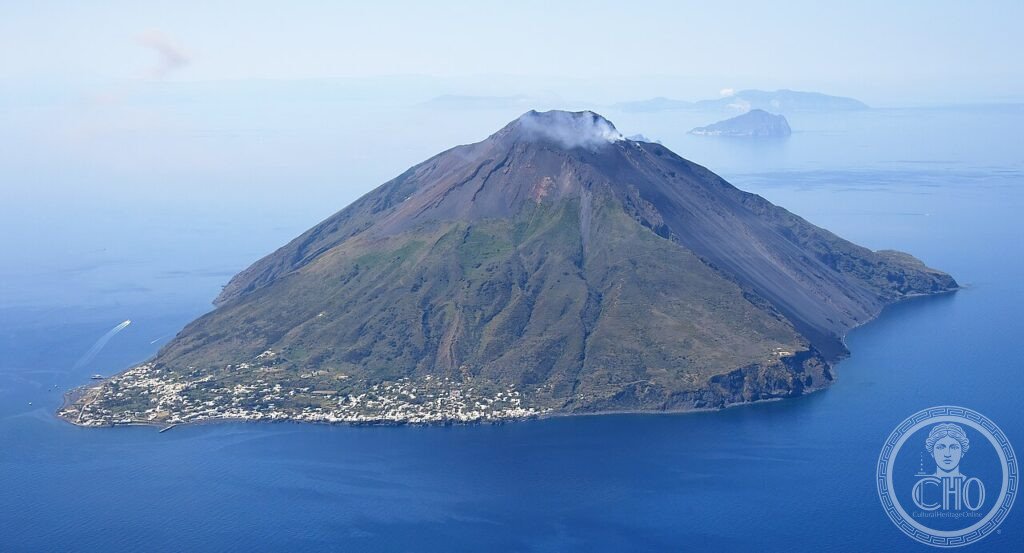
The Aeolian Islands (Isole Eolie) are a set of seven active and dormant volcanic islands in the Tyrrhenian Sea north of Sicily that have played a central role in the history of volcanology — the Stromboli volcano’s signature pattern of small, regular explosions every fifteen to twenty minutes has given its name to the “Strombolian” eruption type, one of the five basic categories of volcanic eruption recognized by science worldwide — and whose obsidian from Lipari was one of the most widely traded commodities in prehistoric Europe, distributed by seafarers from the Mesolithic (c.9000 BCE) across the western Mediterranean from Malta to Spain.
At a glance
The Aeolian Islands (Isole Eolie, province of Messina, Sicilia) are a UNESCO World Heritage Site inscribed in 2000 (ref. 908) under natural heritage criteria (vii) and (viii) — the only Italian UNESCO site inscribed exclusively as a natural heritage site. The inscription covers all seven islands (Lipari, Vulcano, Stromboli, Salina, Panarea, Filicudi, Alicudi) plus their surrounding marine areas, totalling approximately 1,598 hectares of land and 14,762 hectares of marine zone. The islands are part of the Aeolian volcanic arc, a subduction-related chain of volcanoes generated by the subduction of the African tectonic plate under the Eurasian plate, active from approximately 1.3 million years ago to the present. Stromboli is the most continuously active volcano in the world — it has been erupting with regular Strombolian explosions for at least 2,000 years without major interruption — and was used by 19th-century sailors as a “lighthouse” for Mediterranean navigation.
Key facts
- Stromboli (926 m, year-round eruptions): The northernmost of the Aeolian Islands; the subaerial part (the island visible above water) is only 3% of the total volcanic structure, which extends 2,700 m below sea level; the “Stromboli” eruption type is defined as: regular, rhythmic explosive eruptions every 15-20 minutes from a permanent lava lake in the summit craters (Crater NE, Crater SW), throwing incandescent lava fragments 150-300 m into the air; Stromboli has erupted at this pattern for at least 2,000 years (documented by Roman authors); major Paroxysm events (much larger eruptions) occur every few years (2019 paroxysm: lava flow to the sea on the “Sciara del Fuoco” flank; 2022 paroxysm: ash and lava flow visible from Calabria). The recommended view is from the “Pizzo dello Sciara” viewpoint (290 m altitude) or from boats at night (the “Strombolicchio” sea-stack is a separate volcanic plug)
- Lipari (island and main town): The largest Aeolian island (37.6 km²); the Lipari caldera is currently dormant; the island has been continuously inhabited since approximately 4000 BCE; the obsidian (volcanic glass, produced by rapid cooling of silica-rich lava) of the Monte Pelato obsidian flow on Lipari is the origin of one of the most important prehistoric trade networks in the Mediterranean — Liparian obsidian has been found at sites in Spain (4,000 km distant), North Africa, the Levant, and the British Isles; the Museo Archeologico Regionale “Luigi Bernabò Brea” at Lipari town contains the most important prehistoric Mediterranean archaeological collection outside Athens, tracing 8,000 years of human occupation on the islands
- Vulcano (island): Directly north of Sicily (visible from Capo Peloro on clear days); currently dormant but with active fumaroles, mud pools, and thermal emissions at the Porto di Levante area (the famous sulphur baths); the island gives its name to all explosive volcanic vents (a “vulcano” in Italian = any volcanic crater, from the Roman god of fire Vulcanus)
- UNESCO: 2000, ref. 908 (natural heritage)
- GPS: 38.7905, 14.9341 — Google Maps (Stromboli island)
History
The obsidian of Lipari was the most important non-lithic raw material in Mediterranean prehistory before the Bronze Age metallurgy revolution. The volcanic glass — harder, sharper, and easier to knap (chip into tools) than flint — was used to make scrapers, blades, arrowheads, and knives from approximately 9000 BCE; the Liparian obsidian was identified in the 1960s-70s by trace element analysis as the source of obsidian artefacts found at sites up to 4,000 km distant in Spain, North Africa, the Levant, and (in the widest interpretation of the distribution maps) as far as Britain. The Aeolian Islands therefore represent the most important prehistoric long-distance trade route in the western Mediterranean — a network that predates by several thousand years the Greek and Phoenician trading networks that conventional history identifies as the beginning of Mediterranean trade.
The Greek name “Aeolian Islands” (from Aeolus, god of winds) reflects the importance of the islands as a navigation landmark in classical antiquity: Homer set the episode of Odysseus and Aeolus (who gave Odysseus a bag containing all the winds) on “Aeolia,” most likely the island of Lipari. Thucydides mentions the Sicels and Siculians inhabiting the islands before the first Greek colonists from Cnidus (Rhodes) arrived at Lipari in 580 BCE to found the Lipara colony. The Roman name “Liparae insulae” (Liparian islands) reflects the dominance of Lipari as the main settlement.
What you see
Each of the seven islands offers different geological and cultural experiences. Stromboli: guided ascent to the craters (mandatory; solo ascent above 290 m is prohibited; guides from Magmatrek, Società Navigazione Pippo; depart 16:00 to arrive at 290 m viewpoint for the sunset eruption display; full summit ascent to 920 m: 5-6 h round trip, headlamp essential); boat tours at night from Stromboli port (most spectacular view: the Sciara del Fuoco observed from the sea with eruption visible as a red glow). Lipari: the Museo Regionale at the Norman castle hill (essential — 8,000 years of local history, extraordinary prehistoric Mediterranean collection); the obsidian flows of Monte Pelato (accessible by 4WD or trekking); the white pumice beaches of Campo Bianco. Vulcano: the sulphur mud baths at Porto di Levante (open June-October, a natural therapeutic experience and a genuine geological curiosity — the mud is heated by fumarole gas from below); the Fossa di Vulcano crater (391 m; 2-3 h round trip; active fumaroles visible on the crater rim).
Gallery
Practical information
- Getting to the islands: Ferry and hydrofoil services from Milazzo (Sicily), Naples, and Palermo. Main operators: Liberty Lines (hydrofoil, fast service), Siremar (ferry). Milazzo to Lipari: 55 min hydrofoil; Lipari to Stromboli: 1h50 hydrofoil. Full timetables at libertylines.it.
- Stromboli guided ascent: Booking essential (mandatory for any ascent above 290 m). Magmatrek: magmatrek.it. The night ascent (arriving at the viewpoint around 22:00, descending by torchlight) is the most spectacular experience.
- Season: The islands are year-round but tourism concentrates June-September (ferries more frequent; some services reduced or suspended November-March). Stromboli erupts year-round regardless of season.
- Accommodation: Limited on Stromboli and Alicudi; book 2-3 months ahead for summer. Lipari has the widest choice. Wild camping is prohibited on all islands.
Getting there
The Aeolian Islands are reached by ferry or hydrofoil from Milazzo (Sicily), the main departure port (85 km east of Palermo, 40 km west of Messina). By car from Palermo: A19 then A20 to Milazzo (2h30). By train: Trenitalia to Milazzo from Messina (40 min) or from Palermo (2h30); then 10-min taxi to the ferry terminal. By air: Catania-Fontanarossa airport (130 km from Milazzo, 1h30 by car or train) or Palermo-Punta Raisi airport (90 km from Milazzo, 1h10 by car). The islands have no car ferry services in summer for non-resident vehicles (cars must be left in Milazzo); on Lipari, renting a scooter or electric bike is the standard transport.
Nearby
- Cefalù — 90 km west of Milazzo on the Sicilian coast; the Arab-Norman Cathedral of Cefalù (1131, Roger II of Sicily — part of the Arab-Norman Palermo UNESCO inscription 2015 ref.1487); the Byzantine mosaics of Christ Pantocrator in the Cathedral apse (c.1148, the oldest surviving Pantocrator mosaic in Sicily)
- Messina — 40 km east of Milazzo; the Museo Regionale di Messina (Antonello da Messina collection; Caravaggio “Raising of Lazarus” and “Adoration of the Shepherds,” 1609, painted during the artist’s second Sicilian sojourn)
- Etna (Parco dell’Etna) — 80 km south of Messina; Europe’s largest active volcano (3,350 m, currently with near-constant summit activity); cable car to 2,500 m from Zafferana Etnea side; guided summit ascent (3,350 m) from Piano Provenzana in good conditions
Sources
- UNESCO: whc.unesco.org/en/list/908
- Wikipedia EN: Aeolian Islands
- Keller, Jörg and Conte, A.M. (eds.): The Aeolian Islands: Volcanism and Mediterranean Navigation, Pangea, 1995
- Magmatrek Stromboli: magmatrek.it
Find it on the map
See this place and what’s around it →📷 Become a Cultural Heritage Online photographer
Share your photos of places: they stay published under your name as the author. The more they're seen, the more you get noticed — and soon a contest will reward the most appreciated photos.
Log in or sign up free to add a photo