
Ferrara in the 15th and 16th centuries was one of the most sophisticated courts in Europe: the Este family — dukes of Ferrara from 1264 to 1598 — commissioned Biagio Rossetti in 1492 to design the “Addizione Erculea,” a planned urban extension of the medieval city that doubled Ferrara’s area and became the first example of modern city planning in the western world, a grid of broad straight streets designed for wheeled traffic, with piazzas distributed at regular intervals, at a time when every other Italian city was still building by improvisation.
At a glance
Ferrara (province of Ferrara, Emilia-Romagna) is a UNESCO World Heritage Site inscribed in 1995 (ref. 733) as “Ferrara, City of the Renaissance and its Po Delta,” extended in 1999 to include the landscapes of the Po Delta. The historic centre of Ferrara, enclosed within its 9-km Renaissance walls (completed 1518), contains the finest surviving example of Renaissance urban planning in Italy: the Addizione Erculea, designed by Biagio Rossetti for Duke Ercole I d’Este from 1492, which created a planned new quarter north of the medieval city with wide straight streets (the via degli Angeli, now Corso Ercole I d’Este), regularized blocks, and a coherent architectural programme. The city also contains the Castello Estense (1385), the Palazzo Schifanoia (the Este summer palace with its famous astrological fresco cycle), and the Cathedral of San Giorgio (1135, with the facade cycle of the Last Judgment by Niccolò).
Key facts
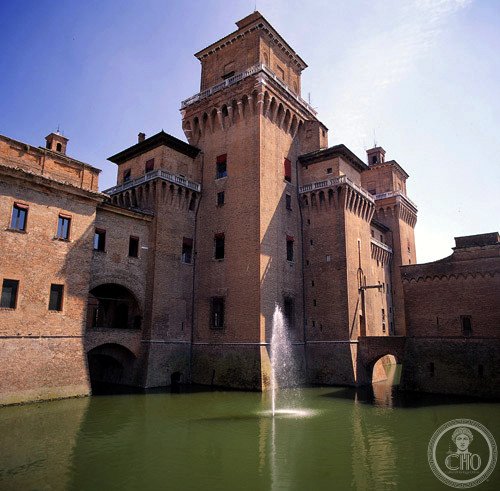
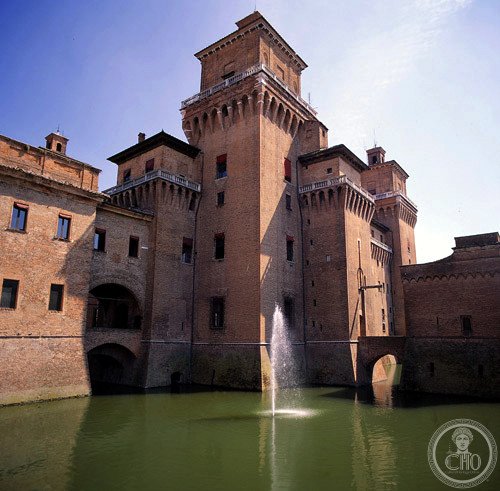
- Castello Estense (1385-1402, Bartolino da Novara): The moated castle at the centre of the city, begun by Niccolò II d’Este in 1385 after an anti-Este revolt in Ferrara; the four corner towers (Torre dei Leoni, Torre di Santa Caterina, Torre dei Marchesi, Torre di San Paolo), the moat (the only surviving Renaissance water-filled moat in Italy surrounding a city-centre building), and the internal courtyard with a suspended garden; now a museum with the original Este apartments
- Addizione Erculea (1492-1505, Biagio Rossetti): The planned urban extension of Ferrara north of the castle, designed for Duke Ercole I d’Este; the grid plan with three main streets (Corso Ercole I d’Este, Corso Porta Po, Corso Porta Mare) converging on the Quadrivio degli Angeli (the central intersection with four churches at its corners — the Quadrivio is the only surviving Renaissance urban node of this type in Italy); the total area added was approximately equal to the medieval city; the plan was designed to accommodate 40,000 new inhabitants (Ferrara in 1492 had approximately 100,000 inhabitants — the fourth largest city in Italy)
- Palazzo Schifanoia (1385-1493): The Este summer palace (south of the Castello, on the city edge); the Sala dei Mesi (Room of the Months, 1469-1470, Francesco del Cossa and Ercole de’ Roberti): a fresco cycle depicting the 12 months of the year in three registers (top: classical deities in chariots, middle: zodiacal signs, bottom: Este court life scenes); the most important secular fresco cycle of the Italian Quattrocento to survive; UNESCO protection
- Cathedral of San Giorgio (begun 1135): The main church of Ferrara, with a remarkable 12th-century Romanesque facade by Nicholaus (Niccolò), with a tympanum cycle of scenes of the Last Judgment and the life of St George above the three portal arches; the facade was modified in the 15th century with the addition of a Gothic loggia above the portals; now deconsecrated (the cathedral function was transferred to the adjacent Chiesa dei Gesuiti in the 17th century; the building is used for exhibitions)
- UNESCO: 1995, ref. 733 — extended 1999 (Po Delta)
- GPS: 44.8385, 11.6193 — Google Maps
History
The Este family (originally from Este, near Padua) became signori of Ferrara in 1240 and remained the ruling dynasty until 1598, when Duke Alfonso II d’Este died without a legitimate heir and Pope Clement VIII reclaimed Ferrara as a papal fief. The Este court in the 15th and 16th centuries was one of the most culturally important in Europe: Ferrara was the first Italian court to have a permanent theatre (the Teatro Corte, 1471), the birthplace of the chivalric romance as a literary form (Matteo Maria Boiardo’s Orlando Innamorato, 1483, and Ludovico Ariosto’s Orlando Furioso, begun 1502), and the site of Torquato Tasso’s Gerusalemme Liberata (1581). The Este artists’ patronage included the Flemish painters (Jean Clouet the Younger worked in Ferrara), the Renaissance court style paintings of Francesco del Cossa and Ercole de’ Roberti, and the architectural commissions that produced the planned city extension.
The Addizione Erculea, designed by Biagio Rossetti (1447-1516), is considered by historians of urbanism the first consciously planned European city extension: a grid of new streets applied to a defined area (the northern part of the city, between the medieval walls and a new northern wall), with churches and palaces positioned according to an overall plan, not by incremental growth. Rossetti’s design was documented in the 1490s and was known throughout Europe: it influenced the planning of cities from Palmanova (1593) to Richelieu (1631) and, through the Jesuit urban missionaries who used Ferrara as a model, the planning of colonial cities in South America.
What you see
The Castello Estense (Piazza Castello) is the visual centre of Ferrara and the starting point of any visit. The exterior (moat, drawbridge, towers) can be seen free from the surrounding piazza; the interior — the Este apartments (the Sala dei Giochi with frescoed walls, the prison cells in the basement where Ugo d’Este and Parisina Malatesta were executed in 1425 after their affair was discovered by Duke Niccolò III, an episode that inspired Byron, D’Annunzio, and Donizetti) — requires admission (~€8). The Via Scandiana and Via delle Volte (north and south of the castle) are the best-preserved medieval streets in the city, with the characteristic “volte” (covered walkways spanning the street — a distinctive Ferrara urban feature created by connecting the upper floors of houses across narrow lanes).
The Palazzo Schifanoia (Via Scandiana 23) is the most important artistic destination in Ferrara outside the Castello. The Sala dei Mesi fresco cycle (1469-1470, Francesco del Cossa and Ercole de’ Roberti) is visible from the room below (the paintings cover the upper zone of three walls; the lower zone was repainted in the 19th century). Each month is divided horizontally into three bands: the top band shows the classical deity associated with the month (e.g., April = Venus, in a chariot drawn by swans, with Cupid and the Three Graces); the middle band shows the zodiacal sign (Aries, Taurus, etc.) with associated figures; the lower band shows scenes from the Este court of that month — hunts, hawking parties, court entertainments, and processions of the Este court.
Gallery
Practical information
- Castello Estense: Piazza Castello; open Tuesday-Sunday 9:30-17:30; closed Monday and 25 December. Admission ~€8 (reduced ~€5). The roof of the towers and the suspended garden above the moat are included in the admission.
- Palazzo Schifanoia: Via Scandiana 23; open Tuesday-Sunday 10:00-18:00; closed Monday. Admission ~€6 (reduced ~€4). The Sala dei Mesi is in the main floor (piano nobile) of the east wing.
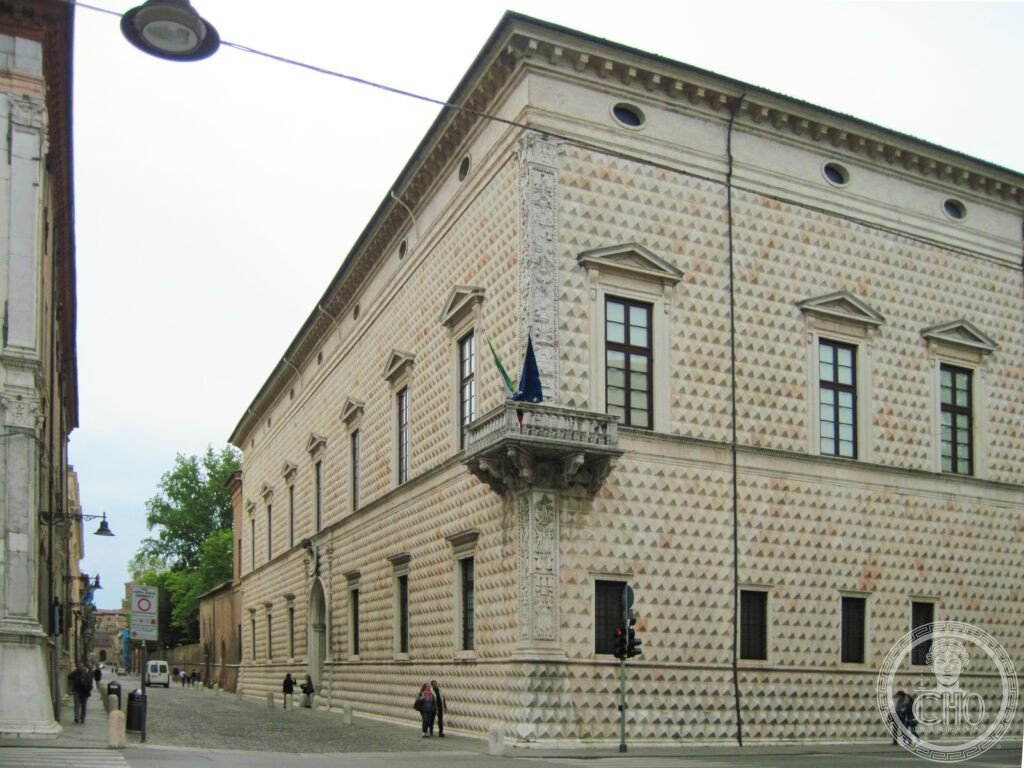
- Palazzo dei Diamanti (Pinacoteca Nazionale): Corso Ercole I d’Este 21; one of the most important Renaissance palace facades in Italy, covered in 8,500 white marble blocks cut in a diamond-faceted pattern (the Este diamond is the dynastic emblem); open Tuesday-Sunday 9:00-14:00 (museum) and variable for exhibitions; admission ~€6.
- Duration: The historic centre on foot (Castello + Duomo + Schifanoia + Diamanti) requires 4-5 hours. The Addizione Erculea (north quarter) can be walked independently in 30 minutes.
Getting there
Piazza Castello, Ferrara (FE), Emilia-Romagna. By train: Trenitalia from Bologna (50 km; 30 min regional); from Venice (130 km; 1h30 with change at Rovigo or Padova); from Padova (90 km; 1h10 via Rovigo). The Ferrara railway station is 1.5 km from the Castello Estense (20 min walk west on Viale Cavour; bicycle rental at the station). By car: from Bologna, A13 north to Ferrara Sud exit (50 km, 35 min); from Venice, A13 south to Ferrara Nord exit (130 km, 1h20). The historic centre is a Limited Traffic Zone (ZTL); park outside the walls at Parking Via Darsena (free) or Parking Arianuova (paid).
Nearby
- Delta del Po — 30-50 km east; the vast wetland of the Po river delta (UNESCO 1999 extension of the Ferrara inscription); the Valle di Comacchio (the largest brackish water lagoon in Italy, with its characteristic fishermen’s huts and eel fishery dating to the Roman period), the Parco del Delta del Po, and the ancient Roman colony of Spina (6th-3rd century BCE, a trading city on the Adriatic coast of the Po Delta, submerged by the 4th century CE; the Museo Nazionale di Spina in Ferrara contains its major artefacts)
- Ravenna — 75 km south-east; (see CHO card for Ravenna Early Christian Monuments, UNESCO 1996 ref.788)
- Bologna — 50 km south-west; (see CHO card for Bologna)
Sources
- UNESCO: whc.unesco.org/en/list/733
- Wikipedia EN: Ferrara
- Rossi, Guido: Biagio Rossetti, architetto ferrarese, Ferrara, 1991
- Castello Estense: castelloestense.it
Find it on the map
See this place and what’s around it →📷 Become a Cultural Heritage Online photographer
Share your photos of places: they stay published under your name as the author. The more they're seen, the more you get noticed — and soon a contest will reward the most appreciated photos.
Log in or sign up free to add a photo