
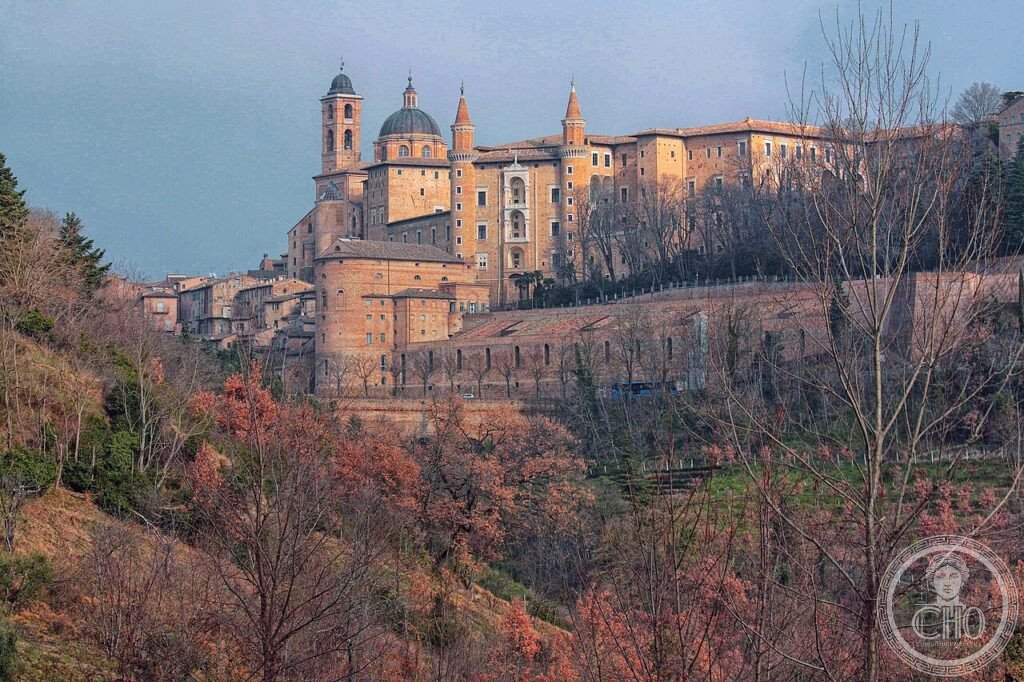
Federico da Montefeltro, Duke of Urbino from 1444 to 1482, was the most successful condottiere in 15th-century Italy — and he spent his military earnings on building what the humanist Baldassarre Castiglione called “a city in the form of a palace”: the Palazzo Ducale of Urbino, designed by Luciano Laurana from 1468, which remains the most sophisticated domestic building of the Italian Renaissance, a palace-city on a hill in the Marche mountains that contained within its walls a ducal court, a library (the finest private library in Europe, second only to the Vatican), and a studiolo whose wood-inlaid panels depict the ideal instruments of a humanist ruler — books, musical instruments, astronomical instruments, hourglass, armour, a squirrel — in trompe l’oeil intarsia of such quality that the best marquetry craftsmen in Europe came to Urbino to make them.
At a glance
Urbino (province of Pesaro-Urbino, Marche) is a UNESCO World Heritage Site inscribed in 1998 (ref. 828) as “Historic Centre of Urbino.” The inscription covers the medieval and Renaissance historic centre of the city, focused on the Palazzo Ducale (the principal building of the reign of Federico da Montefeltro, Duke of Urbino 1444-1482) and the Cathedral. Urbino is one of the best-preserved Renaissance hill towns in Italy, with a historic centre that has been largely unaltered since the 15th century, and is the birthplace of the painter Raffaello Sanzio (Raphael, born 1483). The Palazzo Ducale now houses the Galleria Nazionale delle Marche, one of the most important collections of 15th-century Italian painting outside Rome, Florence, and Venice.
Key facts
- Federico da Montefeltro (1422-1482): Duke of Urbino from 1444; the most consistently victorious condottiere (mercenary military commander) in 15th-century Italy, working for the Pope, the King of Naples, the Florentines, and the Venetians at different times; his military reputation attracted the finest humanist scholars, artists, and craftsmen to his court in Urbino (including Piero della Francesca, who painted his famous double portrait, now in the Uffizi); he collected one of the largest private libraries in Europe (900 volumes at his death, 1482; now the Biblioteca Apostolica Vaticana’s Urbinate collection)
- Palazzo Ducale: Begun approximately 1454 (first phase, by Maso di Bartolomeo); the principal phase (1468-1482) by Luciano Laurana, a Dalmatian architect from Zara who designed the courtyard (Cortile d’Onore — the model for countless Renaissance palace courtyards), the two cylindrical towers on the west facade, and the internal sequence of rooms; the building incorporates the earlier medieval structures of the city as a foundation, adding three main floors of state apartments above
- Studiolo di Federico: A small private study (5 × 3.6 m) on the upper floor of the palace, with walls entirely covered in intarsia woodwork (inlaid wood marquetry depicting books, musical instruments, armour, the Duke’s dog, an hourglass, an astrolabe, a symbolic squirrel) designed by Francesco di Giorgio Martini and executed by Baccio Pontelli (1474-1476); the trompe-l’oeil effect — drawers apparently half-open, books leaning against shelves, curtains drawn back — is the most complete surviving example of Renaissance intarsia as intellectual programme
- Raffaello: Raffaello Sanzio (Raphael, 1483-1520) was born in Urbino; his father Giovanni Santi was a painter at the Montefeltro court; the house where Raphael was born (Casa Natale di Raffaello, Via Raffaello 57) is a museum with early works; Raphael left Urbino for Florence (1504) and then Rome (1508) where he produced the Stanze Vaticane and the Sistine Madonna
- UNESCO: 1998, ref. 828
- GPS: 43.7262, 12.6363 — Google Maps
History
Urbino had been a modest hill-town in the Montefeltro mountain range of central Italy when Federico da Montefeltro inherited the signoria in 1444. Federico’s transformation of the town was driven by the combination of his extraordinary military income (he was the highest-paid condottiere in Italy throughout the 1450s-1470s) and his humanist education: he had studied at the school of Vittorino da Feltre in Mantua (the finest humanist school in northern Italy) and emerged with a conviction that classical learning, military ability, and princely magnificence were inseparable virtues. The patronage programme he pursued in Urbino — the library, the palace, the cathedral, the court of artists and scholars — was a direct expression of this humanist ideal of the prince as patron of arts and letters.
Baldassarre Castiglione, who served at the Urbino court in the early 16th century (under Federico’s son Guidobaldo), immortalised the Urbino court of his memory in Il Libro del Cortegiano (The Book of the Courtier, 1528) — the most influential conduct manual of the Renaissance, which defined the ideal of the courtier (and, implicitly, the ideal of the prince) for the next 200 years across Europe. The book is set in a series of evening conversations in the Palazzo Ducale, and the idealized picture it paints of the intellectual and social life of the Urbino court became the model for every aristocratic court in Europe.
What you see
The visit to Urbino centres on the Palazzo Ducale and its collection (the Galleria Nazionale delle Marche). The two most important spaces in the palace are the Cortile d’Onore (the central courtyard, with its arcade of Corinthian pilasters and the inscription “FEDERICUS DUX” in the frieze, one of the finest courtyard designs of the Italian Renaissance — a model for courtyard design from Bramante’s Belvedere Cortile in the Vatican to countless later examples) and the Studiolo di Federico (the small private study with its complete intarsia programme). The studiolo requires advance booking to enter (limited access; often closed to general visitors; contact the museum).
The Galleria Nazionale delle Marche contains, in addition to the permanent palace rooms, several works of first importance: Piero della Francesca’s “Flagellation of Christ” (c. 1455; one of the most debated paintings in the history of Renaissance art, with an unresolved iconographic programme that has generated over 300 published interpretations) and the “Ideal City” (attributed to Luciano Laurana, c. 1470-80; the most famous of three surviving paintings of perspectively perfect Renaissance urban views; the actual authorship remains disputed). Both works are in Room 11 of the Galleria.
Gallery
Practical information
- Galleria Nazionale delle Marche / Palazzo Ducale: Piazza Duca Federico 107; open Tuesday-Sunday 8:30-19:15 (Monday closed). Admission ~€8 (reduced ~€2). The studiolo: access restricted; check current policy at time of visit (sometimes open only on guided tours or by appointment).
- Casa Natale di Raffaello: Via Raffaello 57; open Monday-Saturday 9:00-13:00, 15:00-19:00; Sunday 10:00-13:00. Admission ~€4.
- Duration: 2.5 hours for the Palazzo Ducale and Galleria. Allow 1 hour for the Casa di Raffaello and the Cathedral. The hilltop historic centre is compact (10 minutes walk across), but the steep terrain requires comfortable footwear.
Getting there
Piazza Duca Federico, Urbino (PU), Marche. Urbino has no railway station (the nearest rail connection is Pesaro, 36 km east, served by Trenitalia from Bologna, Rimini, and Ancona; SOGESA bus from Pesaro to Urbino, 50 min). By bus: Flixbus from Rome (3h) and Bologna (2h30). By car: from Pesaro, SS423 south-west (36 km, 40 min); from Rimini, SS9 west to Pesaro then SS423 (55 km, 1h); from Florence, A1 north to Cesena then SS3bis “Marecchiese” south-west (220 km, 2h30). Car parking outside the city walls (Parcheggio Mercatale, below the Palazzo Ducale, with lift access).
Nearby
- Pesaro — 36 km north-east on the Adriatic coast; birthplace of Gioachino Rossini (1792-1868; the Casa Natale di Rossini at Via Rossini 34 is a museum; the Museo Nazionale Rossini in the Palazzo Montani Antaldi); the Musei Civici di Pesaro (Majolica collection: one of the most important collections of Pesaro majolica and Italian Renaissance ceramic in the world)
- San Leo — 60 km north; a hilltop village above the Montefeltro on a 629-metre limestone pinnacle; the Rocca di San Leo (the impregnable fortress where the alchemist and adventurer Count Cagliostro was imprisoned from 1791 to his death in 1795); the Pieve di Santa Maria Assunta (9th century CE, the most important pre-Romanesque church in the Marche)
- Gradara — 50 km north; a perfectly preserved medieval castle-town in the Montefeltro; the site traditionally (but without historical proof) identified as the castle where Paolo Malatesta and Francesca da Rimini were killed by her husband Gianciotto in 1289 (the episode described by Dante in Inferno V)
Sources
- UNESCO: whc.unesco.org/en/list/828
- Wikipedia EN: Urbino
- Castiglione, Baldassarre: Il Libro del Cortegiano, Venice, 1528 (English: The Book of the Courtier, Penguin Classics, 1967)
- Galleria Nazionale delle Marche: gallerianazionalemarche.it
Find it on the map
See this place and what’s around it →
Historical events at this place (1)
📷 Become a Cultural Heritage Online photographer
Share your photos of places: they stay published under your name as the author. The more they're seen, the more you get noticed — and soon a contest will reward the most appreciated photos.
Log in or sign up free to add a photo