
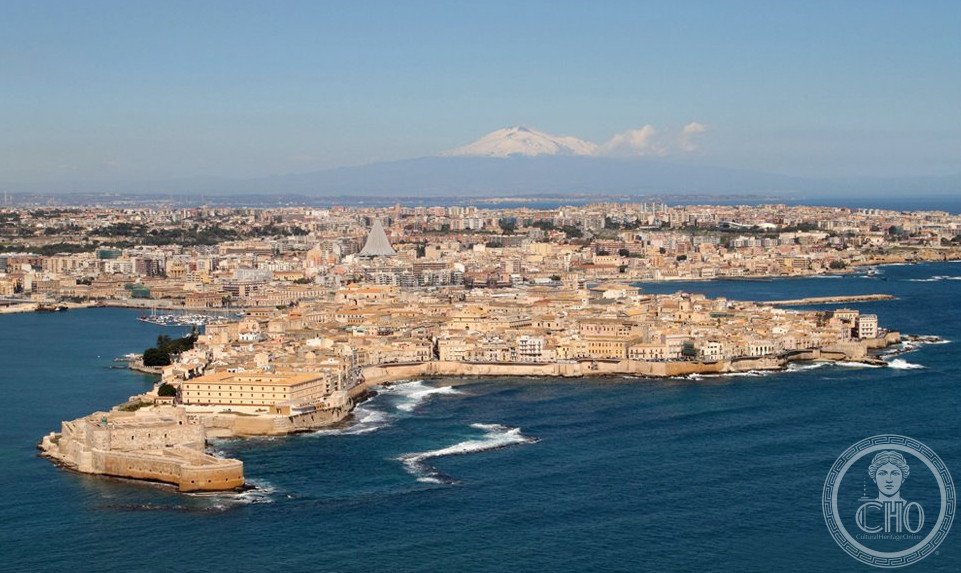
At the height of its power in the fifth century BCE, Syracuse was larger than Athens, richer than Carthage, and the most important city in the western Greek world — a city of 200,000 to 250,000 inhabitants (the largest Greek city outside Greece itself) that defeated two Athenian expeditionary forces (the Sicilian Expedition of 415-413 BCE being the greatest military disaster in Athenian history), produced the first Greek comedy writers (Epicharmus), and invented the hydraulic screw (Archimedes), and whose theatre — cut into the bedrock of the Temenite hill in the fifth century BCE — is the largest surviving Greek theatre in the world.
At a glance
Siracusa (Syracuse) is a UNESCO World Heritage Site inscribed in 2005 (ref. 1200) as “Syracuse and the Rocky Necropolis of Pantalica,” a serial site combining the ancient and medieval city of Syracuse (primarily concentrated on the island of Ortigia) with the prehistoric necropolis of Pantalica (38 km north-west, in the gorge of the Anapo river). Founded by Corinthian colonists in 734 BCE on the small island of Ortigia (later expanded to the adjacent mainland), Syracuse reached its peak under the tyrants Gelon (480 BCE) and Dionysius I (405-367 BCE) and remained the most important city in the western Mediterranean world until its conquest by Rome in 212 BCE. The UNESCO inscription covers Ortigia, the Neapolis archaeological park (theatre, amphitheatre, latomie), and the Euryalus fortress.
Key facts
- The Greek Theatre (Teatro Greco): Built in the 5th century BCE on the Temenite hill overlooking the sea; the largest surviving Greek theatre in the world (138.6 m diameter, 67 rows of seats for approximately 15,000-16,000 spectators); the seats are carved directly from the limestone bedrock; the Theatre was enlarged in the 3rd century BCE under Hieron II and converted by the Romans for gladiatorial combats (the orchestra was lowered and flooded); the Siracusa theatre festival (INDA — Istituto Nazionale del Dramma Antico) presents Greek tragedy and comedy in the theatre each summer (May-June) in continuous use since 1914
- Cathedral of Siracusa: The Cathedral (Duomo) of Siracusa is the only surviving example of a Greek temple converted into a Christian cathedral with its structure substantially intact: the Temple of Athena (5th century BCE, 36 × 22 m, 6 × 14 Doric columns) was converted to a church in the 7th century CE; 12 of the 36 original Doric columns are incorporated into the cathedral walls and are visible from both the interior and the exterior; the Baroque facade (1728-1754, Andrea Palma) was added after the 1693 earthquake
- Necropoli di Pantalica: A prehistoric settlement and necropolis 38 km north-west of Siracusa, on a limestone plateau in the gorge of the Anapo river; approximately 5,000 tomb-chambers carved into the limestone walls of the gorge between the 13th and 7th centuries BCE (the Sicanian/Sicel period, before Greek colonisation); the most important prehistoric site in Sicily; accessible on foot from the Anapo gorge below
- Latomie del Paradiso: A limestone quarry used by the ancient Greeks and later by the Roman and Byzantine periods; the most famous feature is the “Ear of Dionysius” (Orecchio di Dioniso) — a cave 65 m deep and 23 m high cut into the limestone; the name derives from Caravaggio, who suggested to the Syracusan duke in 1608 that the cave’s extraordinary acoustic properties (a whisper at the entrance is amplified to a shout inside) allowed the tyrant Dionysius to eavesdrop on prisoners held in the quarry
- UNESCO: 2005, ref. 1200
- GPS: 37.0623, 15.2932 — Google Maps
History
Syracuse was founded in 734 BCE by Corinthian colonists who chose Ortigia (literally “quail island” in Greek) — a small rocky island in the harbour at the mouth of the Anapo river — as their first settlement. The reasons were clear: the island was easily defensible, the harbour was one of the best natural anchorages in the Mediterranean, and the fresh-water spring of Arethusa (the Fonte Aretusa, still flowing on the waterfront of Ortigia) provided water without a well. The city expanded rapidly from Ortigia to the adjacent mainland (Achradina, Tyche, Neapolis) and by the 5th century BCE was the largest Greek city in the western Mediterranean.
The moment that defined Syracuse as the most powerful polis in the Greek world was the Athenian Expedition of 415-413 BCE — the largest military expedition ever launched by Athens (27,000 soldiers and sailors, 200 ships) which was completely destroyed by the Syracusan forces and their Spartan allies under Gylippus. The defeat was so total (the remnants of the Athenian army were imprisoned in the latomie, the limestone quarries below Neapolis, where most died of disease and thirst) that it broke Athenian naval power and tilted the balance of the Peloponnesian War definitively against Athens. Thucydides’s account of the expedition (Books 6-7 of the History of the Peloponnesian War) remains the greatest military narrative in ancient Greek writing.
What you see
The visit to Siracusa has two main components: the Parco Archeologico della Neapolis (on the mainland, 3 km north of Ortigia; the Teatro Greco, the Roman Amphitheatre, the Altar of Hieron II, and the Latomie del Paradiso) and the island of Ortigia (the medieval and Baroque historic centre, with the Cathedral built inside the Temple of Athena, the Fonte Aretusa, and the Museo Regionale Paolo Orsi). The two components require at least 3-4 hours each; a full day visit is recommended.
In Ortigia, the most arresting single experience is inside the Cathedral (Duomo): the 2,700-year continuity of sacred use on the same site (Greek temple 5th century BCE → Christian cathedral 7th century CE → Baroque interior 18th century) is made physically visible by the incorporation of the ancient Doric columns into the nave walls; standing in the nave, looking at the columns (12 of the original 36 remain), with the baroque stucco above them and the medieval stone floor below, the visitor has the most compressed experience of historical layering available in any single building in Italy.
Gallery
Practical information
- Parco Archeologico della Neapolis: Via Romagnoli 5; open daily 9:00-18:00 (winter), 9:00-19:00 (summer); last entry 1 hour before closing; admission ~€13 (includes theatre, amphitheatre, latomie). The INDA Greek theatre festival (May-June) uses the theatre every evening; check the programme at indafondazione.org.
- Ortigia: Free access (pedestrian historic centre); the Cathedral interior (free; 9:00-19:00) and the Museo Regionale Paolo Orsi (via Teocrito 66; ~€8; Tuesday-Sunday 9:00-19:00; closed Monday) are the key paid venues.
- Necropoli di Pantalica: Free access; accessible by car to the upper car park (above Sortino village, 38 km from Siracusa), then by foot into the gorge (2-3 km descent, 1-2 hours). The site has no services; bring water.
Getting there
Siracusa, Sicilia. By train: Trenitalia from Catania (60 km north; 1h20 regional; 45 min Intercity); from Palermo (255 km; 3h via Catania). By car: from Catania, A18 south (60 km, 50 min); from Palermo, A19 east to Catania then A18 south (260 km, 3h). The train station is 500 m from Ortigia (walk or taxi). The Parco Archeologico della Neapolis is 3 km north of Ortigia (taxi or bus 21/25 from Corso Umberto).
Nearby
- Ortigia e la Fonte Aretusa — the freshwater spring at the tip of the Ortigia island; in Greek mythology, the nymph Arethusa was transformed into the spring by Artemis to escape the river god Alpheus who pursued her from the Peloponnese; the spring is now a small ornamental pool on the Via dei Ginnasi, surrounded by papyrus plants (the only place in Italy where papyrus grows wild, a remnant of the ancient Egyptian colony of Neapolis)
- Noto — 28 km south; the Late Baroque UNESCO city (see separate CHO card); train from Siracusa (35 min)
- Valle dell’Anapo e Pantalica — 38 km north-west; the gorge of the Anapo river with the Pantalica necropolis (5,000 prehistoric tombs carved in the canyon walls); a 2-3 hour walk down the canyon from the upper car park above Sortino; the canyon floor has a seasonal stream, dense Mediterranean scrub, and kingfishers
Sources
- UNESCO: whc.unesco.org/en/list/1200
- Wikipedia EN: Syracuse, Sicily
- Thucydides: History of the Peloponnesian War, Books VI-VII (Sicilian Expedition) — standard edition: Penguin Classics (trans. Rex Warner)
- Parco Archeologico Neapolis: parcoarcheologicosiracusa.it
Find it on the map
See this place and what’s around it →📷 Become a Cultural Heritage Online photographer
Share your photos of places: they stay published under your name as the author. The more they're seen, the more you get noticed — and soon a contest will reward the most appreciated photos.
Log in or sign up free to add a photo