
In 1576, the Republic of Genoa invented a system unlike anything in Europe: a mandatory public rota (rollo, or list) of the 42 most important noble palaces of the city, whose owners were required, in strict rotation, to provide free lodging to foreign heads of state, ambassadors, and other dignitaries visiting the republic — not in an inn or a public palace, but in private homes of extraordinary magnificence, each competing with the others in the scale of its frescoed salons, the quality of its collection, and the luxury of its gardens.
At a glance
Genova (Genoa) is a UNESCO World Heritage Site inscribed in 2006 (ref. 1211) as “Genoa’s Strade Nuove and the System of the Palazzi dei Rolli.” The inscription covers two main components: the Strade Nuove (the “New Streets” — Via Garibaldi, Via Balbi, and their extensions — designed as a system of large streets lined with new aristocratic palaces from 1558 to 1583) and the Rolli system (the list of 42 palaces designated in 1576 as official state residences for visiting dignitaries, expanded to 163 palaces in 1664). The Strade Nuove and the Rolli palaces represent the first example in European history of a systematic policy of using private architecture as a form of state representation — a concept that influenced the design of capitals across Europe in the 17th-18th centuries and was directly published and disseminated by the Flemish painter Peter Paul Rubens in his 1622 architectural album Palazzi di Genova.
Key facts
- The Rolli system (1576): Decreed by the Genoese Republic in 1576, the Rolli was a lottery system: when an important foreign visitor arrived in Genoa, lots were drawn among the families listed on the Rollo to determine which palace would host the guest; the hosting family bore all costs (food, staff, entertainment) without public compensation; the system remained in force until 1729. The original 1576 decree lists 42 palaces; the 1664 revision lists 163 palaces in three categories (First Category: 11 palaces reserved for crowned heads; Second Category: 28 palaces for princes and high nobility; Third Category: 124 palaces for ambassadors and lesser dignitaries)
- Via Garibaldi (Strada Nuova): The principal Strada Nuova, opened 1558-1583 under the design direction of Galeazzo Alessi; 250 m long, 7 m wide (extraordinary for a 16th-century Italian city); lined on both sides with the largest aristocratic palaces in Genoa; the three most important are: Palazzo Rosso (1671; collection of Van Dyck, Rubens, Durer; now a museum); Palazzo Bianco (1530; collection of Flemish and Italian Renaissance painting; now a museum); Palazzo Doria Tursi (1565; now the Town Hall; the “Violin Stradivari” — one of three certified Stradivarius instruments owned by a public institution — is here)
- Peter Paul Rubens, Palazzi di Genova (1622): The Flemish painter Rubens visited Genoa twice (1600-1608) and was so impressed by the Rolli palaces that he compiled and published an architectural album of 73 measured drawings of the principal Strade Nuove palaces in 1622; the album was widely circulated among European architects and directly influenced the design of aristocratic palaces in Belgium, France, and England in the 17th century — including the Rubenshuis in Antwerp (Rubens’s own house, directly modelled on a Genoese palazzo)
- UNESCO: 2006, ref. 1211 — “Genoa’s Strade Nuove and the System of the Palazzi dei Rolli”
- GPS: 44.4081, 8.9316 — Google Maps
History
Genoa in the 16th century was one of the wealthiest cities in Europe — the financial capital of the Iberian empire (the Genoese merchant-bankers, led by the Doria and Grimaldi families, held the debt of the Spanish Crown and managed the flow of American silver through Europe from approximately 1530 to 1630) and a major commercial power in its own right. The construction of the Strade Nuove (the “New Streets”) from 1558 was a deliberate urban prestige project: the Republic commissioned a series of new streets in the western part of the medieval city, designed to a width and regularity impossible in the existing medieval fabric, and sold the building lots to noble families on condition that they build palaces of a specified minimum height and quality. The result was the most homogeneous series of 16th-century aristocratic palaces in Italy — each palace different in its decoration and plan but conforming to the urban framework of the Strada Nuova.
The Rolli system of 1576 was the regulatory complement to the Strade Nuove: having built their palaces, the noble families were required to use them as instruments of state hospitality. The system was extraordinary in its conceptual innovation — it made private architecture serve a public function without public compensation, creating a network of de facto state residences distributed across the city rather than concentrated in a single palace or hotel. The term “albergo” (hotel), still the Italian word for a hotel, derives from the Genoese “albergo” — a clan or extended family grouping — which managed the hospitality rotation collectively in the Rolli period.
What you see
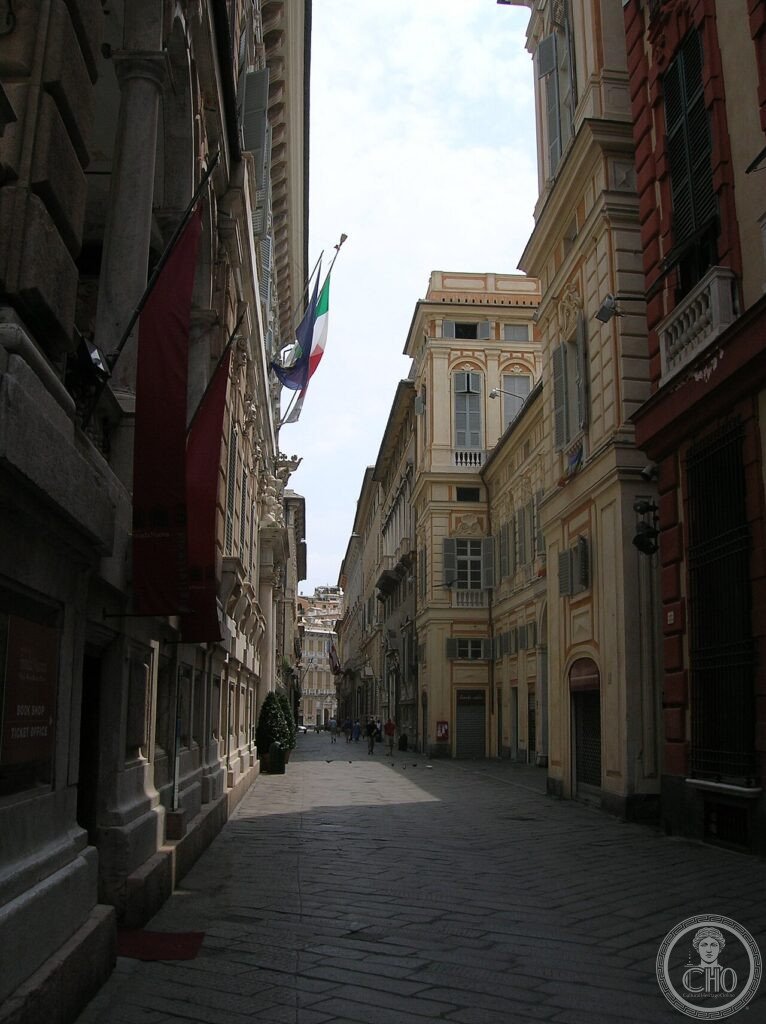
The visit to the Strade Nuove and Rolli palaces centres on Via Garibaldi (the principal Strada Nuova): a 250-metre street in the centre of the historic city, now a pedestrian zone, flanked on both sides by the 16th-century palatial facades. The three museums open to the public on Via Garibaldi are run by the Musei di Strada Nuova system: Palazzo Rosso (Van Dyck portraits of the Genoese nobility, Rubens, Guercino; the period rooms — frescoed in the 1680s by Gregorio De Ferrari — are the most important Baroque interior in Genoa); Palazzo Bianco (Flemish painting including Jan van Eyck, Jan de Beer, Gerard David; Caravaggio’s Ecce Homo is exhibited here); and Palazzo Doria Tursi (the Town Hall; the Stradivarius “Canone” violin of Paganini, one of the most important Stradivarius instruments, is on permanent display in a temperature-controlled case).
The Rolli Days (the biannual event in spring and autumn when all 163 palaces on the Rolli list open to the public simultaneously for one weekend) is the best way to experience the full extent of the system: dozens of private palaces, courthouses, banks, and institutions that occupy the historic Rolli buildings open their interior frescoed rooms and courtyards to visitors — normally inaccessible spaces that reveal the extraordinary density of 16th-17th century painted decoration in Genoese private architecture.
Gallery
Practical information
- Museums: Palazzo Rosso, Palazzo Bianco, Palazzo Doria Tursi — combined ticket “Musei di Strada Nuova” ~€9; open Tuesday-Sunday 9:00-19:00. Closed Monday.
- Rolli Days: Biannual (spring and autumn, usually one weekend in May and one in October); free entry to all participating palaces; programme published at rolli.genova.it. Highly recommended — the only time many private interiors are accessible.
- Duration: 2 hours for Via Garibaldi + Palazzo Rosso + Palazzo Bianco. A full day for all three Musei di Strada Nuova + the Palazzo del Principe (Doria, Andrea Doria’s 16th-century residence; 3 km west) + the Cathedral of San Lorenzo.
Getting there
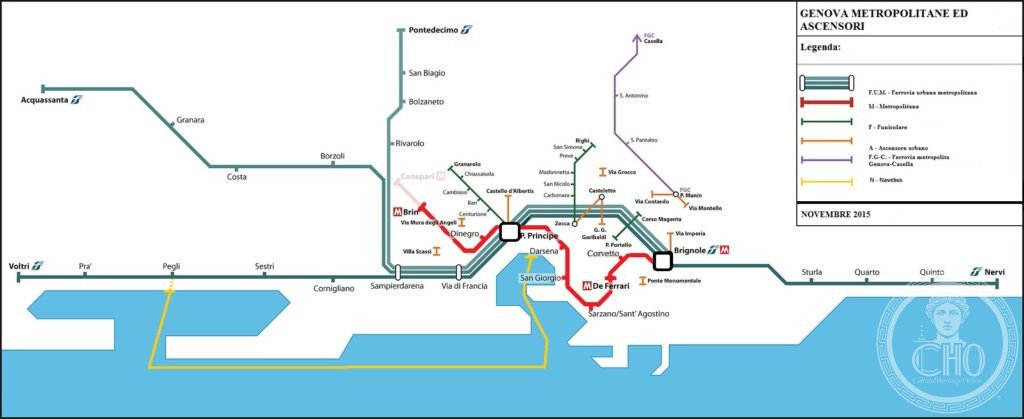
Via Garibaldi, Genova, Liguria. By train: Genova Piazza Principe station (Trenitalia from Milan 1h30; from Turin 1h45; from Rome 4h); from the station, walk 10 min east to Via Garibaldi, or take the metro (1 stop to Darsena, then walk 5 min). Genova Cristoforo Colombo airport is 7 km west of the centre (bus shuttle Volabus, 35 min). By car: from Milan, A7 south (140 km, 1h30); from Turin, A26 south (170 km, 1h45). The historic centre is a ZTL zone; park at Garages Principe or Caruggi near the station.
Nearby
- Cattedrale di San Lorenzo, Genova — 400 m east of Via Garibaldi; the principal church of Genoa (built 9th century on Roman foundations; the Gothic facade 1307-1312; the black-and-white striped marble revetment; the Cappella di San Giovanni Battista with the golden sarcophagus of John the Baptist, 1490-1503); the Museo del Tesoro di San Lorenzo (the Sacro Catino — a Roman glass dish traditionally identified as the Holy Grail — the dish of the True Last Supper — is displayed here)
- Porto Antico e Acquario di Genova — 300 m south of Via Garibaldi; the revitalised historic harbour designed by Renzo Piano for the Genoa Expo 1992; the Aquarium of Genoa (one of the two largest aquariums in Europe; 70 tanks, 12,000 fish, shark tunnel); the Biosfera (a greenhouse sphere by Renzo Piano on the pier); the Galata Museo del Mare (the most important maritime history museum in Italy)
- Nervi e Riviera di Levante — 12 km east by train; the clifftop promenade of Nervi (4 km, from Nervi to Bogliasco) is the most accessible cliff-walk on the eastern Ligurian Riviera; the Passeggiata Anita Garibaldi is the most famous section
Sources
- UNESCO: whc.unesco.org/en/list/1211
- Wikipedia EN: Strade Nuove and Palazzi dei Rolli
- Rubens, Peter Paul: Palazzi di Genova, Antwerp, 1622 (facsimile: Electa, Milan, 1989)
- Musei di Strada Nuova: museidigenova.it
Find it on the map
See this place and what’s around it →📷 Become a Cultural Heritage Online photographer
Share your photos of places: they stay published under your name as the author. The more they're seen, the more you get noticed — and soon a contest will reward the most appreciated photos.
Log in or sign up free to add a photo